
By Eilene Lyon
Last month I shared some background on my Arbogast ancestors who migrated to Ohio from Alsace, France. Of the Arbogast children who traveled with their parents to America, my 3rd great-grandfather was John C. Arbogast Jr. He was 12 when he landed in Tuscarawas County in 1840. He still lived with his parents a decade later, appearing by name for the first time in American records on the 1850 census.1
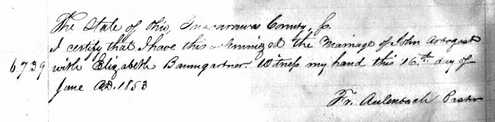
He married Julia Elizabeth Baumgartner in June 1853 in the Evangelical Lutheran Church in Jefferson Township, Tuscarawas County.2 Their first two children were born in Ohio, including my 2nd great-grandmother, Louise Eliza (Arbogast) Schaaf (b. 1856).
In February 1858 John moved his family briefly to Bureau County, Illinois, then relocated to Jersey County which borders the Mississippi River. He purchased 200 acres of land and settled down to farming.3

During their time in Jersey County, Elizabeth gave birth to 14 more children. One of these, son Jacob, died at age five in October 1864.4 Two months later, John was drafted into Company C of the 53rd Illinois Regiment.5 He was 36 years old at the time, with six young children at home. Many men in his position paid a substitute to take their place, but he did not have the means.6
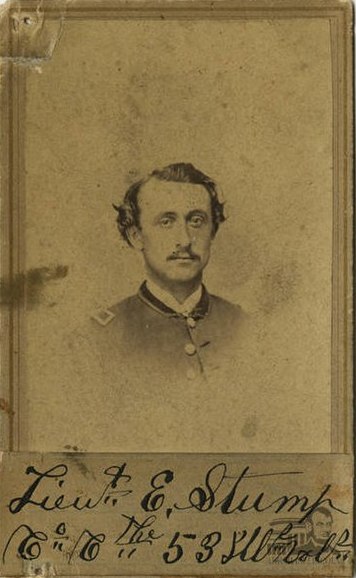
The 53rd Illinois originally formed in 1862, and in December 1864 they were engaged in the siege of Savannah, Georgia.7 John probably would have joined the regiment as they began their campaign through the Carolinas that lasted from January to April 1865. The 53rd Illinois was consolidated with the 41st Illinois on January 4, 1865 and they began their march to Beaufort, South Carolina. They participated in battle at Bentonville, North Carolina, on March 20 and 21.8
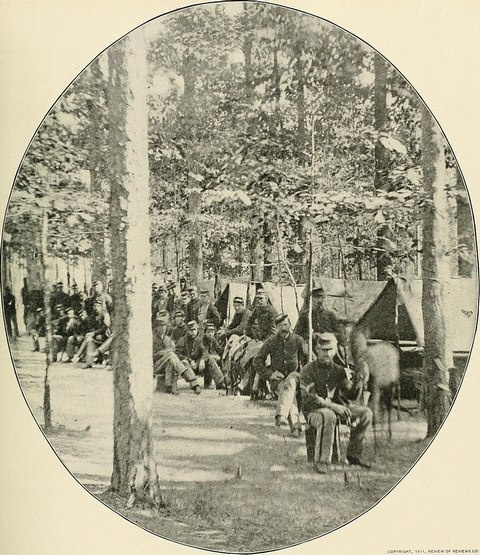
Two days prior to this battle, John, suffering from exposure, came down with a lung fever, which also affected his eyes. His ailment was severe enough to put him in the hospital, under care of the regimental surgeon. Perhaps his illness saved his life, but it led to a lifelong disability, for which he was able to obtain a pension in the 1890s.9
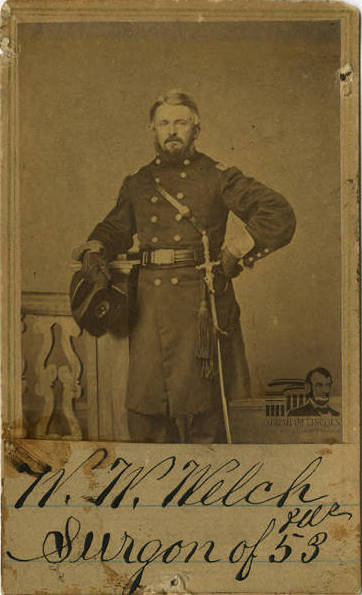
He remained with his regiment until his discharge at Louisville in July 1865. Prior to heading to Kentucky, the regiment marched in the grand review in Washington, D.C. on May 24, 1865.
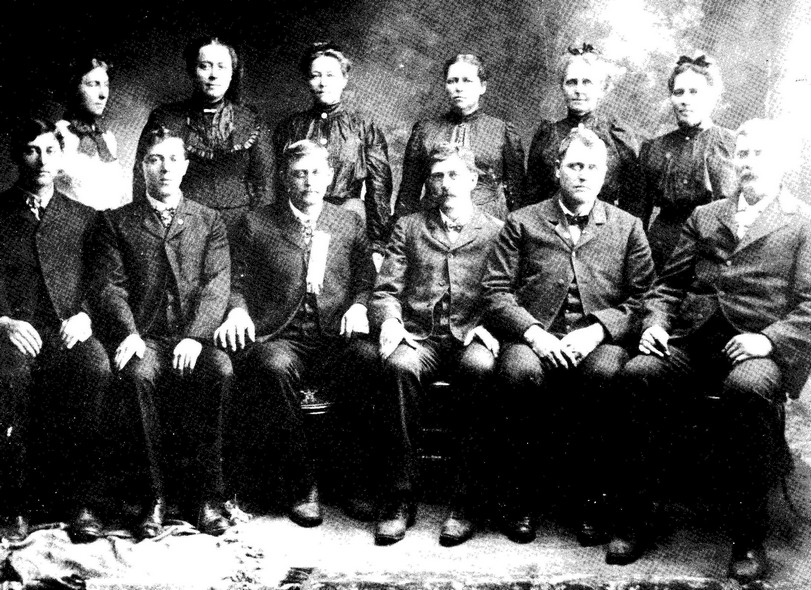
John and Elizabeth buried two more young children before 1880, but the remaining 13 all lived well into adulthood. Though I have a photograph of Elizabeth and another of 12 adult children, I have not found any photographs of John.

By 1890, John and Elizabeth were living in Hazel, Hamlin County, South Dakota.10 They had two children living in adjacent counties. About 1895, they relocated to Emmet County, Iowa, where they also had two children living.
John died July 5, 1896, in Forsythe, Emmet County, of kidney failure.11 Elizabeth filed for a widow’s pension, for which she received $8 a month from the federal government, plus $2 for each of her two youngest children. She died in Palo Alto County, Iowa, in 1907. Both are buried in the Oak Hill Cemetery in Emmet County.
Featured image: Harper House served as the Union Army hospital during the Battle of Bentonville, North Carolina. This is probably where John was treated for his lung fever in March 1865. (Wikimedia Commons)
- 1850 U.S. census, Tuscarawas County, Ohio, population schedule, Jefferson Township, p. 54b, dwelling 720, family 722, John Arbogast [Sr]; image, Ancestry (https://www.ancestry.com/imageviewer/collections/8054/images/4093961_00114 : accessed 18 April 2025). ↩
- “Ohio, U.S., County Marriage Records, 1774–1993” database, Ancestry, marriage for John Arbogast and Elizabeth Baumgartner on 16 June 1853 by Fr. Aulenbach Pastor; image (https://www.ancestry.com/search/collections/61378/records/1763679 : accessed 18 April 2025). The 1860 census indicates Carl Aulenbach was an Evangelical minister. ↩
- Biographical sketch of John Arbogast in History of Greene and Jersey Counties, Illinois : together with sketches of the towns, villages and townships, educational, civil, military, and political history; portraits of prominent individuals, and biographies of representative men… (Springfield, Ill.: Continental Historical Co., 1885) p. 408. Information is supported by deeds from Jersey County. ↩
- Ibid. ↩
- Report of the Adjutant General of the State of Illinois, Vol. 5, 1861–1866, (Springfield, Ill.: Baker, Bailhache & Co., printers, 1867) p. 140; online at Internet Archive (https://archive.org/details/reportofadjutant00illinois : accessed 18 April 2025) ↩
- 1860 U.S. census, Jersey County, Illinois, population schedule, p.33, dwelling 20, family 20, indexed as John Asbegrass [poor image]; image, Ancestry (https://www.ancestry.com/imageviewer/collections/7667/images/4213649_00033 : accessed 18 April 2025); John’s personal property is listed as $140. ↩
- “Union Regimental Histories: Illinois,” Civil War Archive (https://www.civilwararchive.com/Unreghst/unilinf5.htm#53rd : accessed 18 April 2025). ↩
- Illinois Adjutant General’s Report: Regimental and Unit Histories, Containing Reports for the Years 1861–1866, p. 173; PDF version online at Illinois Secretary of State (https://www.ilsos.gov/departments/archives/databases/reghist.pdf : accessed 18 April 2025). ↩
- Civil War pension files 561,654 and 462,684 for John Arbogast and Julia E. Arbogast; images, National Archives and Records Administration, PDF file F41-968795667E-LYON, 83 pp. ↩
- Ibid. 1890 Veterans Schedules of the U.S. Federal Census, Hamlin County, South Dakota, John Arbagast; image, Ancestry (https://www.ancestry.com/imageviewer/collections/8667/images/SDM123_94-0374 : accessed 18 April 2025). ↩
- Civil War pension files, see Note 7. ↩
 Myricopia
Wow, that house on the John A farm looks like it could have existed back in the day. Have you ever visited the place? Interesting about his service in the Civil War.
LikeLiked by 1 person
I have not been there. I’m hoping to learn more about the house, though. So many Civil War casualties were due to disease, and many left with long-term complications, too. For John, it presented like asthma, and at times his eyes were so bad he was effectively blind.
LikeLike
That’s awful about his long-term complications.
LikeLiked by 1 person
Oh, to have had antibiotics back then!
LikeLiked by 1 person
It’s interesting to think that some men bought their way out of serving—not unlike modern times when those with the wherewithal found ways to avoid the draft.
Sometimes I wonder whether we are now heading to another civil war.
LikeLiked by 1 person
Bite your tongue!! I watched that movie last year “Civil War” and it was terrifying!
My 2nd great-grandfather, Robert Ransom, paid a substitute. But I can understand when you have a large family to support and you’re not exactly a youngster. It seems an almost unreasonable thing for the government to ask of men like that.
LikeLiked by 1 person
It’s probably not fair to ask ANYONE to serve, but if we start treating people with large families differently, then we may create new problems. Let’s hope we don’t have to worry about this.
LikeLiked by 1 person
That’s true, but the military has always had some exemptions to service. Let’s hope we never go back to drafting people and more especially, not going to war at all!
LikeLiked by 1 person
I agree!!
LikeLiked by 1 person
👍
LikeLiked by 1 person
I think John was lucky in many ways to have avoided actual battle and manage life for many years after his illness, but so many children!! I think Elizabeth stood a greater chance of death over the years with so many pregnancies. Times have definitely changed.
LikeLiked by 1 person
Though he wasn’t in that one, I expect he was involved in any number of skirmishes throughout the Carolinas before the war ended. I can hardly imagine one pregnancy, let alone 16! She was a tough cookie!!
LikeLiked by 1 person
What a shame about his health. I wonder if Elizabeth’s widow’s pension was fair for that time or if she still had to supplement it. That’s a fantastic photo of their 12 children.
LikeLiked by 1 person
That was a pretty standard amount. I’m sure her family helped her out some, too.
LikeLiked by 1 person
Wow, what a sobering picture of how different life was back then, before, among so many other things, birth control knowledge and antibiotics.
LikeLiked by 1 person
The world really has changed dramatically over the past 200 years!
LikeLiked by 1 person
I’m sure it’s not often you would have 12 siblings sitting for a portrait. That sum of $12.00 seems like a paltry amount for a widow’s pension, but perhaps it was adequate for that time period.
LikeLiked by 1 person
It was a common amount for pensions. Better than chopped liver!
LikeLiked by 1 person
Yes, this is true!
LikeLiked by 1 person
😏
LikeLiked by 1 person
I can’t get over the 16 children. That many pregnancies would do some damage to a woman’s body.
LikeLiked by 1 person
And none were twins, either! It boggles the mind.
LikeLiked by 1 person
What a fascinating history. An ordinary life, but it would make a riveting story.
LikeLiked by 1 person
I’ve told many family histories (mine and others) here on the blog, plus two books! It’s my passion to honor our more recent ancestors!😉
LikeLiked by 1 person
What an interesting slice of your family history. What an amazing amount of children to raise and care for!
LikeLiked by 1 person
I cannot imagine a family that size! I actually have few people on my tree who were involved in the Civil War. A couple confederates from Missouri via North Carolina and the rest all Union.
LikeLiked by 1 person
Wow. How interesting to have both sides represented in the Civil War. My husband’s family lore includes Israel Putnam, “Don’t shoot until you see the whites of their eyes,” as a relative. That would make my daughter a DAR.
LikeLiked by 1 person
I could do DAR several times over, but it doesn’t really interest me. I didn’t recall who that quote was attributed to, so thank for sharing that!
LikeLiked by 1 person
I think the quote is attributed to more than one person, but the distant relative is one of them.
LikeLiked by 1 person
😊
LikeLike
16 kids?!
I’m sorry, I couldn’t not ask. I wonder how many grandchildren.
LikeLiked by 1 person
Oh my, I don’t think I want to count them! Sometimes though, the next generation says—I’m not gonna have a zillion kids like my parents did.
LikeLiked by 1 person
Well in this case . . .
LikeLiked by 1 person
I’m just happy one of them led to me.😊
LikeLiked by 1 person
The Civil War era of our country’s history is best told through stories like this one, sad but also a tale of survival. The pedantic way in which we learned about the battles of the Civil War made it seem so distant, while real stories give it an immediacy that haunts.
LikeLiked by 1 person
History is always best told as personal experience, in my opinion. And as a storyteller, I have an endless source this way!
LikeLiked by 1 person
WOW, this was a very interesting read. Thank you for posting it. This was my 2nd great grandparents. I must say history has always been my favorite subject. I being born in the south (Texas that is) well my state still rein acts a war they lost🤣😂🤣….I always tell em maybe next year😂
LikeLiked by 1 person
Hi Cousin Crystal! Thanks for commenting. Glad I could shed some light on the lives our ancestors for you. Funny about the reenactors! Why keep losing over and over?
LikeLike
Impressive genealogical history, Eilene and wonderful photos. Enjoyed your narrative, too. You weave the hardships of the times in beautifully. I especially like the last photo of the 12 adult children, women in back, men in front.
LikeLiked by 2 people
Thank you, Jet. I always enjoy learning what I can about my ancestors lives. So much more meaningful than just names and dates.
LikeLiked by 1 person
Wonder research. I wonder why there are more photos of the woman and children than the husbands. I have searched for my g grandfather and gg grandfather without success although have photos of the women. Having all those children indicated they were of a healthy constitution and resilient.
LikeLiked by 2 people
The one of the children was taken long after John died. The one of Elizabeth may have also been taken after he died. Maybe people just didn’t think much about getting portraits done until a loved one died and they didn’t have a picture to remember them by. (In the 1800s, though, people did take portraits with dead people in them—not common today.) Or maybe John’s eye problem was somewhat disfiguring and he didn’t want a photo taken.
LikeLiked by 1 person