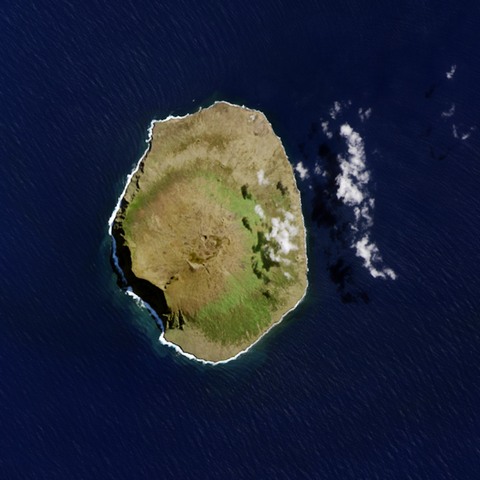
By Eilene Lyon
While pondering this week’s 52 Ancestors prompt “So Far Away” (which I will post later this week), the phrase “Half a World Away” came to mind.
Though we might use it figuratively to mean someplace rather distant, or a mental distraction (like this post), I wondered about the literal sense. What place on earth is half a world away from me?
In other words, if my home was the North Pole, where would the South Pole be?
Checking in with my trusty globe and world atlas, I discovered, not surprisingly, that the point I was seeking is in the ocean. It falls very near a pair of islands, though: Île Amsterdam/Île Saint-Paul.
Having never heard of them, I thought, “Ooooo, something new to learn about!”
These volcanic islands sit roughly equidistant from Africa, Australia, and Antarctica. They are part of a collective of islands in the French territory of Terres australes et antarctiques françaises, or TAAF (French Southern and Antarctic Lands). If you happen to be wandering the southern Indian Ocean, you’ll definitely want to pay a visit (but please don’t stay).
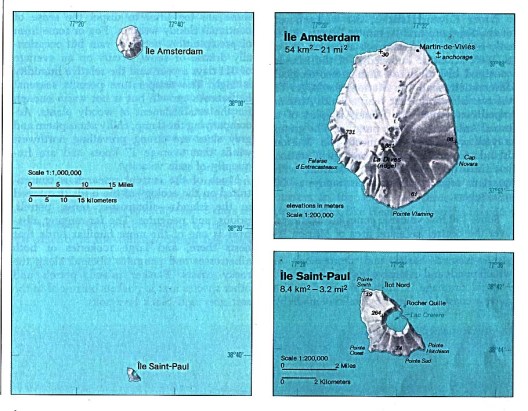
Source: Wikimedia Commons
History
We can assume that for most of their existence, these two volcanoes were unmolested by humans. Spanish and Portuguese explorers discovered them in the 16th century, but aside from noting their existence, the sleeping peaks were left in peace.
Undoubtedly, later explorers hunted for sustenance, particularly amongst the fur seals and eggs of nesting seabirds. There are tales of shipwrecks as well, perhaps a Robinson Crusoe saga or two lies buried in the jungles somewhere. The volcanoes last erupted in 1792 and 1793.
Amsterdam has a tiny, semi-permanent resident population of researchers (much like in Antarctica) studying climate and the flora/fauna of the islands. The only attempt to colonize St. Paul was the establishment of a spiny lobster cannery in 1928, an effort abandoned by 1930 with devastating consequences for the remaining employees.
Ecology
Like my home, Amsterdam and St. Paul are in a temperate zone. Unlike my desert climate, they have an oceanic climate that retains a very stable temperature in summer and winter, plus is very humid, with over 40 inches of rain per year.
Subantarctic fur seals have colonies on both islands. Seabirds breeding on Amsterdam include great skuas, two types of penguin, Antarctic tern, and an endemic species of albatross – Amsterdam albatross. St. Paul has a colony of southern elephant seals in addition to fur seals. Many varieties of seabirds breed there as well. An endemic flightless duck and several species of petrels were driven to extinction by introduced predators. Some of them (pigs, goats, and rats) have been eliminated in recent years.
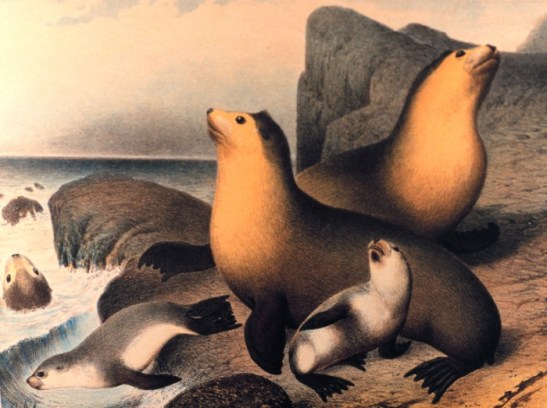
Southern Fur Seals (Arctocephalus gazella) on New Amsterdam Island in the Indian Ocean. (Source: Wikimedia Commons)
The plant life is not diverse, but there are a variety of habitats due to the elevational grade (sea-level to nearly 3,000 feet on Amsterdam). The lower regions are dominated by grasslands. Upper slopes have one species of tree, Phylica arborea, mixed with ferns. There are bogs as well. Dutch sailors greatly reduced the woodlands on Amsterdam, which are still struggling to recover.
A colony established on Amsterdam in 1871 brought the introduction of cattle to the isolated ecosystem, with predictably detrimental effects on the native plants, and in turn on the wildlife. The five left behind became a feral herd of 2,000. They were fully eradicated between 2008 and 2010.
If I’ve piqued your curiosity, be sure to check out the Wikipedia sources below.
Feature image: Amsterdam Island – NASA Earth Observatory
Sources:
https://en.wikipedia.org/wiki/%C3%8Ele_Amsterdam
https://en.wikipedia.org/wiki/%C3%8Ele_Saint-Paul
https://en.wikipedia.org/wiki/Amsterdam_and_Saint-Paul_Islands_temperate_grasslands


It turns out that any of the contiguous United States will land you in the Indian Ocean if you go straight through the earth. That’s a big miss for a country this size. Thanks. Interesting post and I learned something new.
LikeLiked by 1 person
Good observation!
LikeLike
That’s big.
LikeLike
I have always had a fascination for extremely remote areas and read up on Île Amsterdam/Île Saint-Paul southern neighbor, the Kerguelen Islands. If you like wind, it is the place to go.
The wonderful thing about these islands is that they have been turned into protected areas.
LikeLiked by 1 person
That’s good to hear! I almost included the Kerguelen group, but had enough to go on with the first two.
LikeLike