By Eilene Lyon
My 3rd great-grandmother, Abigail “Abby” (Bedford) Jenkins (1801–1882) had seven surviving siblings and one who died as an infant. I’ve written about several of them, as well as about her father. I’m still searching for her maternal family line (Thompson).
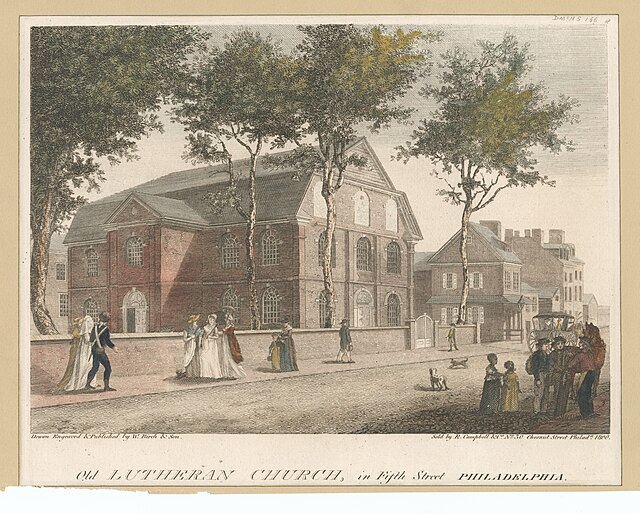
Researching the Bedfords is somewhat complicated by the fact that they lived in the greater Philadelphia metro area in the early 19th century. They didn’t always live in the city, but sometimes across the Delaware River in New Jersey. Most of the family moved to Springboro, Ohio, in the 1830s, a bucolic Quaker-founded town. Two of Abby’s siblings stayed behind in Pennsylvania: Philadelphia and Isaac T.
Some of the Bedford siblings, including Abby, later relocated to Indiana. She was close to her next younger sibling, Joseph A. Bedford. I’ve struggled to find records for him, but I have a little information from one of his children. Until earlier this year, I had little clue about his later life or where he died.
Joseph was born about 1802 in greater Philadelphia. Around 1823, he married a woman named Amy Collins.1 At least three children were born to them in the metro area—Ann J., George T., and William S. In September 1835, Joseph decided to join his widowed mother and siblings in Ohio.2
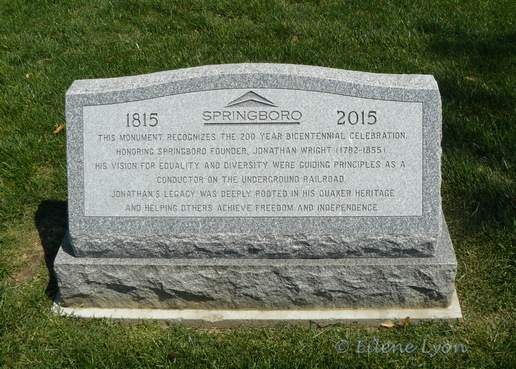
While living there, Joseph and Amy buried several children in the late 1830s and early 1840s—there is no known record of their names or ages.3 The couple had two more surviving children: Henrietta D. (known as Retta) and Collins T. When these two had barely reached school age, their mother died. Amy was buried in the Friends cemetery in Springboro on December 31, 1845.4 This event splintered the family.
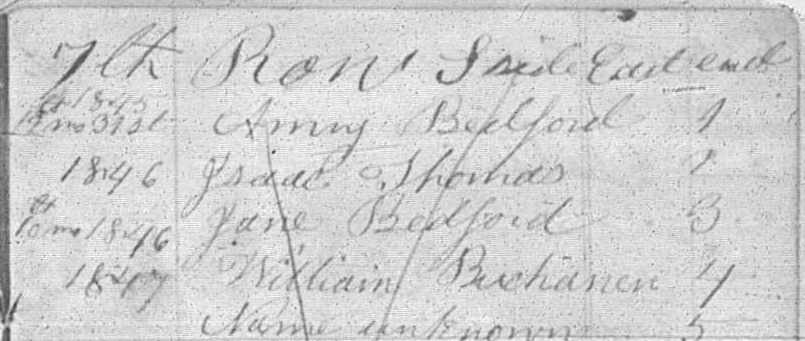
Ann and George were old enough by then to find work and board out. Joseph may have cared for the younger children for a few years, but by 1850 he had left them in the care of others. Retta and Collins were living with their older sister, who had married by then, and had an infant of her own to care for.5
According to a letter Abby wrote to her husband Henry, then mining for gold in California, her “brother Joe” was working with his son George in Cincinnati in 1851 and “doing better.”6 My search in Cincinnati city directories for the early 1850s did not turn up Joe or George.
Abby missed her family after moving to undeveloped eastern Indiana in 1837, so any direct contact with them had great meaning. In 1852, brother Joe was to visit Abby, but she told Henry that Joe was still on the road. Her family had built a new home and needed help. She wrote that “I am waiting for brother Joe. I cannot tell what keeps him—if he does not come I will try to get Wm, but he is very busy farming.”7 Whether Joe ever showed up at her home is in doubt.
Joe eventually surfaced in Fountain County in far western Indiana by 1860. His daughter, Retta, married her first husband in Fountain County in 1854, so he may have joined her there around that time.8 In 1862, Joe married a widow with young two sons: Frances (Drollinger) Bonebrake.9 Joe and Frances had a daughter together, Margaret Elizabeth “Maggie” Bedford, in 1864.10 It appears that Maggie cared for her much older half-sister, Retta, at the end of her life.11
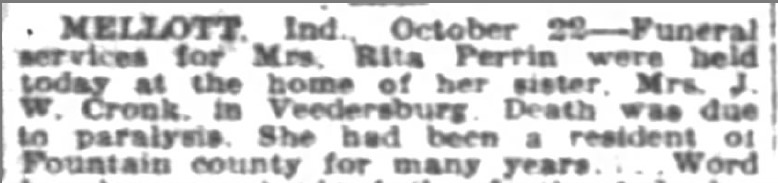
Joe lived on the land Frances and sons inherited from her first husband, Adam Bonebrake. Joseph farmed this land near Veedersburg and also worked as a carpenter.12 The property provided the only clue to Joe’s death.
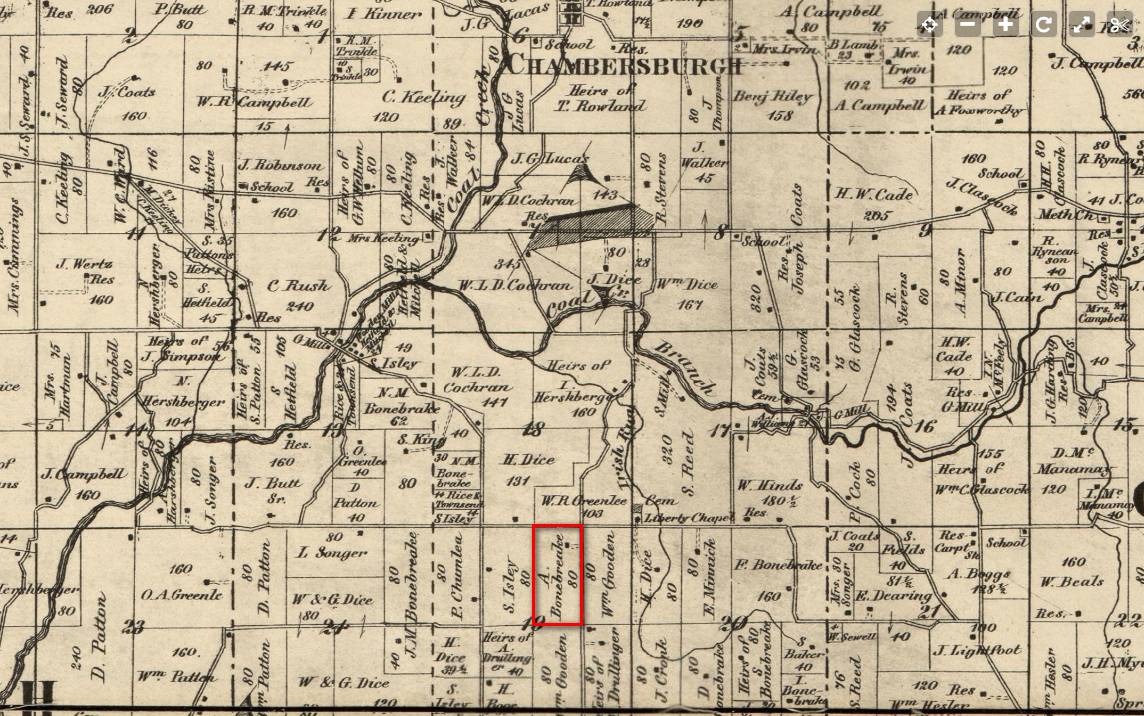
In June 1876, Frances filed a petition with the Fountain County court. This is the only mention I’ve found so far for “The Estate of Joseph A. Bedford, dec’d.” In her petition, Frances said the land, net of encumbrances, was not worth over $500. She got an appraisal for $475.32 and the court granted that this “property be set off to said widow absolutely” in the September 1876 term.13
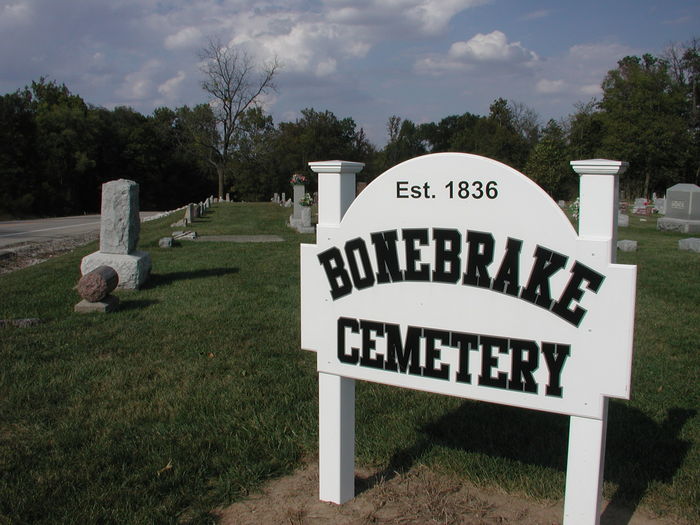
Frances outlived Joseph by almost 30 years and was buried with her first husband in the Bonebrake Cemetery.14 This cemetery is located southeast of Veedersburg along W. Bonebrake Rd. Joseph’s final disposition is not certain, but he is almost certainly buried in the Bonebrake Cemetery, as is his daughter, Henrietta D. Perrin.15
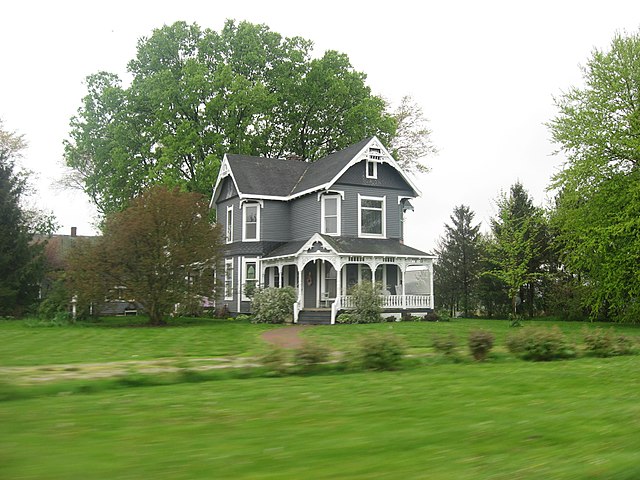
Feature image: The historic Clinton F. Hesler Farmhouse near Veedersburg, Fountain County, Indiana (Wikimedia Commons).
- Joseph’s children’s death certificates consistently name Amy Collins as their mother. ↩
- Henrietta (Bedford) Perrin (Cincinnati, Ohio) to “Dear Friend Cousan” [James H. Ransom], letter, 9 Feb 1925; privately held by author, Durango, CO. ↩
- Society of Friends, Springboro Monthly Meeting [Hicksite]; “Church records, 1773–1917,” database, FamilySearch (https://www.familysearch.org/search/catalog/302201 : accessed 26 July 2024), digital film 8,132,974 images 43 and 44. ↩
- Society of Friends, Springboro Monthly Meeting [Hicksite]; “Church records, 1773–1917,” database, FamilySearch (https://www.familysearch.org/search/catalog/302201 : accessed 26 July 2024), digital film 8,132,974 images 52 and 54. ↩
- “1850 United States Federal Census,” database, Ancestry, (https://www.ancestry.com/imageviewer/collections/8054/images/4204490_00080 : accessed 26 July 2024), record for Ann J McCashen, Liberty, Logan County, Ohio, image 24. ↩
- Abigail (Bedford) Jenkins to “My dear Henry” [Henry Z. Jenkins], letter transcript, 20 August 1851; Cornelius James Brosnan Papers, 1917-1950: Jenkins Letters 1851-1863, University of Idaho Special Collections MG-18. ↩
- Abigail (Bedford) Jenkins to “My dear Henry” [Henry Z. Jenkins], letter transcript, 26 June 1852; Cornelius James Brosnan Papers, 1917-1950: Jenkins Letters 1851-1863, University of Idaho Special Collections MG-18. ↩
- Henrietta Bedord to Cyrus Perrin, Fountain County, 16 October 1854; “Indiana, U.S., Marriage Index, 1800–1941,” database, Ancestry. ↩
- Joseph A Bedford to Francis Bonebrake, Fountain County, 13 September 1862; “Indiana, U.S., Marriage Index, 1800–1941,” database, Ancestry. ↩
- “Indiana, US. Death Certificates, 1899-2017,” database, Ancestry, (https://www.ancestry.com/imageviewer/collections/60716/images/44494_351235-02308 : accessed 26 July 2024), record for Margaret Elizabeth Crouk [Cronk], 1933-06, image 2309. ↩
- “MELLOTT. Ind., October 22” The Indianapolis News, October 22, 1925, p. 27; image, Newspapers.com : accessed 26 July 2024. ↩
- “1870 United States Federal Census,: database, Ancestry (https://www.ancestry.com/imageviewer/collections/7163/images/4263370_00229 : accessed 26 July 2024), entry for Joseph A Bedford, Mill Creek, Fountain County, Indiana, image 27. ↩
- Fountain County Circuit Court, “Probate Records, 1832–1918,” database, FamilySearch, digital film 7,664,247, image 335 : accessed 24 February 2024. ↩
- https://www.findagrave.com/memorial/35327426/frances_bonebrake ↩
- “Indiana, U.S., Death Certificates, 1899–2017,” database, Ancestry (https://www.ancestry.com/imageviewer/collections/60716/images/44494_350087-01322 : accessed 26 July 2024), entry for Henrietta D. Perrin, 1925-13, image 1323. Gives burial place and date; informant is brother-in-law, John W. Cronk. ↩
 Myricopia
I imagine it would have been so much harder in those days when a relative didn’t show up as expected to find out what was happening. Sometimes even now with all our resources people can fall through the cracks.
LikeLiked by 2 people
You really had to have some patience and hope for the best. But sometimes no news WAS bad news. I think Joe just had some difficulty with losing the children and his wife in such a short span of time.
LikeLiked by 1 person
I think his sister made a comment that hinted at that.
LikeLiked by 1 person
That was the sense I got from her comments. His life just went topsy turvy for a few years or more.
LikeLike
So much hardship. I am imagining the long silences waiting for letters.
LikeLiked by 2 people
Even when I was young, waiting for letters could be an agony. More recent generations probably can’t really relate to that tension.
LikeLiked by 1 person
I remember it well. I wrote to my grandmother in England all the time and it took so long for mail to arrive.
LikeLiked by 1 person
We moved a lot while I grew up—always leaving friends behind. I did make an effort, but eventually all faded away.
LikeLiked by 1 person
just commenting on another blog about that lag time aspect in news of family and friends. I think most people took the route to simply go on living their lives as best they could because really how could you do otherwise? When I think of these time periods, most especially for women but really the impacts across entire families, I think that word “resigned” is very appropriate. Childen were raised to just go where directed, move on, find ways to manage and maybe even schooled imperceptibly in turning emotions aside as much as possible in their need to survive without a parent or family nearby. Imagine a child trying to reconcile their needs and emotions against the rest of the family who was really just as lost in knowing what to do yet I can see that those who were able took some of these family members in and made them their own. I discovered one of those stories in my own history and I’m still confused by all of it!
LikeLiked by 2 people
I agree with what you’ve written. Death in these frontiers communities was so commonplace that people did learned to steel themselves. But that doesn’t mean they grieved any less than we do today. They just trucked on and did what needed to be done. They didn’t have the leisure time to fret and moan.
LikeLiked by 1 person
Really good point Eilene, and I agree.
LikeLiked by 1 person
Gods and bad aspects of their times and ours.
LikeLiked by 1 person
Great research! It’s amazing how much people moved around and how far family members could be dispersed.
LikeLiked by 2 people
Your post is a good object lesson for us to not take our current ease of communication from a distance for granted.
LikeLiked by 2 people
Indeed. I recall the agony of waiting for responses to letters I’d sent. Younger people probably can’t even imagine it!
LikeLiked by 1 person
When my husband was on a Mediterranean cruise, with the Navy, it took two weeks for letters to get back and forth.
LikeLiked by 1 person
You are left wondering what might have befallen him in the big gap!
LikeLiked by 1 person
Exactly! Hurry up and wait.
LikeLiked by 1 person
Great research, Eilene. There are so many threads to follow, and sometimes some conflicting dates and details. Ancestry searches bring out the detective in us!
LikeLiked by 1 person
Thank you. Yes, there is often conflicting info to resolve and unanswered (or unanswerable) questions raised.
LikeLiked by 1 person
I still struggle to imagine a world in which communication was so sparse and so difficult.
LikeLiked by 1 person
It really was time-consuming and fairly expensive even to communicate by letter.
LikeLiked by 1 person
Now we complain if the wifi is slow!
LikeLiked by 1 person
🤣
LikeLike
Family dynamics are always so interesting. Very cool those letters survived so you have at least some idea what was happening. I don’t think it was unusual for men to abandon their children if their mother died.
LikeLiked by 1 person
I suspect you’re right about “abandonment.” I also think that some of those men still maintained contact and even responsibility even if the children lived with other people. Unfortunately, Retta really didn’t say anything about her personal family life, that I know of. She wasn’t very literate.
LikeLike
Two things always get me when I read about people of that era. One, how many children they had. And two, how many children they buried. They HAD to be tough minded!
LikeLiked by 1 person
I can hardly imagine it myself!
LikeLiked by 1 person
Eesh.
LikeLiked by 1 person
So many hardships and deaths in those days. It boggles my mind sometimes and so many youngsters that pass away – tough times and tough people. I am old enough to remember the value of communication by writing letters. After we moved to the U.S. when I was 10, I was close to my grandmother and we kept in touch by letter, sometimes weekly as we only visited about three or four times a year. There was a weekly telephone call after 7:00 p.m. for three minutes – hardly enough to say more than “hello”. I had friends I left behind and also through the years I had penpals. The art of letter writing is lost now and some young people will likely never pen a letter in their lifetimes.
LikeLiked by 1 person
I’m right there with you. I rarely lived close to my grandparents, so letters were a constant, particularly once I reached adulthood. With moving as much as we did, writing to friends left behind was something I stated about 6th grade. Eventually all those faded away, though, no matter how close we were in person. I do feel sad that aspect of life is probably gone forever.
LikeLiked by 1 person
Yes, it is sad and even writing Christmas cards with letters tucked inside has become a lost tradition as well.
LikeLiked by 1 person
Yep. Haven’t seen one of those since my aunt gave them up.
LikeLiked by 1 person
Yes and, if you get one, it is a form letter – I’ve had a few of those through the years.
LikeLiked by 1 person
Well, that’s what I expect from a Christmas letter, actually. I like to put a short personal note in the card itself.
LikeLike
That’s all I do anymore, but since I got the Jacquie Lawson subscription I send e-cards to all but a few people who like the traditional cards.
LikeLiked by 1 person
Waiting for letters to arrive, always sort of wondering if all was well. We forget how difficult it was to communicate back in the day.
LikeLiked by 1 person
Of course they didn’t know of a faster way than the mail, so at least they had that!
LikeLiked by 1 person