Travel and education go hand in hand. What have you learned? Originally published March 9, 2018. EL
“Seeing this gradation and diversity of structure in one small, intimately related group of birds, one might really fancy that from an original paucity of birds in this archipelago, one species had been taken and modified for different ends.” – Charles Darwin Voyage of the Beagle (1839)
By Eilene Lyon
Just after completing my environmental biology degree in December 2007, we took an appropriate trip to Ecuador, including a 4-day excursion in the Galapagos Islands. My “mentor,” Charles Darwin, spent five weeks exploring the islands in the fall of 1835, exactly 300 years after their discovery.
Darwin was on a 5-year circumnavigation of the southern hemisphere on board the Beagle. Though only in his early 20s during the journey, his 1839 book about it reveals his intelligent and inquisitive mind. He didn’t publish The Origin of Species for another 20 years, but he was clearly piecing together a theory on this trip. He took every opportunity to explore the lands along the way – especially since he never got over his vulnerability to seasickness.

HMS Beagle at the Galapagos Islands by Keith R. W. Kersting of Hawai’i from Voyage of the Beagle (2000)
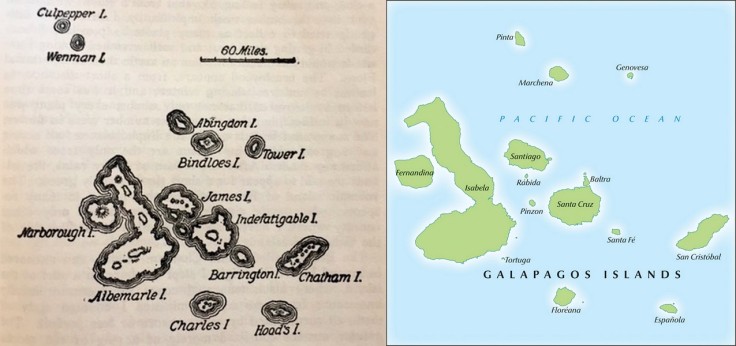
From these maps, you can see that the names of the islands were changed since Darwin’s day. The endemic wildlife has suffered decline since he visited, particularly the tortoise populations. I thought I’d accompany my photos with some of the great scientist’s insights and observations.
Despite predation by humans in earlier times, the wildlife today is completely unafraid of visitors. Even birds do not fly off at your approach. It’s as if they don’t even see you – almost conjuring a sense of invisibility. The only carnivorous bird on the island is the Galapagos hawk. Sea lions do not hunt on shore. Generally, the animals just die of old age.
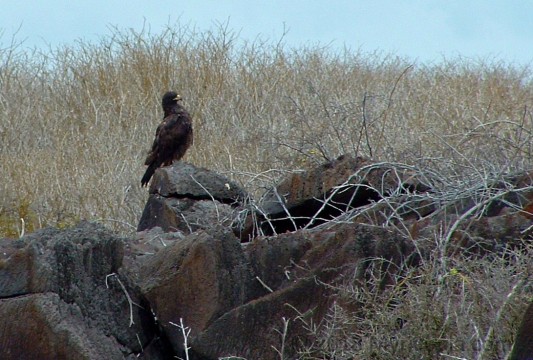
Galapagos hawk
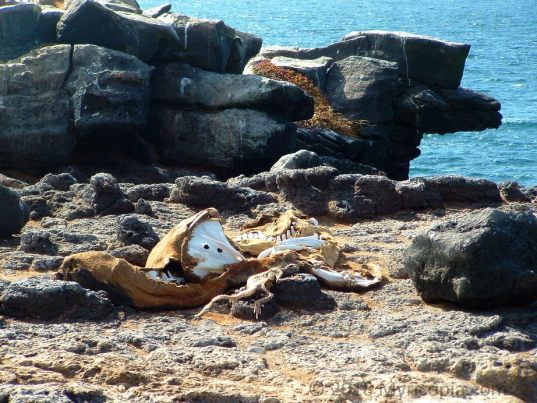
Sea lion and iguana carcasses, most likely natural deaths.
“The remaining land-birds form a most singular group of finches, related to each other in the structure of their beaks, short tails, form of body and plumage.”
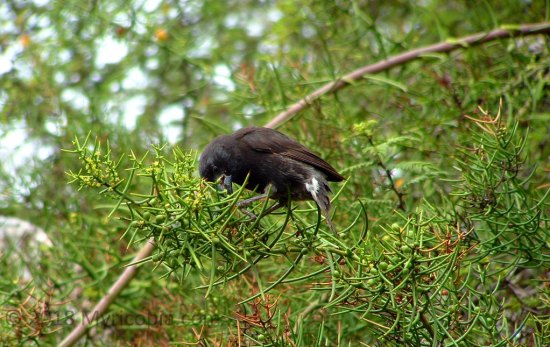
A large-beaked finch eating berries
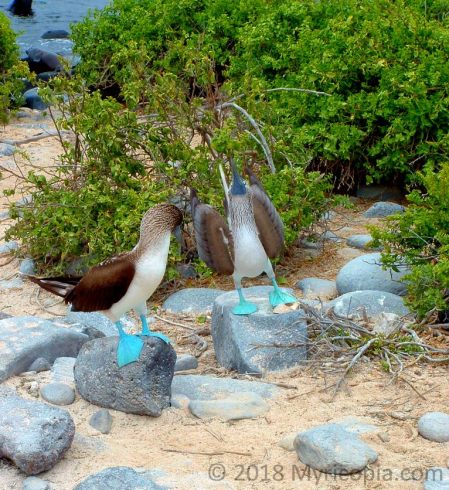
Blue-footed boobies doing a mating ritual
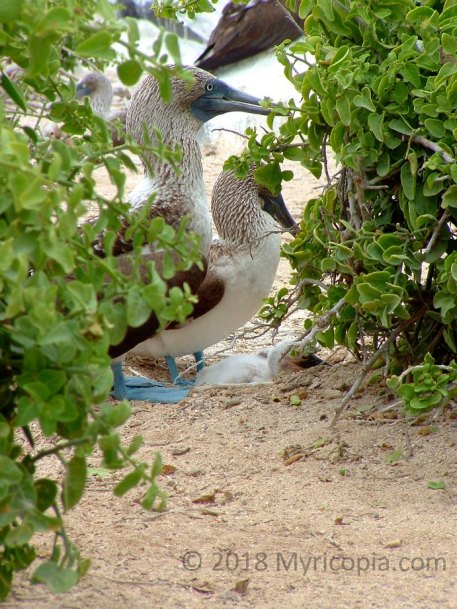
A boobie couple with their chick in the “nest.” You really need to watch your step!
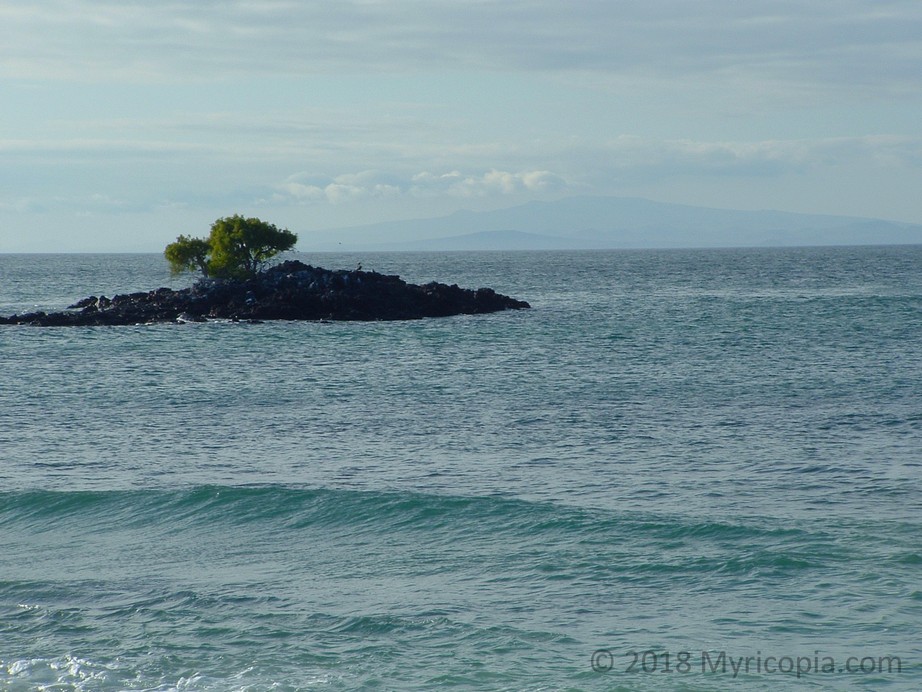
“Nothing could be less inviting than the first appearance. A broken field of black basaltic lava, thrown into the most rugged waves, and crossed by great fissures, is everywhere covered by stunted, sun-burnt brush-wood, which shows little signs of life.”
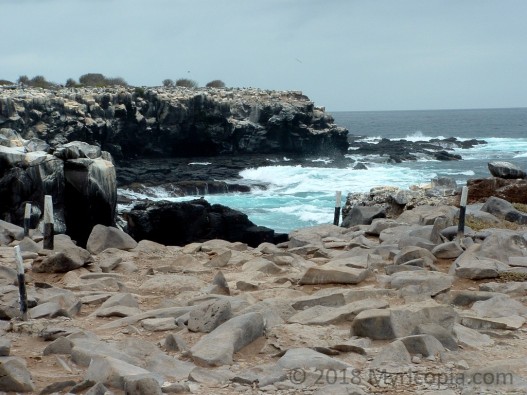
Barren, basaltic coast of Española Island
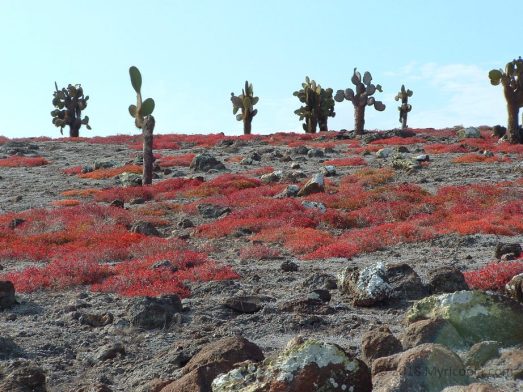
Unique vegetation on South Plaza Island, including prickly pear trees.
“The absence of the frog family in the oceanic islands is the more remarkable, when contrasted with the case of lizards, which swarm on most of the smallest islands. May this difference not be caused, by the greater facility with which the eggs of lizards, protected by calcareous shells, might be transported through salt-water, than could the slimy spawn of frogs?”
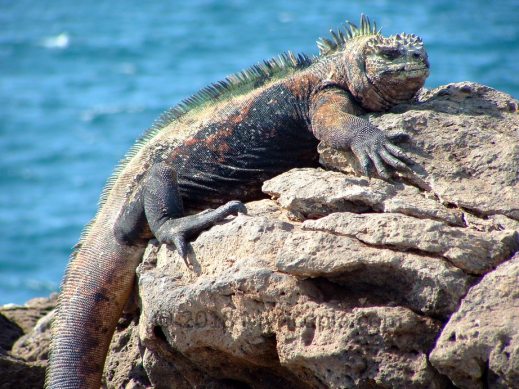
Marine iguana
“The rocks on the coast abounded with great black lizards, between three and four feet long; and on the hills, an ugly yellowish-brown species was equally common.”
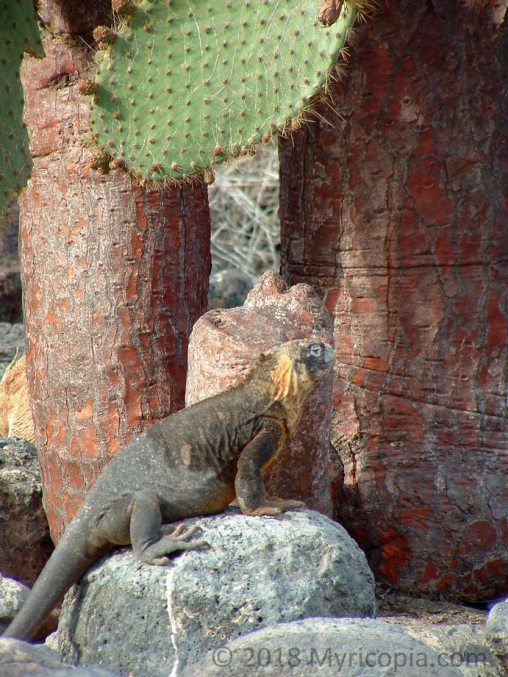
Land iguana
“As I was walking along I met two large tortoises, each of which must have weighed at least two hundred pounds: one was eating a piece of cactus, and as I approached, it stared at me and slowly walked away; the other gave a deep hiss, and drew in its head.”
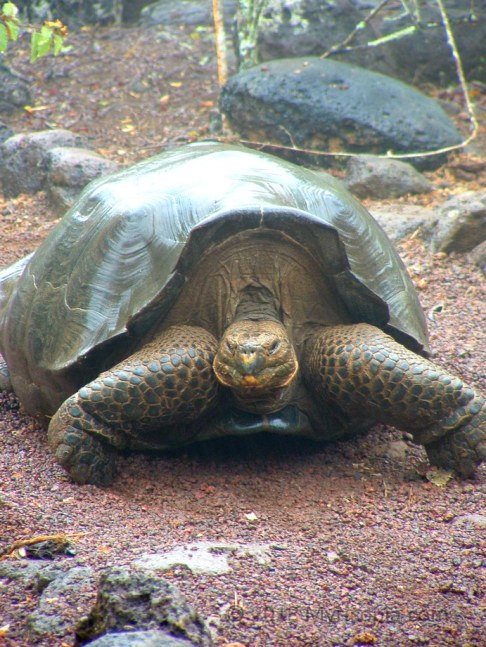
“While staying in this upper region, we lived entirely upon tortoise-meat: the breast-plate roasted (as the Gauchos do carne con cuero), with the flesh on it, is very good; and the young tortoises make excellent soup; but otherwise the meat to my taste is indifferent.”
“The old males are the largest, the females rarely growing to so great a size: the male can readily be distinguished from the female by the greater length of its tail.”
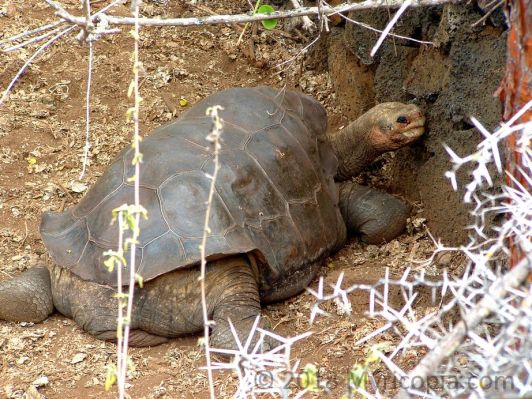
Lonesome George (d. 2012) in his enclosure at the Darwin Research Center. He was the last of his species of tortoise.
“Considering the wandering habits of the gulls, I was surprised to find that the species inhabiting these islands is peculiar, but allied to one from the southern parts of South America.”
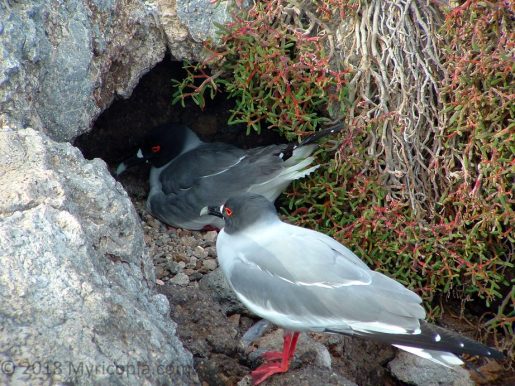
Swallow-tailed gulls
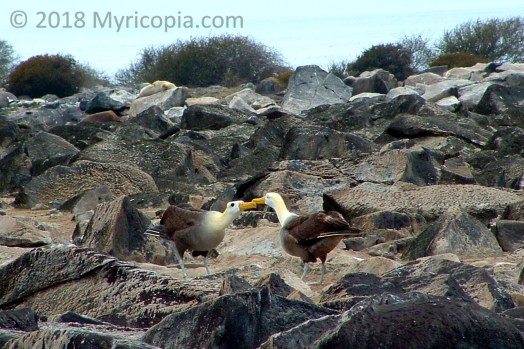
Mating dance of the waved albatross
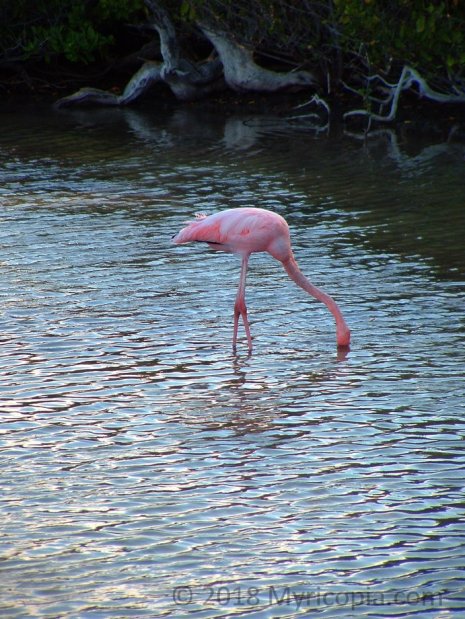
Uncooperative flamingo – refused to lift its head even once!
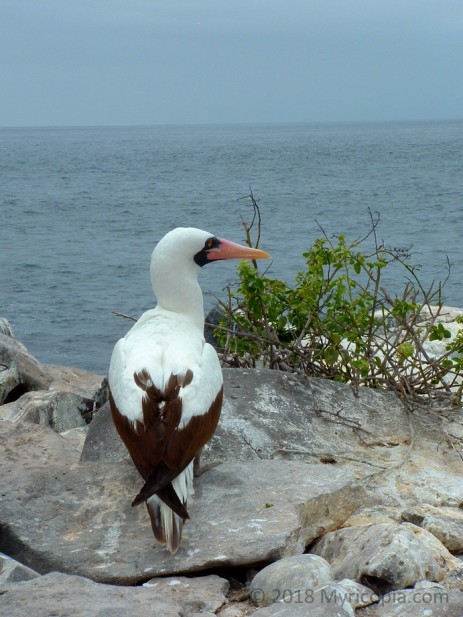
Masked boobie
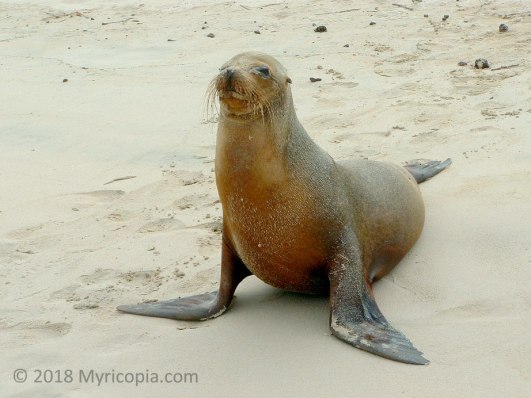
Darwin didn’t mention sea lions in his chapter about the Galapagos. But they are a delight to tourists. We were told not to approach them, but they apparently weren’t given the same message.

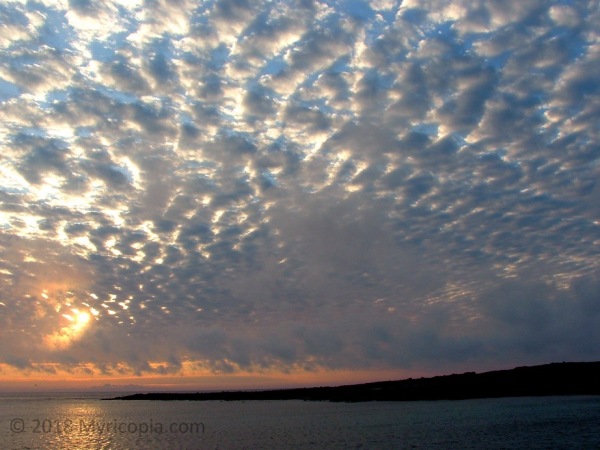
A Galapagos sunrise
Source of all quotations:
Darwin, Charles. 2000. The Voyage of the Beagle with an Introduction by H. James Birx. Great Minds Series, Prometheus Books, Amherst, New York.
 Myricopia
That must have been an amazing trip, especially with looking it through two different lenses, yours and Darwin. It was interesting to read Darwin’s words with your photos.
LikeLiked by 1 person
It was incredible. We also visited the cloud forest outside of Quito and the rainforest of the Amazon basin. I think that latter spot was the best, though Galapagos comes close!
LikeLiked by 1 person
Oh my gosh, what an experience. I bet you saw some interesting birds in the cloud forest!
LikeLiked by 1 person
We did indeed! We also got caught in a big rain storm as it was getting dark and slipped and slid in the mud back to the lodge, thinking we’d never find our way!
LikeLiked by 1 person
Oh my, that must have been a little heart pounding!
LikeLiked by 1 person
I little scary, yes!
LikeLiked by 1 person
What gorgeous photos – thanks for sharing! Mother Nature truly is incredible…
LikeLiked by 1 person
This trip to Ecuador was my only visit ever to South America and we even stood on the equator there. It was a phenomenal place to visit. I’m sorry to hear that the country is in turmoil now, like so many others in that continent.
LikeLike
How fascinating. It reminds me of scenes in Master and Commander.
LikeLiked by 1 person
Reading the Voyage of the Beagle is an adventure in itself. It’s delightfully written.
LikeLiked by 1 person
My heart still breaks for the blue footed booby we saw doing the mating dance all by himself. He had worn a little hollow beneath his feet. I hope he found a nice lady friend eventually!
LikeLiked by 1 person
Reminds me of our house wren of the past two years! We didn’t see any lonely boobies on Galapagos, though.
LikeLike
Oh yes, with his fancy house and no mate.
LikeLiked by 1 person
That’s the one!
LikeLiked by 1 person
Such a special place.
LikeLiked by 1 person
It really is!
LikeLiked by 1 person
So fascinating! Thanks for sharing. I can’t seem to get over the boobies blue feet!
LikeLiked by 1 person
They do have unique feet!
LikeLiked by 1 person
I love how you paired your own photographs with Darwin’s text.
LikeLiked by 1 person
Thanks, Liz. It’s a fun book to read – I do recommend it.
LikeLiked by 1 person
You’re welcome, Elaine.
LikeLiked by 1 person
I loved all the photos of the birds and animals in this post Eilene. Sad to think how many will eventually become extinct.
LikeLiked by 1 person
We did get to see Lonesome George, the last tortoise of his kind and gone now. Many, many species have and will be going extinct in this “Anthropocene.”
LikeLiked by 1 person
That’s is very sad. My boss traveled to the Galapagos Islands a few years ago and I saw his photos of the giant tortoises, different species than Lonesome George – pretty amazing to see them.
LikeLiked by 1 person
All the native animals evolved with no or few predators. Then we came along.
LikeLiked by 1 person
“We” are nothing special sometimes.
LikeLiked by 1 person
Yep.
LikeLiked by 1 person
Our visit to this biological wonderland is always worth revisiting – especially because I haven’t visited the islands. Thanks for promoting Mr. Darwin. Hope all is well with you.
LikeLiked by 1 person
I know you can appreciate Darwin’s contributions to our scientific understanding of life. I’m doing well, thanks!
LikeLiked by 1 person
I enjoyed this piece so much, thank you for reposting. I can’t imagine how sad it must have been for the staff at the centre to see Lonesome George’s decline and demise, makes me wonder whether this was an example of Darwin’s Natural Selection or if Darwin and his crew, and probably many other visitors, contributed by consuming meat of George’s ancestors. Your photos are awesome, even the stubborn flamingo!
LikeLiked by 1 person
Yes, tortoises suffered from human predation over the centuries. We can add George to our decimation of so many species. Glad you enjoyed this post, it’s one of my favorites.
LikeLike
What an amazing trip and spectacular pictures as well. I’m so glad you had this experience!
LikeLiked by 1 person
The whole trip to Ecuador was to celebrate graduating with my environmental biology degree in December 2007. It was a fabulous trip.
LikeLiked by 1 person
Sounds amazing!
LikeLiked by 1 person
Very special and still top-of-mind nearly two decades later.
LikeLiked by 1 person
I can see why. I’m glad you had such a spectacular experience. This is why we travel.
LikeLiked by 1 person
Darwin’s contribution to our knowledge of natural selection laid the groundwork for so many. And to think , the guy who expanded our minds with his theories on evolution is best remember these days by The Darwin Awards.
We’re the top of the food chain? Seriously?
LikeLiked by 1 person
There is no chain. Web is the more appropriate metaphor. We’re prey and predator like most everything else, except we found ways to exterminate many of the things that prey on us (save viruses, bacteria, alligators, and white sharks).
LikeLiked by 1 person
Thanks so much for sharing this. Wonderful photos!
LikeLiked by 1 person
Thank you, Amy! Glad you enjoyed this. It’s one of my favorite posts—good enough to rerun.🙂
LikeLiked by 1 person