By Eilene Lyon
It all started with a song, “Goodbye Sun Valley,” by a short-lived British group called The Colourfield. It was included on their 1987 album, “Deception.” I call it my birthday song, partly because of the first five words; partly because it’s about self-redemption, something I ponder, particularly on my birthday.
The second verse begins with, “I passed the monkey puzzle tree…” For decades, I didn’t give it much thought, but as my botanical skills and interest grew, that monkey puzzle tree gnawed. Could it be a real thing, I wondered? Hello, Google! It is indeed genuine, but I had never seen one. I just loved the very idea of a tree called “monkey puzzle.” What a great name!
Sometime in the last decade, I finally spotted my first monkey puzzle tree (Araucaria araucana), probably in Europe. I wasn’t able to stop and get a photo—or didn’t think of it at the time. That was also the last sighting, until our recent trip to Europe when I spied my second one. Again, I wasn’t able to get a picture, because we were on a group bike ride in suburban Belgium. Had to keep up the others. Bummer.
On our last full day in Europe before heading home, we took a trip up the Thames River from Westminster to Kew Gardens. We had several hours to explore the gardens and conservatories (aka Glasshouses). As we strolled through the 326-acre (132-hectare) Royal Botanical Gardens, I observed a couple trees with signs saying they were Remarkable Trees. There was a QR code for a map of all the Remarkable Trees, but I didn’t snap on that. I kept my eye out for another one, but no luck.
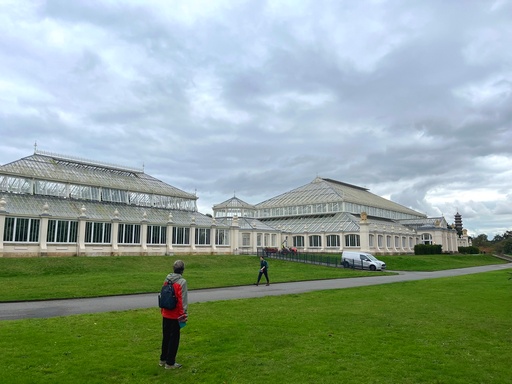
Shortly after 4 p.m., we needed to return to our tour boat on the river. I tried looking up the Kew Gardens monkey puzzle tree online without success. Then comes The Putterer to the rescue! He noticed a Kew employee walking past as we headed back to the entry gate. He asked her if she knew where a monkey puzzle tree might be—she thought a moment and directed us to a place just about a hundred yards away!
And there was our magnificent specimen:
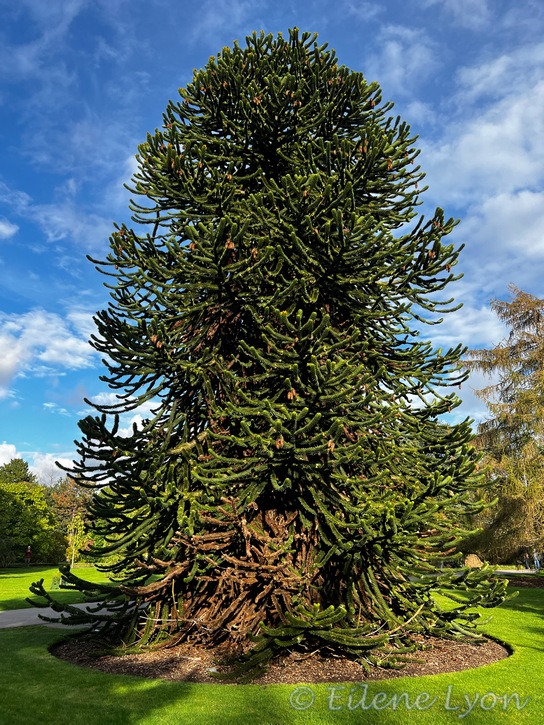
The tree is native to Argentina and Chile, and was introduced to Great Britain in 1795. It is an evergreen known for its razor-blade-like leaves. It’s a dioecious species: male cones and female cones grow on separate trees. The Kew tree we observed had female cones.
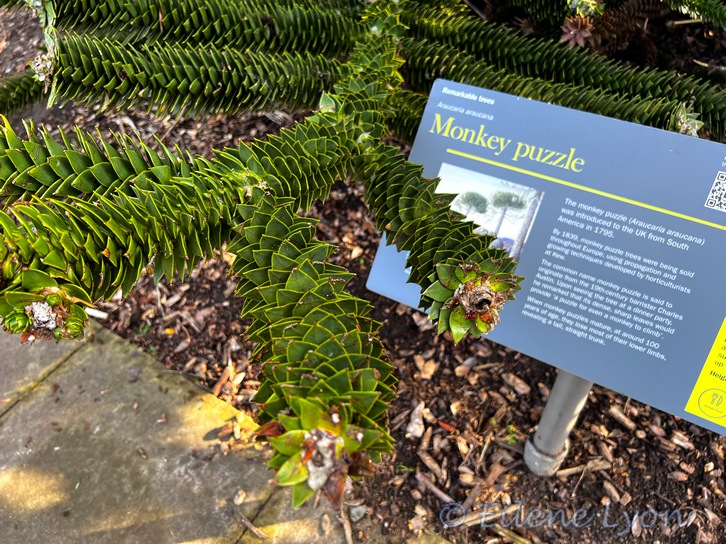
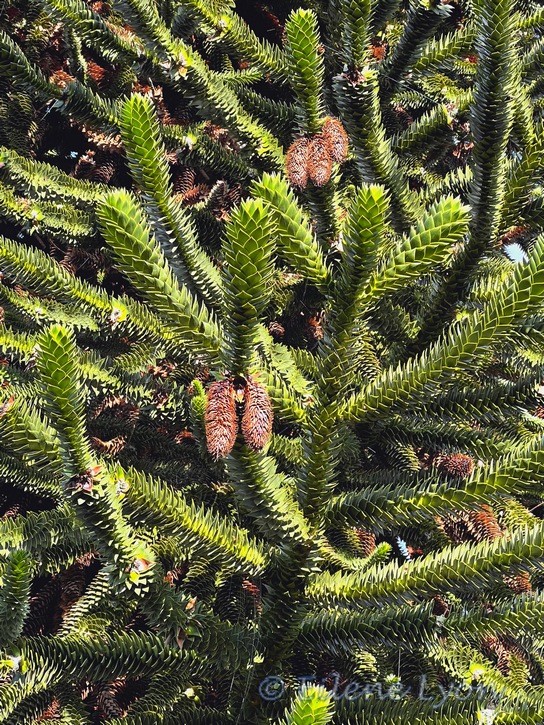
The legend goes that a barrister in the 19th century, Charles Austin, declared that those sharp leaves provided “a puzzle for even a monkey to climb,” giving the tree its common name. The trees lose their lower branches when they mature at around 100 years, giving it a lollipop appearance. It’s unlikely that a monkey would be climbing one even then.
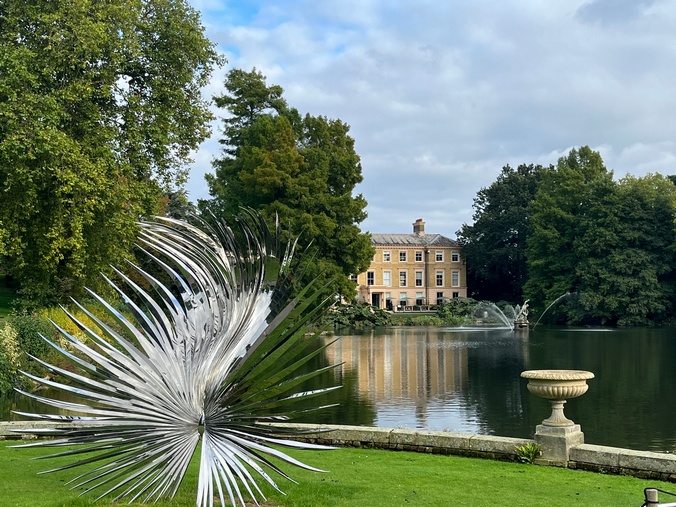
Feature image: A scene at Kew Gardens. Probably won’t be any monkeys climbing on that sculpture, either!
 Myricopia
Wow!
LikeLiked by 1 person
😊
LikeLike
I’m glad you were able to finally find and fully appreciate this tree!
LikeLiked by 1 person
It would be interesting to see it in its native landscape, too.
LikeLiked by 1 person
I have randomly seen Monkey Puzzle trees all my life Eilene! They do grow in WA, not always very well, but I remember seeing a few as a child and now… one block away lives a huge MP tree that I walk under often. Everyone that I can remember seeing was positioned in an “older” neighborhood (even my local one) and already quite large so their lower branches were/are already leaning down, clearly planted long, long ago.
LikeLiked by 1 person
Good to know there are some in the US! I read a blog by a woman who had tried planting them several times and they always died. She finally switched to another kind of tree that wasn’t quite so painful to work with.
LikeLiked by 1 person
And here I was thinking it was simply called the Monkey Tree. I remember seeing one and taking its picture, I think it was in Costa Rica (but I’m not sure). Now I’m going to have to go through my pictures!!
I love how we can obsess about something like this and I’m so very glad you were able to finally capture one 🙂
So… is your birthday near now?
LikeLiked by 1 person
People do but and plant them in their yards, but I’ve heard they can be difficult to keep alive.
Birthday next month.😊
LikeLiked by 1 person
So I read (because, of course, I had to check).
Oh? I’ve got quite a few dates in December 🙂
LikeLike
Guess you’ll have to check the song lyrics.😊
LikeLiked by 1 person
Yes, because my speakers at work suck and I could hear a whole lotta nuthin!
LikeLiked by 1 person
Oh darn.
LikeLiked by 1 person
I just have to remember later….
LikeLiked by 1 person
🙂
LikeLiked by 1 person
I love the reason why this plant is called what it is. I’m not familiar with it, but think it’s charming to look at even before I know the rest of the story.
LikeLiked by 1 person
It would be fun to find out if anyone ever saw a monkey in one!
LikeLike
Yes! 🐒
LikeLiked by 1 person
Well, I learned two things today. First time hearing of either the Colourfield or The Monkey Puzzle Tree. Your posts are always so enlightening.
LikeLiked by 1 person
I aim to please and enlighten! 😄
LikeLiked by 1 person
I’d never heard of either the Colourfield or the monkey puzzle tree! I love the way the tree got its name.
LikeLiked by 1 person
That info was courtesy of the sign at Kew.
LikeLiked by 1 person
😁
LikeLiked by 1 person
I didn’t know that song at all, but I do know lots of monkey puzzle trees because they are quite common here. However, I have never investigated the story of how they got here and how they were named, so I have learnt something!
LikeLiked by 1 person
I think the climate and soil there must be especially suitable. Maybe even the latitude has something to do with it.
LikeLiked by 1 person
What a great song! I’ve never heard it before. I also never heard of a monkey puzzle tree before, either.
LikeLiked by 1 person
I’m glad you like it!
LikeLike
So interesting!
LikeLiked by 1 person
Thank you!
LikeLike
I have never heard of a monkey puzzle tree before! Very interesting.
LikeLiked by 1 person
I think maybe they’re uncommon in the US, though Deb says they have them in Washington State.
LikeLiked by 1 person
I think I saw a monkey puzzle tree at the Phoenix Desert Botanical Garden – I will have to confirm that next time I am there!
LikeLiked by 1 person
That would be interesting. They might have something online that would tell you. I don’t know anything about their native habitat, but there is a lot of desert in Chile.
LikeLike
I have never heard of this tree or the song but I love both. I’m so glad you got to stop and admire one.
LikeLiked by 1 person
Me too! A long time coming to get a close up. The first two I saw were in fenced yards.
LikeLiked by 1 person
I’m so happy for you!
LikeLiked by 1 person
It’s just a silly little thing, but satisfying.😊
LikeLiked by 1 person
Not silly at all! I think it’s wonderful!
LikeLiked by 1 person
😊
LikeLike