By Eilene Lyon
(Note: I originally wrote this, and stashed it, in 2011. I’ve updated the percentage of female pilots. Emily Howell Warner died in Littleton, Colorado, on July 3, 2020 at age 80.)
Back in 2010, my husband and I took a Frontier Airlines flight from Denver to Orlando, Florida. Before we left the gate, the captain came out in the aisle to make a special announcement. She told us that one of her heroines was a special passenger on our flight. Sitting across the aisle from us was another woman in a captain’s uniform, Emily Howell Warner, the first female pilot hired by a U.S. scheduled passenger airline, that same airline: Frontier.
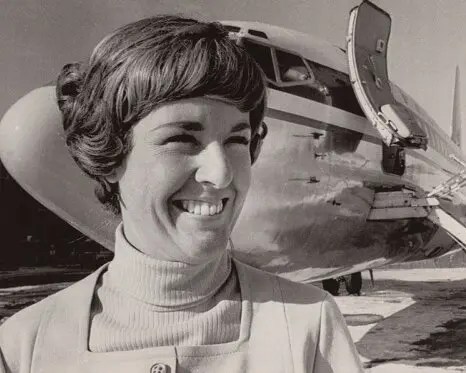
What was so remarkable about that experience was its rarity, even in the 21st century. Today, less than 9% of commercial pilots are women. That may seem low, but many commercial pilots got their training in the military.
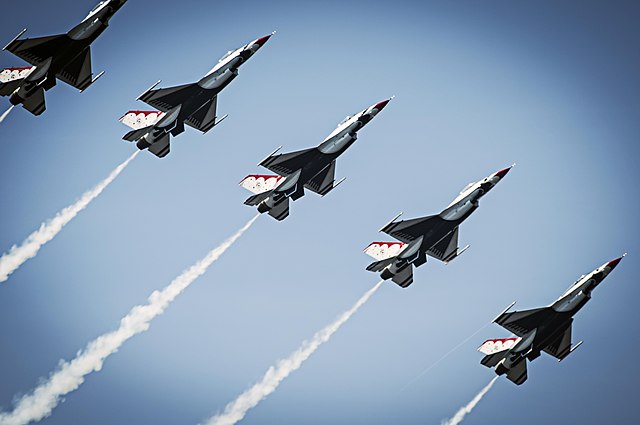
It was in 1973, the same year that Ms. Warner became a pilot for Frontier, that the Navy announced it would start training female pilots. The Air Force followed a year later. The first female to qualify to fly a fighter jet, the F-16, did so in 1994. It wasn’t until 2006, less than two decades ago, that a female joined the elite ranks of the Air Force Thunderbirds.
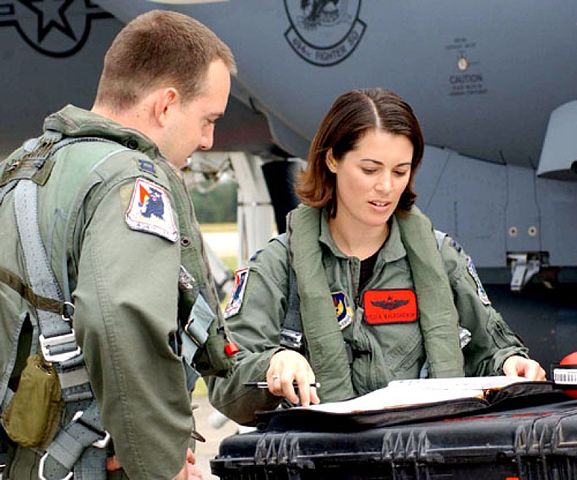
Captain Nicole Malachowski encountered people at air shows who didn’t believe a woman had what it takes to be a Thunderbird pilot. She told them, “The proof is in the pudding. Watch the show. Point out which one’s the girl.” They never did.
The military’s resistance to female pilots was also a barrier to another group of women—those who wished to become astronauts, the most elite pilots on earth. Today’s female astronauts and military pilots owe a debt of gratitude to a special group of women who became known as the “Mercury 13.” You’ve probably never heard of them, but they proved, in 1962, that they were as qualified as men to travel to space.
When NASA was formed under President Eisenhower in the late 50s, the agency never even considered women for astronaut positions. One of the requirements to become an astronaut was experience as a jet test pilot, because the same qualities that make a good test pilot would be desirable for the adventure of space travel.

But the military only allowed men to be test pilots, so NASA had a built-in excuse not to take women. Even though women have a history of flying pretty much dating as far back as men, they simply weren’t given the opportunity to take on the most challenging aviation jobs.
The first male astronauts were known as the “Mercury 7” and included such illustrious names as John Glenn, James Lovell, Alan Shepard and Gus Grissom. All were jet test pilots and all had passed a grueling series of 87 physical tests and a battery of psychological tests in order to become part of the space program. The man who supervised those tests was Dr. Randy Lovelace.
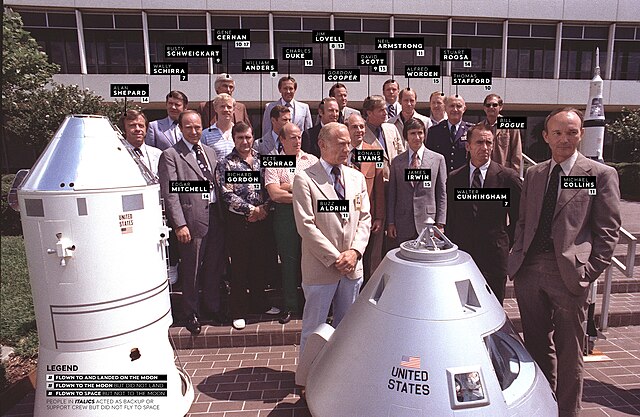
Dr. Lovelace also happened to believe that women would make excellent astronauts. In 1962, he set out to prove it, scientifically, on his own time and dime, at the Lovelace Clinic in Albuquerque, New Mexico. His choice for his first test subject was Jerrie Cobb, a 28-year-old pilot. Cobb had been flying since she was 12 and had more than 7000 hours of flight time—more than John Glenn’s 5000 hours.

She had several world records in aviation, including altitude and light-plane speed. Cobb spent a week undergoing the same testing the Mercury 7 had done, except that in some cases, her tests were made even more challenging. And, she did them all with far fewer complaints than the male test subjects.
Two tests are particularly notable: the isolation test and the MASTIF, a room-sized gyroscope. When the men took their isolation test, they were placed in a dark room with a table, chair, pencils and paper. Cobb’s test was done in a sensory deprivation tank. The men could move around the room and write their thoughts down. Cobb couldn’t do either of those things, and she managed to do it for over eight hours, without any serious problems, which was a record.
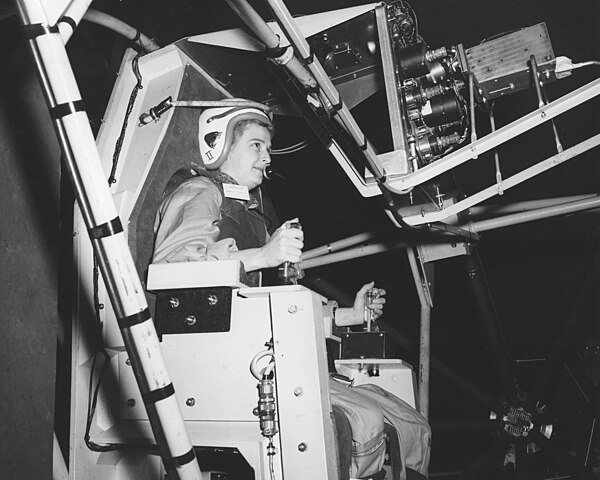
The MASTIF gyroscope was designed to simulate a craft tumbling out of control. The person strapped inside had switches to operate to get the spinning under control, while being totally disoriented. When Alan Shepard was tested, he had a visceral reaction and had to hit the “chicken switch” to stop the machine. Cobb passed with flying colors.
After Cobb completed her testing, other female pilots were invited to go through the same rigorous routine. Twenty women went through the tests and 13 passed, including Cobb. Cobb went on to do two weeks of additional testing at a Navy facility in Florida. The other 12 women were just about to do so, when word got to an Admiral who disapproved and canceled the tests a day before they were to start.
The women weren’t about to let that be the end of things, though. There was significant publicity about the Mercury 13 and their success in the initial testing, but the women decided to challenge NASA in Congress. The hearings were going well, until Jacqueline Cochran stepped in to testify.
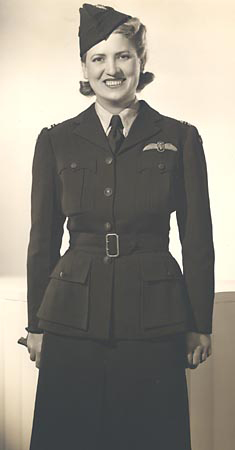
Cochran was the most celebrated and accomplished female aviator of the time. Because of her age and health issues, however, she hadn’t been accepted for the astronaut testing. Perhaps she was a bit jealous of Cobb and the other women, because, unfortunately, she testified against them and that was the end of the hearings.
Still not satisfied, Cobb made an appeal to vice president, Lyndon Johnson. When she had a personal audience with the man, he told her that he wouldn’t support women becoming astronauts, because then Blacks, Hispanics, Asians and other minorities would clamor to be included also.
Cobb felt it necessary to point out to the VP that women weren’t a minority. None of the Mercury 13 ever succeeded in becoming astronauts, but many of them continued their careers in aviation and made valuable contributions in that regard.

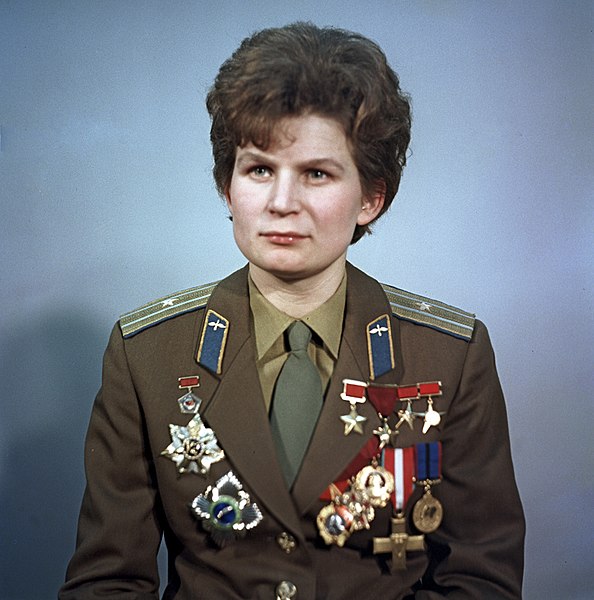
Of course, the first woman in space was Sally Ride, in 1983. Oops, excuse me, Sally Ride was the first AMERICAN woman in space. The Russians actually sent the first woman into space way back in 1963.
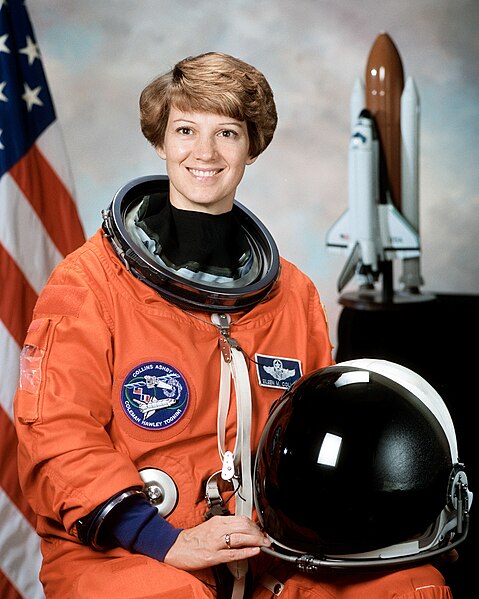
The first woman to pilot the space shuttle was Eileen Collins, in 1999. She also became the first female commander of the space shuttle. Even though women have been part of the shuttle program since Sally Ride went up, the media still do not treat women equally.
In 2006, when Discovery was about to launch, CNN did a story on the astronauts. There was lengthy coverage highlighting career achievements of the men. When the story switched to the women, though, the coverage focused on how their children were holding up and what the women’s hobbies were.
If you’re interested in learning more about the Mercury 13 women, I recommend the book Almost Astronauts, by Tanya Lee Stone, which also has an excellent bibliography. One thing I learned from the book was that there is an International Women’s Air and Space Museum in Cleveland, Ohio. That’s conveniently where my niece happens to live.
I look forward to taking her there someday. She may not be interested in becoming a scientist, aviator or astronaut, but I hope that exposure to women’s accomplishments will inspire her. It’s important for all of us, male and female, to know that it’s okay to dream big—and shoot for the stars.
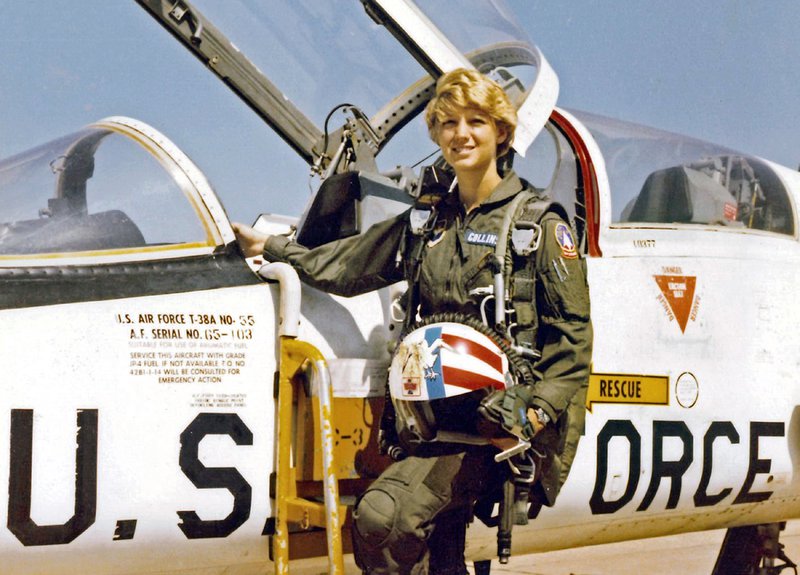
Feature image: Commander Eileen Collins of NASA’s space shuttle program. (Wikimedia Commons)


This was so interesting. I tend to forget how many fights for equality are very recent. I think we start thinking and taking things for granted. Thanks for highlighting this one issue that is still very clearly a hard fought battle and as recent events show us how easy it is for things to change if we don’t stay vigilant.
LikeLiked by 1 person
Yes, despite all the hard-won battles, women still have a ways to go in the U.S. And it’s looking like the road is going to be pretty rocky from here out. Frustrating.
LikeLiked by 1 person
A great tribute to women pilots. Unfortunately, their role has been a steep and slow climb. Although not fast enough, progress has been made. Thanks for the tip about the Cleveland museum. A relative from Cleveland is currently visiting, and she didn’t know of it. We are guessing at the NASA facility near the airport. Well done, Eileen.
LikeLiked by 1 person
Oops … not at NASA … the museum is downtown near the Rock & Roll Hall of Fame.
LikeLiked by 1 person
Thank you, Frank. I looked at their website and it seems to be at a small airport on the lake. I’m sure she can also find the address online.
LikeLike
Thanks for writing this. I fear that with Hegseth heading the DOD, we will be slipping backwards…
LikeLiked by 1 person
Things are not looking good right now, I agree.
LikeLiked by 1 person
What a fascinating post, Eilene! Women always have to do twice the work of men to prove themselves, even when it’s obvious they are right for the job. I just might have to look into that book because of you. (I won’t lie, I probably would not have glanced at the book lying on a table!)
LikeLiked by 1 person
Think of all the lost opportunities we humans have given up by suppressing the ideas and contributions women could have made over the millennia.
LikeLiked by 1 person
No kidding. I’d love to know where exactly, it came to be that women were not equal to men. sigh.
LikeLiked by 1 person
Might makes right. Ha.
LikeLiked by 1 person
You betcha!
LikeLiked by 1 person
Excellent post, Eilene! Sometimes I think young women forget how hard women before them had to fight for acceptance.
LikeLiked by 1 person
And we are still having to fight.
LikeLiked by 1 person
Yes!
LikeLiked by 1 person
I got madder and madder reading that! As for the woman who testified against them – words fail me. I suppose its akin to the anti-suffragist women which I could never understand either.
LikeLiked by 1 person
It is a bit infuriating, yes! There seem to be certain women who set us back. Frankly, many are fundamentalist Christians who buy into the patriarchy.
LikeLiked by 1 person
Interesting post but also infuriating to think about the unnecessary limits imposed on women within the aviation industries. Women have fought to be included for as long as I can remember.
LikeLiked by 2 people
And they are just as capable, if not more so.
LikeLiked by 2 people
A woman attacking (mentally or physically) another woman for whatever reason seems worse than if it had been a man. Strength in numbers. Thought provoking post, Eilene.
LikeLiked by 2 people
There are some disappointing aspects of relations between women sometimes.
LikeLike
Thank you for giving these accomplished women their due!!
LikeLiked by 1 person
They are strong, smart women. Excellent role models.
LikeLiked by 1 person
Yes! I remember in particular what a role model Sally Ride was.
LikeLiked by 1 person
Yeah, her trip to space was a BIG deal!
LikeLiked by 1 person
This was so fascinating to read. It’s amazing how women were treated and discriminated against. That comment from LBJ is awful!
LikeLiked by 1 person
It was a different time (thankfully), but we still have a long way to go!
LikeLiked by 1 person
So true! I’ve written about this issue several times on my blog. I was accepted on the men’s golf team in high school with a friend because there wasn’t a women’s team. But we weren’t allowed to play in matches. That’s one small example. My friend and I were better than many of the. boys.
LikeLiked by 1 person
What?! That’s just sad. I hope at least you learned how to play well.
LikeLiked by 1 person
I played better, won a few tournaments as an adult. After NCL surgery lost my long drive. Life goes on!
LikeLiked by 1 person
It does. Getting older has its pluses and minuses (literally 🤣).
LikeLiked by 1 person
👍🏼
LikeLiked by 1 person
What an interesting post. I’m afraid that we are now backsliding after all the hard work so many women put in to “prove” themselves. This new government seems to believe that if you aren’t white and male, you are DEI. Sad.
LikeLiked by 1 person
It is quite disheartening, to say the least. Maybe we’ll see a flip in two or four years. Who knows?
LikeLike
This post was very informative as well as enlightening Eilene. Several times I had to shake my head at the disparaging treatment and belief that women could not excel at a man’s job – grrr! I wonder why you stashed this post away, but the content is way more impactful now.
LikeLiked by 1 person
I wrote this long before I had a blog. I’ve been working on short pieces for possible book projects, so no dig out all the essays I could find. This one seemed well-suited for the blog. Glad you liked it.🙂 It is timely, as you say.
LikeLiked by 1 person
Thanks for the explanation and all the information. It is fun to learn about history this way!
LikeLiked by 1 person
Thank you, Linda.
LikeLiked by 1 person
You’re welcome Eilene.
LikeLiked by 1 person
Thanks for this. Amidst the current conversation about DEI hires, it’s important to remember that women have long been as capable and as brave as men – when given a fair chance to prove it.
Shame on anyone who thinks a woman can’t handle this job and would be so brazen as to say so to someone who IS doing the job. I’m most of all shocked that Jackie Cochran did not support Mercury 13. She was a pioneer in women’s aviation and led the WASPs. She knew very well those women belonged in the space program.
That museum in Cleveland has been on my list for a while. I was supposed to go to an event there that was cancelled because of Covid. One of these days!
LikeLiked by 1 person
The thing in all that is this idea that we have to be “given a chance.” That just says it all, doesn’t it?
LikeLiked by 1 person
It speaks volumes.
LikeLiked by 1 person
Wow …such an interesting story, though the injustice of the way the women were treated makes me see red. While the Soviets had many, many less desirable ways of doing things, in general it seems they valued women’s contributions in the military far earlier than did most Western regimes.
Why was Cobb’s sensory deprivation test so much more extreme?
LikeLiked by 1 person
It is infuriating, especially from our perspective. I can’t really answer your question except to speculate that maybe sensory deprivation tanks didn’t exist when the men went through the tests.
LikeLiked by 1 person
ah, that makes sense…
LikeLiked by 1 person