By Eilene Lyon
A record group I have not delved into much is naturalization records in the United States. Of course, someone who came to America from Great Britain prior to the Revolution had no need to file for citizenship.
My 4th great-grandfather, Thomas Bedford, was born in Old Sampford, Essex, England, in 1765 to a Quaker family.1 He arrived in South Carolina in 1786 to work for his uncle, Joseph Atkinson. If he applied for citizenship while in South Carolina, it would have been handled at the state level. I have not found a record for this.
Thomas took offense to his uncle’s slave-holding practices and decided to make his own way, wandering north until reaching Philadelphia, Pennsylvania, the Quaker State. Here he married Jane Thompson in 1796.2 I’ve not been able to locate any record with the names of her parents, so I know little about her.
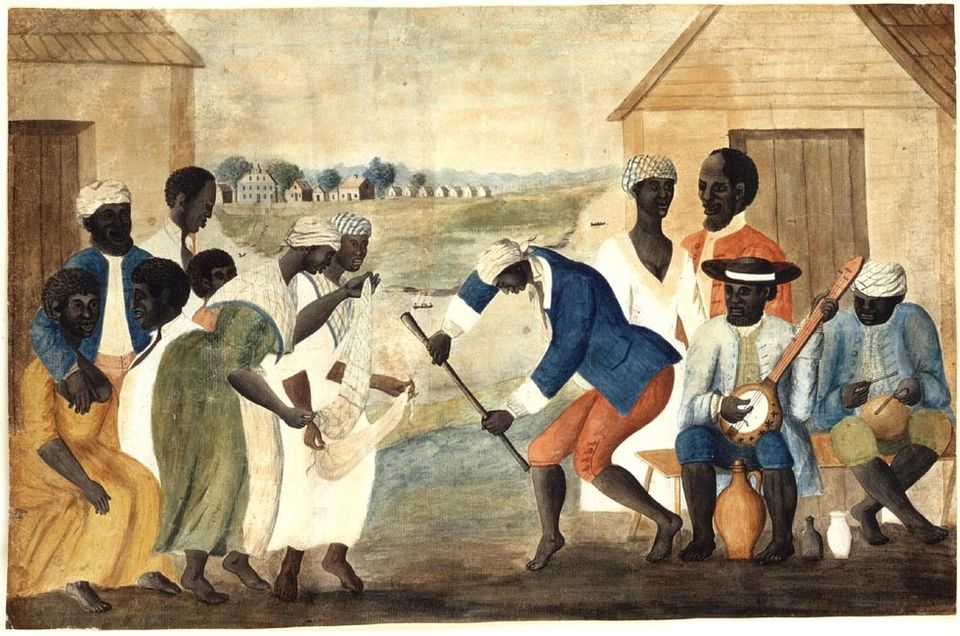
Thomas’s parents were Isaac Bedford (1742–1797) and Abigail Atkinson (1742–1776). The name Isaac Bedford appears many times on my tree. No doubt my 3rd great-grandmother, Abigail (Bedford) Jenkins, was named for her paternal grandmother. Thomas had at least seven full siblings and two half siblings.
His older brother, named for the previously mentioned uncle, was Joseph Atkinson Bedford (b. 1762). Because Joseph came to America well after the ratification of the US Constitution, he did apply for citizenship.
The first federal naturalization law (1790) applied to free white persons, age 21 or over, who had resided in the country at least two years. At that time, an applicant did not need to file a declaration of intent. In 1795, the residency requirement went up to five years, and a declaration of intent had to be filed three years prior to applying for citizenship. A 1798 law upped the residency requirement to fourteen years, but in 1802 it dropped back to five. This law remained in effect for over a century.
Joseph A. Bedford was 36 when he came America in 1798, along with his wife Ann (Bowerbank) Bedford and three young sons: Isaac, Thomas, and Joseph. Ann gave birth to three children in Philadelphia. The son, Peter, sadly died in infancy. The two daughters they named Susannah and Sarah.
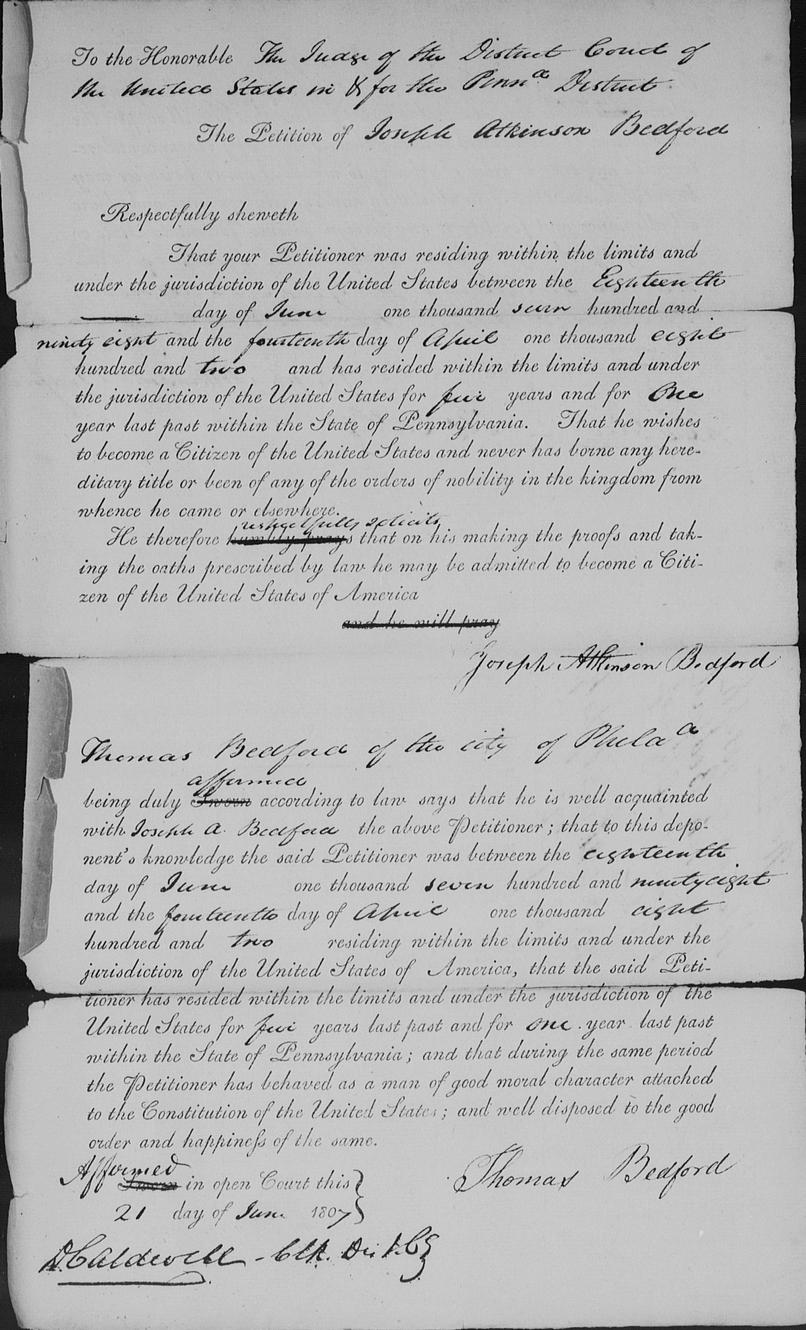
Family Search (and Ancestry) has a database for Philadelphia naturalization records, and here I found Joseph’s citizenship petition, dated June 21, 1807.3 He presented the document in the US District Court at Philadelphia. Part of the petition includes a character witness—none other than my ancestor, Thomas Bedford. This document contains the signatures of both brothers, which clearly shows their beautiful penmanship.
An interesting modification to the document, given that the men were Quakers, is the word “sworn” is crossed out and replaced with “affirmed” in four places. Another modification is done to remove the word “pray.” Instead of “humbly prays,” Joseph “respectfully solicits.”
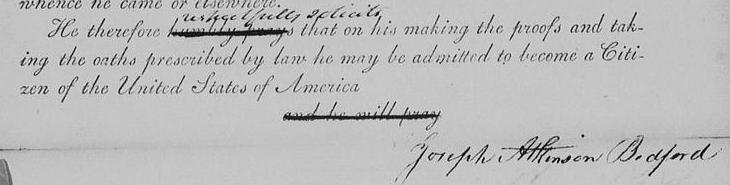
Included on Joseph’s petition is a statement about his residency. I found this of particular interest, because it appears that Joseph may have left the state or country prior to filing this document in 1807. He first arrived in Philadelphia in June 1798, leaving in April 1802. It’s not stated when he returned, but it does say he has completed the five-year residency requirement and resided in Pennsylvania for the past year.
A few other records give us a more detailed look at his life in Philadelphia. A city directory from 1799 indicated Joseph worked as an assistant teller at the Bank of Pennsylvania on Elbow Lane (this may have been in the Germantown suburb). Thomas, at the time, appears to have been a shopkeeper. 4 Another record from that year has Joseph with Ann and their three sons being accepted into the Philadelphia Monthly Meeting (Society of Friends congregation).5
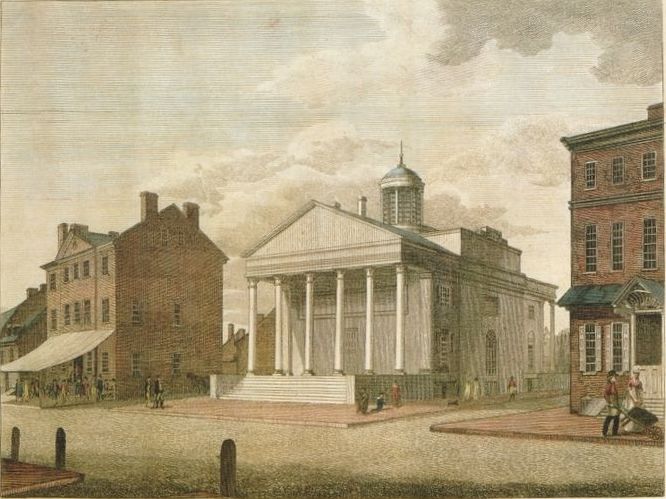
I found the brothers in 1804, both employed as accomptants [accountants] in separate businesses in the old part of the city near the Delaware River waterfront.6
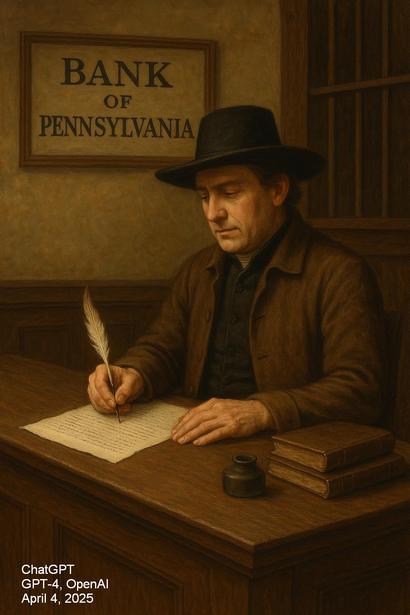
In 1807, the year Joseph filed for naturalization and signed his affirmation to the state (on July 26), he worked as a porter to Pennsylvania Bank on York Road above Callowhill. Thomas was still an accomptant downtown on Sassafras St.7 (Sassafras is now Race St.)
When Joseph became a citizen, his minor children (under 21) automatically received citizenship, though there is no corresponding paperwork to indicate this. Ann, as a married woman, did not legally exist as a separate entity, so she effectively became a citizen upon Joseph’s death, an event that occurred much too soon. He died at age 51 of a remittent fever on October 13, 1814.8 He’d been an American for just seven years.
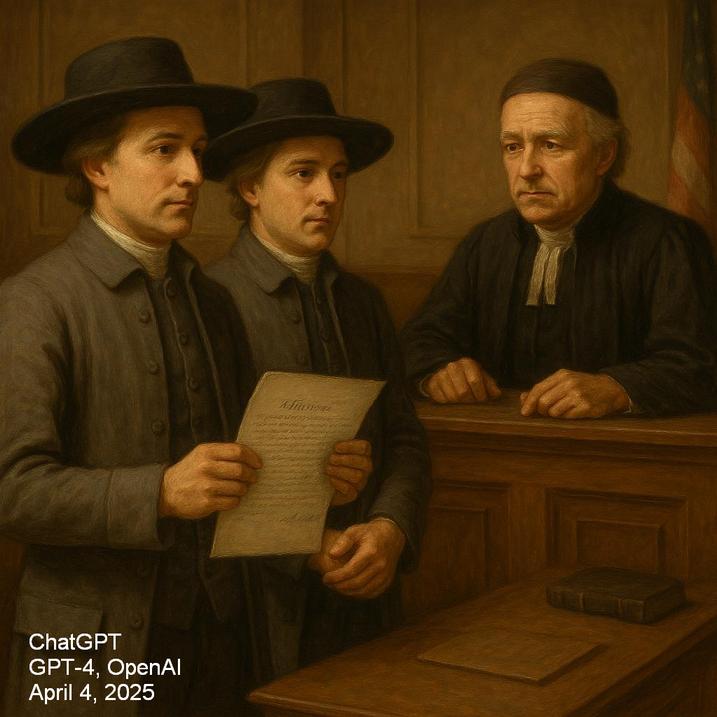
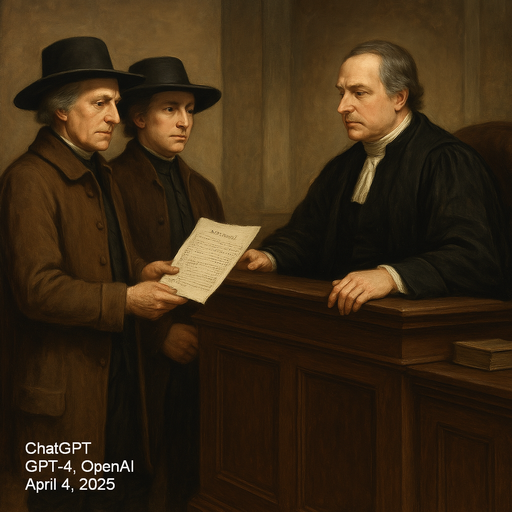
Feature image: AI-generated image of Joseph and Thomas Bedford presenting their petition to a judge in U.S. District Court, Philadelphia, in 1807. This was my first attempt at using AI to generate images for a blog. I much preferred the first rendering, but when I asked ChatGPT to make both men in their mid-40s, I wound up with the feature image that has the men staring off into space instead of looking at the judge. In the image below (the first rendering) the brothers look more like father and son, but otherwise I was quite happy with this one. It looks much more realistic.
- Thos Bedford, birth record, “England & Wales, Quaker Birth, Marriage, and Death Registers, 1578-1837” Ancestry database, image (https://www.ancestry.com/imageviewer/collections/7097/images/41815_b0153705-00101 : accessed 4 April 2025). ↩
- Undated newspaper clipping requesting information about the parents of Joseph A. Bedford, giving their marriage date in Philadelphia as April 9, 1896; Indiana Genealogy collection, image, Ancestry (https://www.ancestry.com/imageviewer/collections/29743/images/dvm_LocHist013471-00026-0 : accessed 4 April 2025) ↩
- “No. 487 Petition of Joseph Atkinson Bedford to become a Citizen of U.S.” Philadelphia, Pa.; images, FamilySearch (https://www.familysearch.org/ark:/61903/3:1:33S7-9PTZ-3SVP : accessed 4 April 2025), Film #4,110,134 images 249–251. ↩
- Cornelius William Stafford, “The Philadelphia Directory for 1799” (Philadelphia, Pa.: William W. Woodward, 1799), p. 19; images Donslist (https://www.donslist.net/PGHLookups/PhilaPA1790sM.htm : accessed 4 March 2020). ↩
- Joseph Atkinson Bedford in Philadelphia Monthly Meeting, Women’s Minutes, 1793–1805; image, Ancestry (https://www.ancestry.com/imageviewer/collections/2189/images/31906_290408-00582 : accessed 4 April 2025. ↩
- James Robinson, “The Philadelphia Directory for 1804” (Philadelphia, Pa.: n.p., 1804), p. 26; images Donslist (https://www.donslist.net/PGHLookups/PhilaPA1800sM.htm : accessed 4 March 2020). ↩
- James Robinson, “The Philadelphia Directory for 1807” (Philadelphia, Pa.: W. Woodhouse, 1807), p. 49; images Donslist (https://www.donslist.net/PGHLookups/PhilaPA1800sM.htm : accessed 4 April 2025). ↩
- K.R. Bunting, Notices of marriages & deaths in Poulson’s American Daily Advertiser, 1791–1839, v. 5 (Philadelphia, Pa.: Genealogical Society of Pennsylvania, 1899–1907), p. 268; image, FamilySearch (https://www.familysearch.org/library/books/viewer/796287/ : accessed 4 April 2025). Burial and cause of death, image, FamilySearch (https://www.familysearch.org/ark:/61903/3:1:S3HY-64GS-3N7 : accessed 4 April 2025). ↩
 Myricopia
“sworn” is crossed out and replaced with “affirmed” in four places
Interesting. I understand why and find it charming. Especially in light of our computerized forms with no provisions made for adding personal nuance to any document. Different times in so many ways.
LikeLiked by 2 people
In some instances, I do modify forms, if they are in Word or PDF format. I’ve decided in healthcare situations that I will no longer digitally sign. They will need to provide paper forms that I can alter, if needed.
LikeLiked by 1 person
Will they take your alterations to the official doc? I fear doing that because that seems like a way for insurance companies to weasel out of paying up. 🤨
LikeLiked by 1 person
I don’t have insurance, which is why it’s important for me to make sure everything is disclosed up front. Our local hospital has very deceptive and downright dishonest business practices.
LikeLiked by 1 person
Interesting that they were able to alter the language in the official documents.
Those are very realistic images. To create them did you just describe their features as you imagined them?
LikeLiked by 1 person
In a general way. I think being more specific might have improved the results. As it was my first try at doing that, I’ll not be too concerned. I think it’s cool to be able to create something when there are no historic images available.
LikeLiked by 1 person
I loved that you tried it. I see that as a great use of AI.
LikeLiked by 1 person
I’m learning a variety of ways it can assist me with my research tasks, but I haven’t yet tried many of them. It’s a learning process!
LikeLiked by 1 person
Wow, your ancestors did have great penmanship! I suspect that some of my early U.S. ancestors may have been Quakers, as well. They had very interesting names (like “Experience,” etc.) One of my ancestors who lived in New Hampshire and was of high rank in the town, got kicked out for “consorting with Quakers.” He moved to Rhode Island. But I love the “consorting with Quakers” terminology — such a great offense, ha ha!
LikeLiked by 1 person
The early Quakers had some characteristics that we’d likely find disturbing, too.😳 But they were big on education and literacy, which has been a benefit to my lineages. Many Quakers in my family tree—even my mother eventually joined them!
LikeLiked by 1 person
I went to a Quaker service once when I was casting about for churches to attend. I couldn’t stand the suspense while waiting for the spirit to move someone! I found all that silence way too stressful. 🙂
LikeLiked by 1 person
There are other congregations that operate more like other Protestant churches. The one my mother attended was like that.
LikeLiked by 1 person
I am always, and I sincerely mean always, in awe of your research skills.
LikeLiked by 1 person
This subject occurred to me thanks to an Advanced Genealogical Skills course I’ve been taking. I hadn’t thought much about naturalization law and how it may have impacted my ancestors and other relatives.
LikeLiked by 1 person
Fascinating about your relatives from so long ago. Interesting that you were able to discover so much. Several things struck me. 1)Thomas’ mother died so young. 2) the writing. 3) the intellect for certain words matching the faith. Cheers to your work.
LikeLiked by 1 person
Yes, So many women (and men, too) died young, some due to childbirth. Quakers really valued education, for both sexes. I think their literacy rate was quite high, despite the relative poverty of many members. Thanks for the feedback, Frank.
LikeLiked by 1 person
I found the modifications to the citizenship petition particularly interesting.
LikeLiked by 1 person
Quakers, typically being well-educated, have a real issue with semantics!
LikeLiked by 1 person
So it would appear!
LikeLiked by 1 person
😊
LikeLiked by 1 person
That’s interesting how the changes were made in this document and I clicked on the document to see it enlarged. I found this sentence interesting: “Ann, as a married woman, did not legally exist as a separate entity, so she effectively became a citizen upon Joseph’s death.”
LikeLiked by 1 person
People do forget that married women did not begin to have rights of their own until the middle of the 19th century. They had to have a male representative in court. Anything they owned prior to marriage became their husband’s. Hard for us to imagine now.
LikeLiked by 1 person
Yes, I keep forgetting that as well Eilene. How different indeed!
LikeLiked by 1 person
We need to remember. Rights are never guaranteed.
LikeLiked by 1 person
Yes, this is very true.
LikeLiked by 1 person
👍
LikeLiked by 1 person
I meant to add that I thought it was interesting how you used ChatGPT to recreate the scene before the judge.
LikeLiked by 1 person
Thanks, Linda. Those sorts of everyday events weren’t captured in paintings and prints, and of course no cameras back then. I’ve been wanting to try AI images, and this seemed like a good case for it. My preference is for real images.
LikeLiked by 1 person
Yes, they depicted it well here. I like real images too, but relied on WordPress for an AI image for my scarecrow (me) typing on the computer, by describing my clothes, down to the straw hat and had a little fun with it. AI did pretty well.
LikeLiked by 1 person
That’s good to know. I guess I didn’t know WP had a decent image generator. I’ll give it a try next time.
LikeLike
I tried it once for kicks and it worked for that post. Where you usually would insert an image from your computer or media file, there is a choice for an WP AI image.
LikeLiked by 1 person
Thanks for the tip.😊
LikeLike
You’re welcome!
LikeLiked by 1 person
This is so interesting! I especially liked reading the history of our process for naturalization (and how easy it once was). And the changes made on his declaration to accommodate his religious identity are also fascinating. Thanks for sharing all this!
LikeLiked by 1 person
Glad you found it useful, Amy. I don’t any records like this for anyone else on my tree. It was a wonderful thing to find, especially with my ancestor’s signature from so far back.
LikeLiked by 1 person
Very, very cool!
LikeLiked by 1 person
😊
LikeLike
So cool.
LikeLiked by 1 person
Thank you.😊
LikeLiked by 1 person
I find the entire history fascinating, but especially the editing they did to the citizen petition.
LikeLiked by 1 person
The Quakers and other pacifists really were persecuted during the Revolution, but later, it seems the courts were flexible about swearing oaths and such. After all the new Constitution did guarantee religious freedom. Several people have remarked on how interesting the edits are.
LikeLiked by 1 person
👍🏼
LikeLiked by 1 person
Maybe I’m dead wrong about this, but after reading how they modified that form, it seems as if they were more adaptable back then than we are today. Sorry, I’m kvetching.
LikeLiked by 1 person
Well, they certainly were not tolerant of the pacifists like Quakers during the Revolution, but after the Constitution guaranteed religious freedom things may have been a bit better, a least for most Christians!
LikeLiked by 1 person
what a cool document! how fortunate they’ve been digitized… I love finding sources like this… How sad Joseph died so young.
LikeLiked by 2 people
It really is a great document. Usually Ancestry and FamilySearch are using the same images, but in this case, FS had a much cleaner version. I’m glad I went looking there, too.
LikeLike