By Eilene Lyon
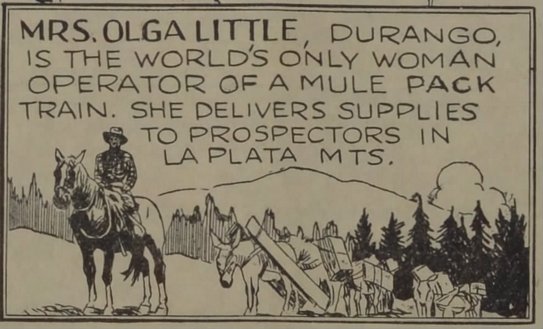
By the time the 1958 episode of TV’s “This is Your Life” aired, Olga Little was already a Colorado legend. She ran her pack string of burros for nearly 30 years (1909-1947) and had been labeled the only female packer “in Colorado,” “…in the West,” and even, with a touch of hyperbole, “…in the World.”
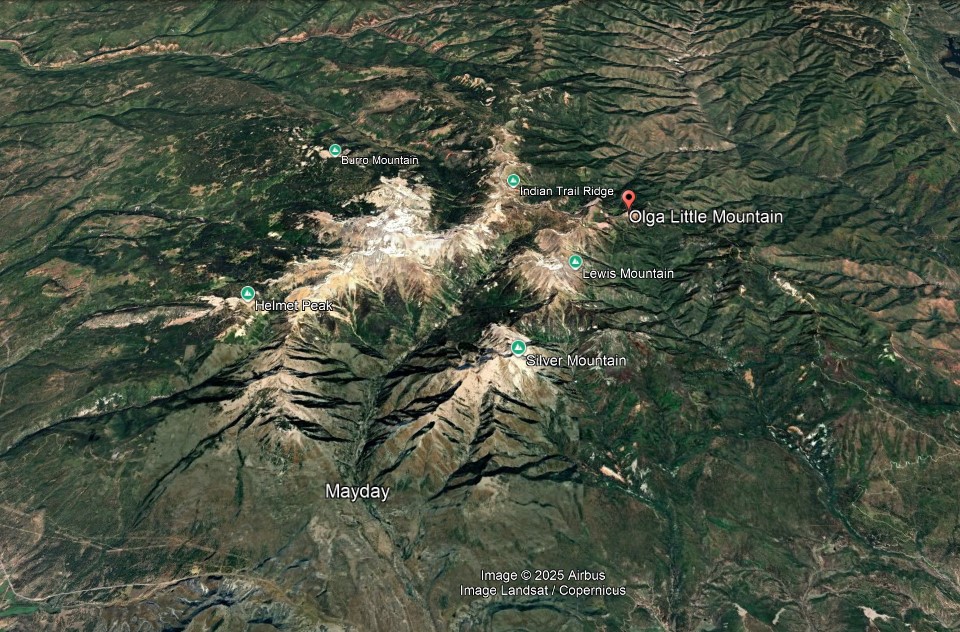
The famous horsewoman, who died in 1970, is memorialized today by a peak in the La Plata Mountains. Olga Little Mountain tops out at 11,246 feet elevation, somewhat taller than the five-foot-four “muleskinner.” Climbers reaching the summit can log their names in a box bearing her likeness.
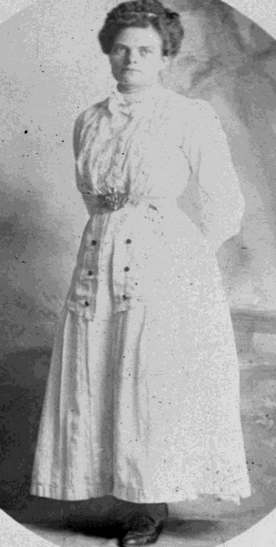
Olga Schaaf*, daughter of Fred (Carl Friedrich) and Johanna Schaaf, came into the world in Germany in 1882 or 1883. The Schaaf family, including Olga’s older brother, Gustave, arrived in New York on March 2, 1885. By summer they were living in Sherman County, Nebraska.
The Schaafs landed in Holyoke, Colorado, and Chama, New Mexico, before coming to La Plata County, Colorado, where they remained. Along the way, two more sons joined the family: Alvin and Oscar.
The wide-open west lit a passion in Olga for horses and cattle. Before long she became known as an accomplished rider and people hired her to break their horses. By age 15 she worked as a livery teamster running teams of four horses. She competed in relay racing at the rodeo, too. Becoming a packer had never been her plan, but a miner in need thrust her into the position.
Floods washed out the road into the La Plata Mountains in 1909, cutting the mines off from supplies. Frank Rivers, who knew Olga’s skills, asked her to bring up a load to the Neglected Mine. When she arrived, the mine superintendent, John Ball, convinced the novice packer to take a three-year contract. He introduced her to Jess Eckert to “teach you all you need to know.” She learned to load a pack saddle and lifted bags weighing 50 to a hundred pounds.
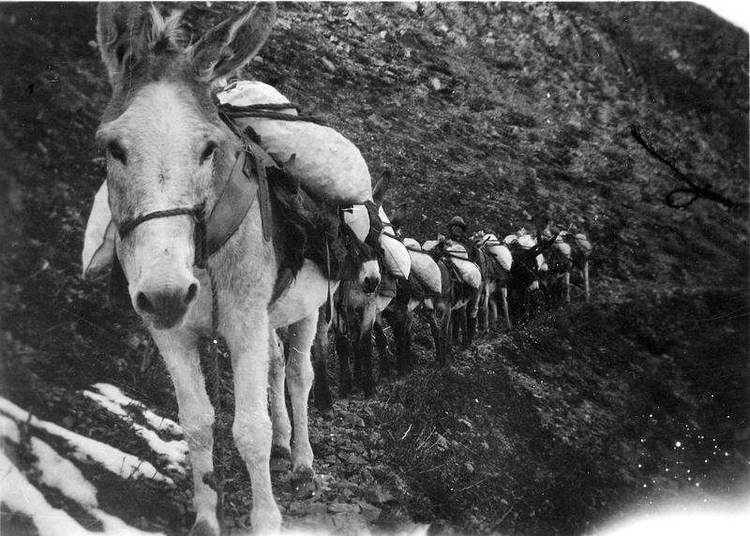
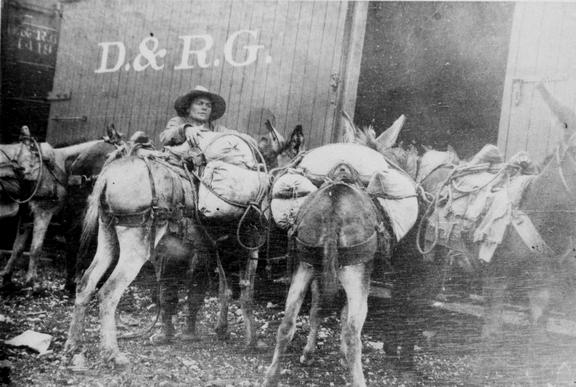
Though she started out using horses, she switched to burros. They could handle the snow better and were sure-footed and trusty. A string of ten could pack a load of one ton. Over the years, they carried food, dynamite, rolls of thick cables, tools, lumber, coal, bales of hay, “everything, says Mrs. Little, but a grand piano.”
Her return trips brought loads of ore from the mines to be smelted in Durango. At least once, she had to pack out the body of a dead miner. She was also credited with saving miners’ lives when they were snowed in, keeping them from starvation. In 1933, she used her pack train to break a trail out of the mountains for the men.
One of the more exciting incidents in her career took place in October 1934, a story carried by the Associated Press. A buck mule deer and four does, apparently fleeing hunters higher on the mountain, barreled headlong into Olga’s train. Olga was “bowled from her horse,” but escaped serious injury. Four burros were knocked from the trail and groceries scattered far and wide.
Though it was obvious to many the hazards of her profession, Olga disagreed. “Lots of people thought my job was awful. But I never gave it a thought. There’s nothing dangerous about it,” she told a reporter.
Over the years, she served nearly every mine in the La Platas. On one early trip, she passed a young miner heading up to the same destination. They struck up a friendship that soon led to marriage. William Chambers Little, a Scot, and Olga wed in 1913. Olga was already well-known throughout the state. In a 1916 article about William C. Little, he’s noted as “husband of Olga Little, the only woman owner and personal handler of a 40-burro pack train in the West.”
He shortly became the second-string pack leader. Each train would have 18 to 30 burros, led by Olga or Bill on horseback. At one time, Olga owned as many as 44 burros and 90 milk cows. Her profession went by many nicknames in addition to muleskinner. A more colorful title was “Jack-Whacker,” sometimes “jackpacker.” “Mule packer” is a slight misnomer.
Olga was known for the great care she took of her animals, and despite the hazards of the mountains, she lost very few. One fell into a ravine in winter and could not be retrieved. She tossed down bales of hay for the stranded survivor until spring arrived.
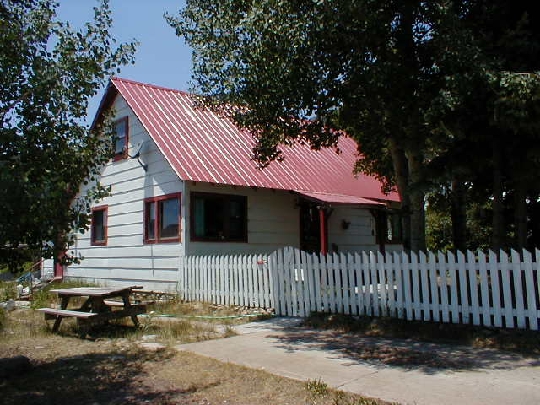
The Littles made their home on 500 acres in the tiny community of Mayday at the mouth of La Plata Canyon. They had no children. Their home began as a single room. The Littles added to it as they repurposed other buildings in the canyon that had been abandoned. There was once a rail spur that ended at their property used to move the ore they packed out of the canyon, though in the early days Olga took her loads all the way to Durango, 16 miles away.
Once the packing business began to wind down, Bill Little took an interest in collecting and polishing stones and making jewelry. For many years, part of the rock collection and mementos from Olga’s packing years were displayed at First National Bank in Durango.
On several occasions beginning in 1938, Olga visited the Denver area with her pack string to demonstrate how things were done in the “old days” of mining. She also rode in the parades in Durango and participated in other equine-related events.
Though the Littles retired from packing they did have the work of running their ranch to keep them in shape. Bill Little passed away in 1969. Olga followed the next year. Both are buried in Durango’s Greenmount Cemetery.
*An interesting aside is that my great-grandmother was Emma Schaaf, no known relation to Olga’s family. My Schaaf ancestors arrived in America in the early 1800s.
Feature image: Olga and her sure-footed burros in La Plata Canyon—“nothing dangerous about it!” (Center for Southwest Studies P 015.033)
Sources:
Paul Pennington, “Honoring Olga Little on the Summit of Her Mountain,” Durango Herald (Durango, Colorado), September 7, 2018, https://www.durangoherald.com/articles/honoring-olga-little-on-the-summit-of-her-mountain/.
Roscoe Fleming, “The Story of Mrs. Olga Little,” The Rocky Mountain News (Denver, Colorado), November 1, 1941, https://www.coloradohistoricnewspapers.org.
Jim Lyon, “Burros ‘Gentle’, Says Woman Who’s Driven ’em since 1909,” The Rocky Mountain News (Denver, Colorado), July 4, 1947, https://www.coloradohistoricnewspapers.org.
“Mrs. Olga Little Leaves with Her Pack Train,” Durango Semi-Weekly Herald (Durango, Colorado), May 11, 1914, https://www.coloradohistoricnewspapers.org.
Debra Mayoux, “A True Pioneer: Olga Schaaf Little the first woman to lead a mue train to and from southwest Colorado mines,” Farmington Daily Times (Farmington, New Mexico), April 1, 2001.
“Five Fleeing Deer Hurl Pack Train down Mountain,” Rocky Mountain News (Denver, Colorado), October 12, 1934, https://www.coloradohistoricnewspapers.org.
“William C. Little, Husband of Olga Little,” Eastern Colorado Times (Cheyenne Wells, Colorado), November 9, 1916, https://www.newspapers.com/article/eastern-colorado-times-19161109-william/179773295/.
“Pack Train Is Attacked By A Buck and Does,” The Daily Sentinel (Grand Junction, Colorado), October 11, 1934, https://www.newspapers.com/article/the-daily-sentinel-19341011-pack-train-i/179772507/.
“Lady Jack-Whacker,” The Daily Sentinel (Grand Junction, Colorado), July 6, 1950, https://www.newspapers.com/article/the-daily-sentinel-19500706-lady-jack-w/179772295/.
“Mrs. Olga Little, Durango,” Windsor Beacon (Windsor, Colorado), January 30, 1941, https://www.newspapers.com/article/windsor-beacon-19410130-mrs-olga-little/179773039/.
“Denver Starting Second Century,” Fort Collins Coloradoan (Fort Collins, Colorado), October 30, 1958, https://www.newspapers.com/article/fort-collins-coloradoan-19581030-denver/179773197/.
“Strong Women Helped Shape Area,” The Daily Sentinel (Grand Junction, Colorado), July 4, 1976, https://www.newspapers.com/article/the-daily-sentinel-19760704-strong-women/179772633/.
“They Won’t Put John Deere out of Business,” The Daily Sentinel (Grand Junction, Colorado), August 6, 1978, https://www.newspapers.com/article/the-daily-sentinel-19780806-they-wont/179772953/.
“Peak Named for Durango Mule Skinner,” The Daily Sentinel (Grand Junction, Colorado), October 8, 1983, https://www.newspapers.com/article/the-daily-sentinel-19831008-peak-named-f/179772852/.
John Marshall and Jerry Roberts, Living (and Dying) in Avalanche Country : Stories from the San Juans of Southwestern Colorado, (Silverton, Colo.: J. Marshall, 1992), p. 65, http://archive.org/details/livinganddyingin00mars.
Alton Pryor, Amazing Women In the Old West, (Roseville, CA : Stagecoach Publishing, 2014), p. 35, http://archive.org/details/amazingwomeninol0000pryo.
Ancestry.com.


What a gal!
LikeLiked by 2 people
She was quite something!
LikeLike
What an absolutely fascinating story, Eilene. Imagine how different her life would have been if her family had stayed in Germany! Instead, she became a legend of the “Wild West”! An amazing woman. Thanks for sharing.
LikeLiked by 2 people
She was American as they come. How many women have a mountain named for them?
LikeLiked by 1 person
Amazing!
LikeLiked by 1 person
Indeed.
LikeLiked by 1 person
What a brilliant and wonderful share, Eilene! I was riveted all through and fascinated by Olga. Fun stuff.
LikeLiked by 2 people
She won’t ever be forgotten around here at least.
LikeLiked by 1 person
No kidding! What a far-from-average life some people lead!
LikeLiked by 1 person
Must be willing to buck the tide of society. Not that many people choose to do that.
LikeLiked by 1 person
That is so very true. Takes a great amuont of courage.
LikeLiked by 1 person
I’ve bucked a little, but not enough to win the rodeo!
LikeLiked by 1 person
You’ve got one up on me!
LikeLiked by 1 person
😂
LikeLiked by 1 person
Interesting story, Eilene. Thanks for sharing!
LikeLiked by 2 people
Glad you enjoyed. She’s a fixture in our county, for sure.
LikeLiked by 1 person
What an incredible life!
LikeLiked by 2 people
Just a way to make a living in her mind, but she got to spend so much time in these beautiful mountains.
LikeLiked by 1 person
What an interesting life story. She must have been a really tough cookie.
LikeLiked by 2 people
No question about that! She was just making a living, but what a way to do it. And she couldn’t have had a more gorgeous “office.”
LikeLiked by 1 person
What a cool story! I love to learn new things. She sounds amazing. Thanks for sharing!
LikeLiked by 2 people
Thanks, Jackie! She was a unique character, all right.
LikeLike
I loved reading this interesting bit of history. I especially enjoy stories about women in history that didn’t stay in traditional roles.
LikeLiked by 2 people
Plenty of non-trad wife about Olga!
LikeLiked by 1 person
Definitely!
LikeLiked by 1 person
Thank you for passing along the story of this remarkable woman!
LikeLiked by 1 person
Glad you enjoyed her story. She’s a true local celebrity.
LikeLiked by 1 person
Rightfully so!
LikeLiked by 1 person
This was a great post. She had such an interesting life and made such a difference for so many. I applaud her tenacity and also applaud Durango for recognizing her contribution to the community and its history. Sincere thanks for sharing her story.
LikeLiked by 2 people
You’re welcome, Judy. I like that she is one of our local notable people. I can’t imagine what it was like to do something no other woman around was doing.
LikeLiked by 1 person
She was indeed a woman before her time. Brilliant that you and others have highlighted her life. There are many unsung heroes within all our communities. Unfortunately, many don’t become recognised until after their death. for some, that might be preferable, as a few individuals don’t enjoy the limelight. Great story, Eilene.
LikeLiked by 2 people
Thanks for all your insightful comments, Suzanne. We used to do a group Chautauqua performance here called “Women of the San Juans” and one woman portrayed Olga. I did a madame named Bessie Rivers. Another of the characters was Caroline Westcott Romney who started the first newspaper in Durango. I profiled her in my Colorado book and may consider doing a biography on her.
LikeLiked by 1 person
What an interesting life Olga Little led and how nice that not only you have memorialized her here, but also Olga Little Mountain is a fitting tribute to all her hard work with her pack, no matter the elements. I like that she took such good care of her animals as well, losing few and that she sustained her burro that fell into a ravine by tossing hay down to it until Spring. Now that is compassion for that animal. I was surprised that her pack of burros could haul a ton – that stat is just amazing to me Eilene!
LikeLiked by 2 people
They were sturdy animals, those burros. I’m a little skeptical about the burro in the ravine story—it didn’t come directly from Olga—but it’s undoubtedly in the spirit of her character.
LikeLiked by 1 person
The burros were impressive singly or as a team. Well, even if the burro in the ravine is a folk tale, as you say, it goes along with a legend.
LikeLiked by 1 person
It seems she had a knack for working with them and them with her.
LikeLiked by 1 person
Olga was something else! She put the A plus in adventure.
LikeLiked by 1 person
She was definitely something else! I’ll bet a lot of her work was pure drudgery and backbreaking, too. But she got to really live in the great outdoors.
LikeLiked by 1 person
What a cool story – an old time long-haul trucker! She was incredible! I love how her husband was defined by who she was – always nice to see 😊
LikeLiked by 2 people
That mention of him in the paper really amused me. I hope he was also amused by being her sidekick. Great characterization of her career!
LikeLike
This seems like a good subject for a film. The West is and was such a different world, such a different way of living, from what I know. I did have ancestors who traveled the Santa Fe trail and lived in Santa Fe and others who lived in Colorado, but my closest direct relatives almost all lived on the east coast.
LikeLiked by 2 people
I would be surprised if she wasn’t already part of a few documentaries. There is quite a collection of photographs of her and Bill, the burros at work, etc.
LikeLiked by 1 person
Fantastic essay on Olga Little, Eilene. You really brought the story to life here, and the photos were a nice treat.
LikeLiked by 2 people
She was a quotable woman and has been well-documented—made my job easy! Thanks for reading, Jet.
LikeLiked by 1 person
What a fascinating woman! She must have been tough as nails to do all that.
LikeLiked by 2 people
She certainly looks the part of “tough as nails”!
LikeLiked by 1 person
She does! We need to hear more stories like hers!
LikeLiked by 1 person
Always keeping an eye out here…
LikeLiked by 1 person
You do a great job at that!
LikeLiked by 1 person
Thanks!
LikeLike
Very interesting 🤔
LikeLiked by 1 person
Thank you.🙂
LikeLiked by 1 person
A very interesting lady! It’s a change to hear of the husband being defined by the wife’s role. I’m sure he had strength of character to withstand any sidelong glances. And I love that she didn’t give up her career, but he joined hers!
LikeLiked by 2 people
It seems like a rather unusual arrangement for the time. To her, it just seemed like a job to be done.
LikeLiked by 1 person