By Eilene Lyon
Note: Just before Christmas 2024, I encountered a male tarantula roaming our neighborhood. In Southwestern Colorado, October is the month we usually see tarantulas crossing the road. Why? Read on…
Our local tarantula species (Aphonopelma vogelae), considered a “mini-tarantula,” is an unintimidating creature. They seem oblivious to the presence of humans and dogs. You must bluntly interfere with their ambling to get even a mild reaction. Stings or bites are unlikely. A tarantula can use its mandibles to procure food with a venomous bite. Or it can deflect potential threats with irritating hairs on the end of its abdomen. I’m neither food nor foe.
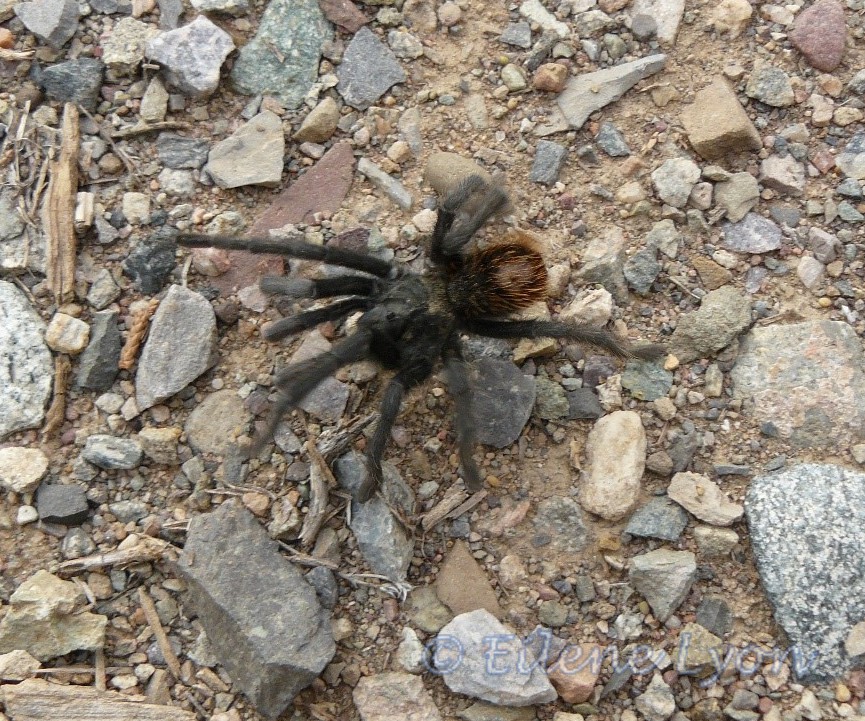
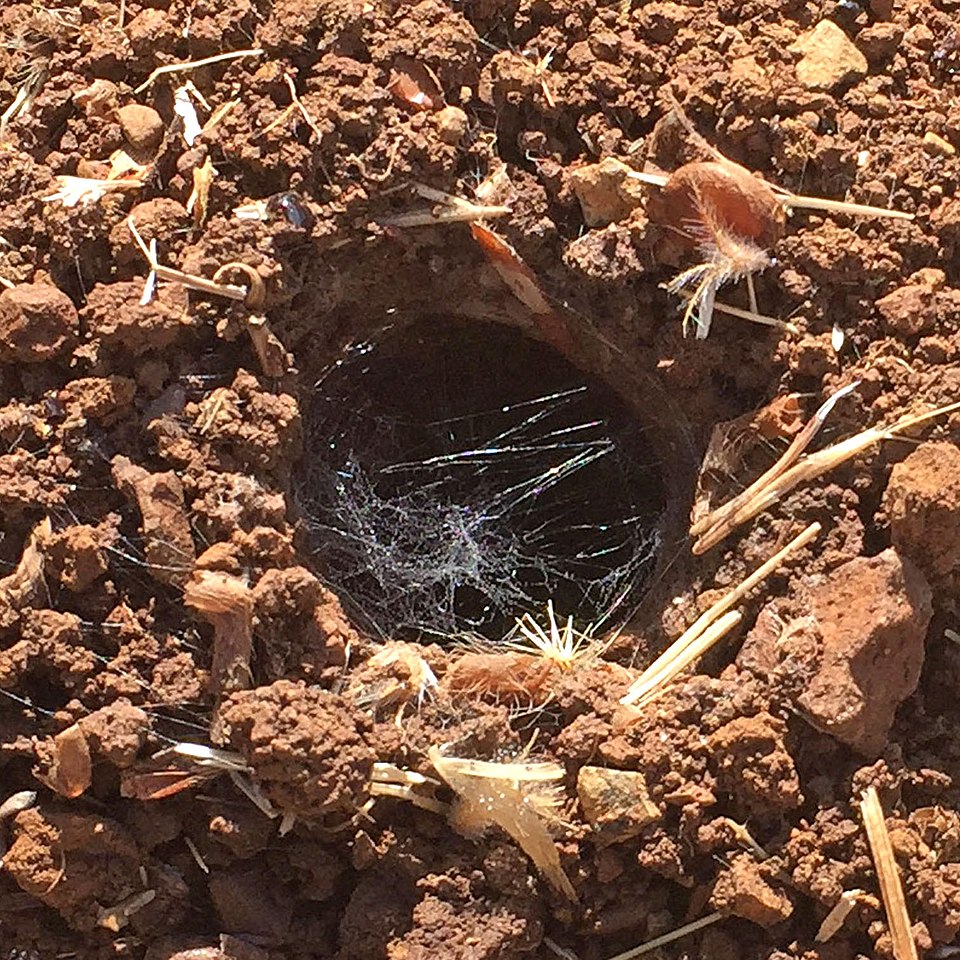
Females do not venture beyond the immediate vicinity of their burrows, from which they emerge at dusk to hunt. Unlike some spiders and insects, Ms. Tarantula is not inclined to eat her mate. Still, Mr. T makes his approach with caution. He strokes her and offers her sperm pouches to fertilize her eggs.
One researcher, observing mating behavior in captivity, remarked, “Frequently when the male has just touched the female with one of his front legs, and she does not show any visible response, he will slap her vigorously several times, which brings prompt action.” If I suitor tried this on me…well, let’s say there may be something to an arachnid’s cannibalistic post-coital behavior.
She waits until early summer to lay her eggs in a silk sack, stashing it in her burrow where the eggs gestate for 50–60 days. The young spiders do not venture far from the mother’s burrow before creating their own. It may take up to a decade for them to reach maturity (probably less for our local species, maybe eight years).
A. vogelae males, like all tarantula species, once they have completed their one-time mating mission, will weaken and typically die from cold weather or senescence, usually by late November. Some tarantulas in captivity have been known to extend their short span of maturity to the following summer, but this is not the norm. Females, on the other hand, may live another decade after maturing, producing offspring with a succession of doomed mates.
The male spider I encountered in late December was unusually long-lived. A retired biology professor told me, after I reported my find, “I think seeing tarantulas means good luck.” Lucky for him, perhaps, on this snowless winter day.
He is fortunate in a number of respects. He’s reached maturity without being eaten by a bird or lizard, or worse (I’ll get to that). He’s outlived his peers, has the chance to enjoy our relatively balmy winter, and probably passed on his genetic code. Maybe those genes will allow his male offspring to survive past their usual best-by date, making these spiders winners in a climate-changing world.
His most dreadful enemy—the tarantula hawk—is nowhere to be found this time of year. The tarantula hawk (Pepsis or Hemipepsis spp.) is no bird. It is actually a wasp in the Pompilidae family, up to two inches long, gun-metal blue with bright orange wings. We see them flying around in the summer months, conspicuous by their size and coloration. The adult wasps are nectivorous, but the females are seeking more than just a sweet sip.
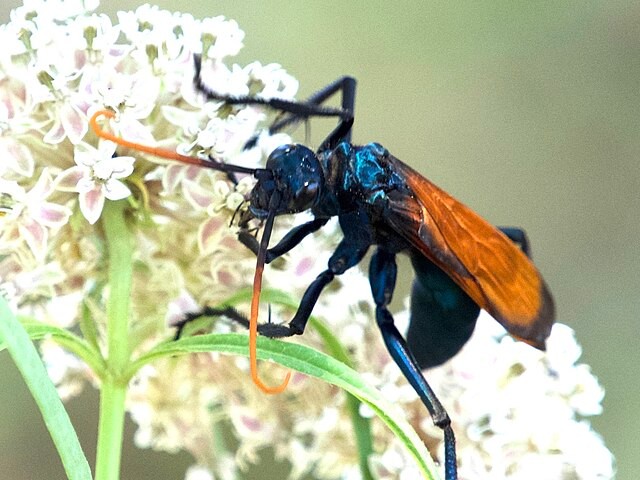
A major reason that tarantulas remain in burrows during the day is to avoid these wasps. Much as the prairie dog fears the red-tailed hawk, the spider fears the spider hawk. The arachnids wish to avert a fate worse than being eaten by a bird or lizard or fox. The tarantula hawk is seeking hosts for her larvae.
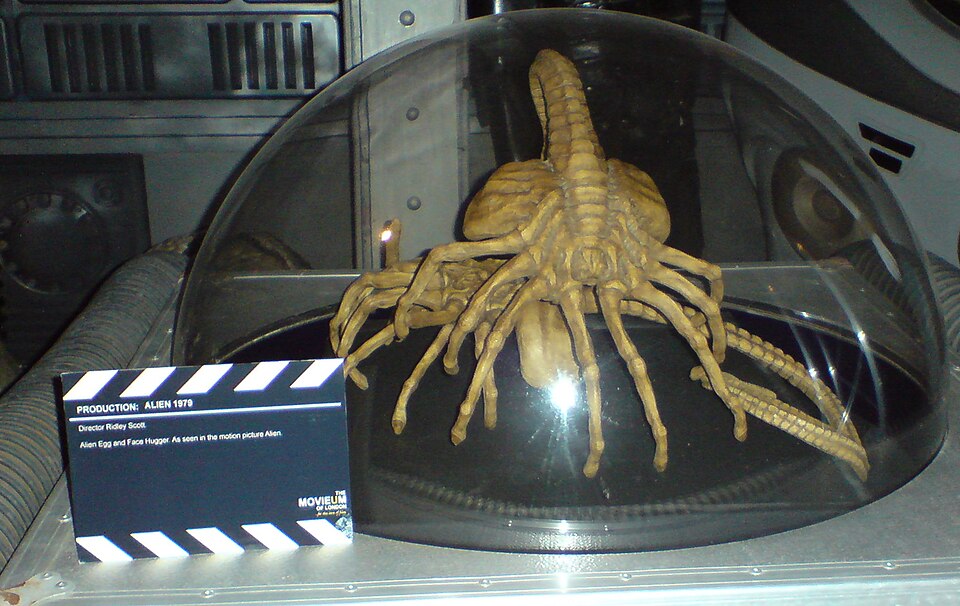
If she lucks into finding a spider outside its burrow, she will paralyze it with her powerful venom, then lay an egg on her victim, depositing it back in its burrow. After hatching, the larva will devour the still-living tarantula. Yes, just like the creatures in the movie “Alien.” The spider will defend itself, but invariably in vain. Where is Ripley when you need her?
An unfortunate human or other mammal may discover that these wasps have a wicked sting—the most painful of any insect—something I hope never to experience. Fortunately, it lasts little more than a few minutes, whereas the similarly excruciating bullet ant sting can last 12 hours or more. Not surprisingly, the people most likely to be stung are those who research these beastly critters. Capturing them for study is not for the faint-of-heart.
One such scientist, the late Justin O. Schmidt, stated that a hawk wasp sting “typically resulted in the stung person uttering an expletive, tossing the net into the air and screaming—such was the immediate pain. To [me], the pain was instantaneous, electrifying, excruciating, and totally debilitating.” He recommends collapsing on the ground and screaming loudly with full abandon. Attempts to do otherwise would likely result in causing more accidental harm to oneself.
I can think of many situations where this advice might be useful: your dog dies, you get fired from your dream job, your best friend gives you the brush off, you perform a spectacular endo from your new mountain bike. The cathartic rolling around and wailing results in “leaving the person emotionally and physically drained,” per Schmidt’s account. Sounds like a great way to hit the reset button.
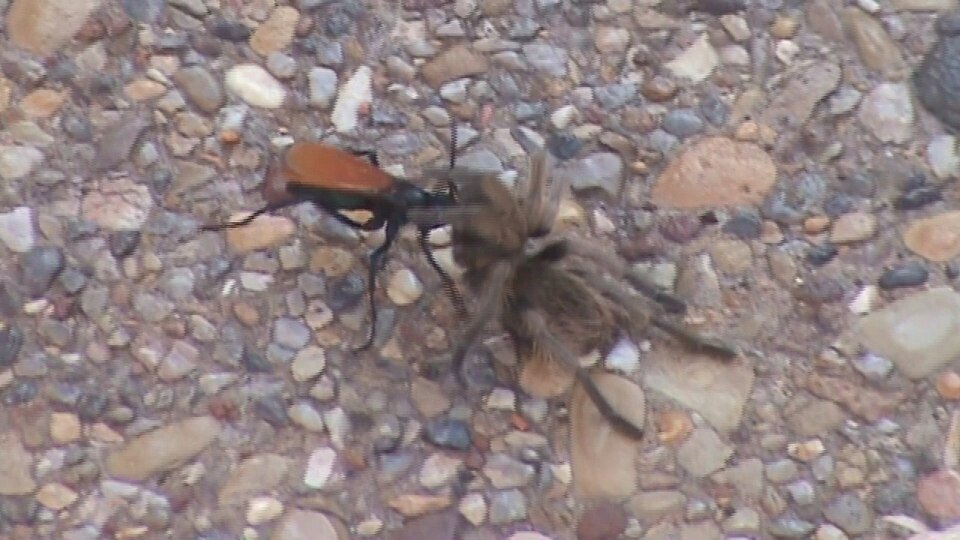
Though tarantula hawk venom causes no lasting harm to vertebrates, the pain it inflicts has effectively eliminated predation. These wasps have no fear of being eaten or attacked themselves. As a result, they live long and their offspring prosper. Their distinct coloration provides protection to other insects that benefit from mimicry.
When we think of predators and top-of-the-food-chain animals (aside from humans), what comes to mind are lions, grizzlies, and white sharks. But even these magnificent and fearsome fauna can’t hold a candle to the successful life of the spider hawk wasp.
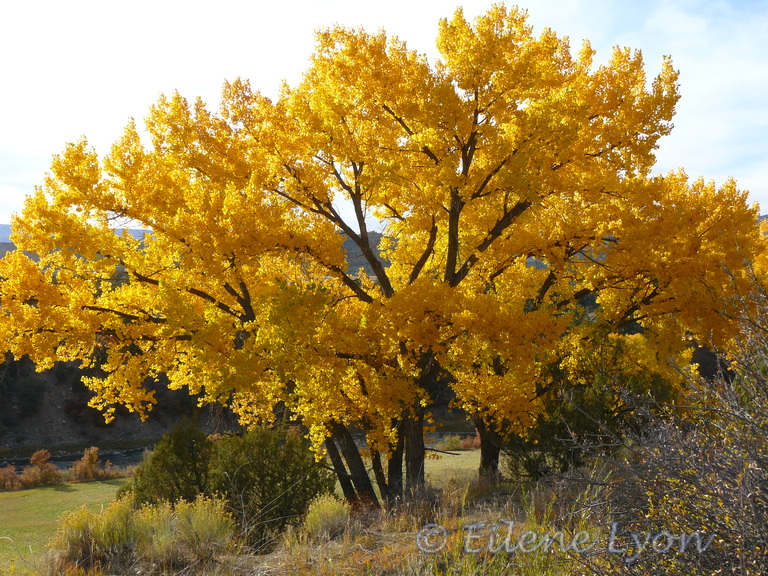
Feature image: A typical October scene, when the male tarantulas are out “looking for love.”
Sources:
Baerg, W. J. “The Life Cycle and Mating Habits of the Male Tarantula.” The Quarterly Review of Biology 3, no. 1 (1928): 109–16. http://www.jstor.org/stable/2808188 .
Schmidt, Justin O. “Venom and the Good Life in Tarantula Hawks (Hymenoptera: Pompilidae): How to Eat, Not Be Eaten, and Live Long.” Journal of the Kansas Entomological Society 77, no. 4 (2004): 402–13. http://www.jstor.org/stable/25086231
 Myricopia
Yikes!
LikeLiked by 1 person
That says it all!
LikeLiked by 1 person
wow…super interesting read
LikeLiked by 1 person
Thank you!
LikeLike
After that amazing education I can easily say I’d rather not meet up with a tarantula but would not run in horror. However, I definitely never want to encounter a tarantula hawk! Any insect with blue and orange and I’m not hanging around 🙂
LikeLiked by 1 person
Having tried to get a photo myself of a tarantula hawk, I can attest they aren’t encouraging you to get anywhere near them. The first time I saw one, I was astounded!
LikeLiked by 1 person
Tarantulas and wasps…enough to keep me out of Colorado!! Yikes!
LikeLiked by 1 person
Haha! They will profoundly ignore you, trust me.
LikeLiked by 1 person
Thanks for educating us about tarantulas! I used to fear them until I met my college boyfriend, who had one as a pet. Like you mention, I was surprised by how docile it was.
LikeLiked by 1 person
They may be, but I still have no interest in picking one up!
LikeLike
Perfect timing on the publication of this one!
LikeLiked by 1 person
Thanks, Andrea! I cut out all the introductory stuff and decided it would make a great Halloween post. My lame attempt at getting it published went nowhere. That’s why I love blogging! Never rejected.😁
LikeLike
I never thought I’d live to see the day I felt sympathy for a tarantula…well, now I have! That Alien like death sounds horrible!!!Also, how did you know the tarantula you found was a male rather than a female?
LikeLiked by 1 person
The females don’t wander around and he was along the side of the road. Not a likely spot for a burrow. Maybe he was still looking for a mate. I sure wouldn’t want to die that way, either. Ick!
LikeLike
Ah, that makes sense…I should have clued from what you’d mentioned earlier about females remaining in the burrow during the day, but it’s early – need more caffeine 🤣☕
LikeLiked by 1 person
I’ve never encountered a female and her brood. That might be a true Halloween fright!
LikeLike
What an utterly fascinating read, Eilene! All that to say, that you can keep them thar critters in your neck of the woods, okay?
LikeLiked by 1 person
Well now, Dale, I think they’d turn their noses up at the thought of living in Montreal. 🤣
LikeLiked by 1 person
Pardon? (said in French). Are you saying they diss the place or the temps? 😉
LikeLiked by 1 person
The temps would be the start of it. And too many opportunities to get run over or smashed on a windshield.
LikeLiked by 1 person
The temps, I get… And city life is definitely not for them, either 😉
LikeLiked by 1 person
Kinda cramps their lifestyle—assuming they like to eat.
LikeLiked by 1 person
Yeah, I’m thinkin’… 😉
LikeLiked by 1 person
🙂
LikeLiked by 1 person
Well, that was interesting! And funny. I particularly enjoyed the section ending “there may be something to an arachnid’s cannibalistic post-coital behavior”.
LikeLiked by 3 people
Thanks, Anabel. Not everyone appreciates my brand of humor.
LikeLiked by 1 person
I’m questioning your comment that your “mini-tarantula,” are an unintimidating creatures. Ugh! Though not afraid of spiders I’m not sure I want to experience their company in my home. Yes, I do appreciate your brand of humour, Eilene.
LikeLiked by 1 person
I think I recall one got in our garage a very long time ago; never in the house. But if one did manage to find his way in, I would gently remove him (without touching). Fortunately, they have a preference for a different sort of environment. 😊
LikeLiked by 1 person
Thank goodness 😊
LikeLiked by 1 person
Yep.
LikeLike
Wow! How interesting. We, fortunately, have neither tarantulas or tarantula hawks where we live. I’m a softy for any spider I find inside the house, safely rehoming them outside. I think if I were to discover a tarantula lurking about, I’d play the scardy-cat female card and summon my husband.
LikeLiked by 1 person
I escort most bugs outside to live appropriately, as well. Flies, mosquitoes, fleas and ticks are a different matter. I see many more of the wasps than the tarantulas. Fortunately, neither have any interest in bothering with the likes of we humans.
LikeLike
Slight problem if the scardy-cat is the husband 😆
LikeLiked by 1 person
*shudder* I’ll leave the wasps and the spiders to the entomologists.
LikeLiked by 1 person
Well, I shan’t be sharing my bed with them, but in the great outdoors I do enjoy observing them.
LikeLiked by 1 person
So does my park ranger son-in-law. He has already texted us tarantulas, scorpions, and rattlers.
LikeLiked by 1 person
So you get to enjoy them vicariously and at a digital remove. Perfect!
LikeLiked by 1 person
That’s what he thought!!
LikeLiked by 1 person
You seem less than enthused, regardless.😏
LikeLiked by 1 person
That is correct. 😁
LikeLiked by 1 person
That was very interesting Eilene and I enjoyed learning about your “mini-tarantula” and their habits. I feel like I just read a story in the “National Geographic”, a magazine we always had at the house through the years. Funny about male mating behavior and fascinating that the males die so early, but the females last another decade.
I have always been afraid of spiders and centipedes. I cannot transport them back outside, but instead will cower as I figure a plan of attack to end their life, even strategizing if I can whack them with my shoe heel, will I miss and then they go missing and are “at large” in the house.
Many years ago in elementary school, we had “show and tell” and a fellow student brought in his family’s pet tarantula. The teacher saw it and asked the student to put it at the rear of the classroom as it was distracting her. He did so, but one of the other kids messed with its terrarium and the tarantula had gone missing when it was time for show and tell. It was an angst-ridden school day until the beast was captured. 🙂
LikeLiked by 1 person
Though I’m not immune to the feeling, I do find it interesting how people cower in the face of other animate beings who generally just wish we’d leave them be to do their thing. And their thing has nothing to do with harming us. Much the opposite. Why do we feel so fragile, I wonder?
LikeLiked by 1 person
I hate myself for my cowardice Eilene, believe me. My mom told me for years, just what you said “that spider is more afraid of you, than you are of it.” But even though she drilled that into my head, it does not make it so in my mind.
Perhaps we feel violated that this creature trespassed where they are not wanted. I’m not saying I’m fine with seeing a spider outside, but I can deal with it there – it’s on its own turf. Once a huge black spider made a tunnel web at the garage door frame on the left side where I had to go past to go into the garage – there is no entry door, so I had to go this way. I was fascinated to watch it trap its prey, wind them into a sticky bundle, etc. … but I was worried about going past it. Finally, even though I hate being “girly” about such things, I asked my male neighbor, in his 50s at that time, if he would kill it for me. He took one look at the spider sitting on the web with those huge legs and said “sorry, I’m afraid of them too!” I sprayed it full force with the hose and prayed it didn’t walk into the garage.
LikeLiked by 1 person
I do understand this reaction to beings so foreign to us. It seems we get predisposed to hate them due to horror stories about black widow bites, brown recluses and other rare events. Sort of like thinking every stranger on the street might be a rapist or murderer. But hard to shake these fears.
LikeLiked by 1 person
You’re correct Eilene. My father worked with a man who was bitten by a brown recluse spider while carrying wood from the woodshed to the house and lost most of his lower arm due to nerve damage from the bite. This was a long time ago, the late 1970s I’d guess, so perhaps there is a better treatment for those poisonous bites now. This gentleman, like my father, was a tool-and-diemaker, so he was unable to work at that trade after this happened.
LikeLiked by 1 person
Yikes! That sounds absolutely awful. Poor man! I do think there are probably better treatments now.
LikeLiked by 1 person
Yes, it was terrible. I remember my father was a shop steward and collect money at the plant for him, so he visited him at home and saw his arm. I’m sure 50 years later there is an antidote or better treatment. I would be leery to handle wood for a fireplace if I stored it outside.
LikeLiked by 1 person
Those spiders are more common in the southeast. Did this happen in Michigan? Canada?
LikeLiked by 1 person
It happened here in Michigan.
LikeLiked by 1 person
Further proof as to how wonderfully complex nature is.
LikeLiked by 1 person
More complex than we will ever know or grasp.
LikeLiked by 1 person
Truth
LikeLiked by 1 person
Wow! This is so interesting. My son had a pet tarantula once, and I was fascinated by it, but I knew nothing of the spider hawk. We all have our problems, lol.
LikeLiked by 1 person
How interesting that there was a pet tarantula in the family, VJ. Yeah, life is a cruel thing sometimes. Or maybe you’re a tarantula hawk and it’s all sweet and good. (Doubt it, though)
LikeLiked by 1 person
Lol. Not at all. I had a spider phobia actually, and tried to overcome that for my kids’ sakes. I do too well, apparently.
LikeLiked by 1 person
I’ve known people with phobias about butterflies and moths. Arachnophobia seems pretty normal.
LikeLiked by 1 person
That was very interesting….but .nature can be cruel!
LikeLiked by 1 person
Well, all beings can do harm to others, humans certainly not being an exception. Same for bacteria and viruses! Size does not matter.
LikeLiked by 1 person
Great post. I saw my first tarantula this fall outside of La Junta. It was very interesting. I’ve always loved spiders. I think I got my love of insects from my father. When I was 5, I stepped on a bee and got stung. My dad took the bee’s side so that’s where it all started.
LikeLiked by 2 people
Ours here were quite late coming out this fall. Last week of October and first week of November. That’s funny that your dad took the bee’s side. Did you step on the bee intentionally?
LikeLike
Oh, no. I just ran out barefoot into the backyard. He told me how the bee gave it’s life when I got stung and I need to be more mindful. All that while I’m screaming and crying. He always took me out to watch the insects, like the marching of the red ants, the day each year the sugar ants flew, and other assorted goings on around the yard.
LikeLiked by 1 person
Just seemed he wasn’t sympathetic to your pain.😢 I also enjoy the insect parade around here. I caught the sugar ant flight this year, in fact. Fewer insect of many kinds each year, with the exception of aphids, of which we get more each year and more kinds of them, too. Those, I really don’t care for.
LikeLike