
Week41: #52 Ancestors – Context
By Eilene Lyon
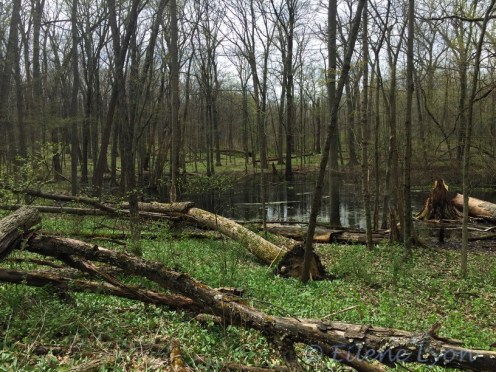
Take a look at a Google Earth image or map of central Indiana today. It will be hard to imagine that two hundred years ago it looked like this:
Tall trees covered the whole country with their wide-spreading branches, depending to the ground, and the shrubbery below arose and united with the branches of the trees. Huge grapevines, scorning to associate with the humble shrubs, like great serpents ascended and festooned the trees to the topmost branches, and thence, spreading in every direction, crept from tree to tree, tying and uniting the tops of a dozen together…The nettles grew so thick, and were so terrible in the burning pain inflicted, that the wounded wild deer in its flight from the hounds of the hunter, although in search of a covert, would never enter…Where the spice-wood did not grow too thickly, male fern formed a solid mass three feet in depth, covering logs and pitfalls so completely that the unwary walker often found himself thrown on his head beyond the obstruction…The highest lands were often table-lands, and the wettest… Here, long sloughs extended over the country for miles, choked with brush and logs, and often without any outlet…1
French traders had been in the region a hundred years and Native Americans for millennia, but beyond the Ohio River, there were no white settlements. Permanent vestiges of native settlements existed only as buried mounds. In 1818, Jacob Whetzel and his son, Cyrus, carved a wagon path through the forests and swamps from the Ohio to present-day Johnson and Marion counties, opening the interior to settlement.2 This was no smooth road, however, and usually people could only travel with horse-packs. In the 1820s, people began arriving from places in the east to settle this land. My Smith ancestors were among them.

The settlers worked for many years to tame this jungle, using a slash-and-burn technique, not unlike what is happening in tropical rainforests today. The removal of trees and shrubs helped to dry out the swamps, but fatal insect- and water-borne diseases were rampant in the early days. They attempted to grow crops, but the squirrels would consume every ear of corn. Wolves would devour their sheep, depriving them of much-needed wool for clothing.3 Venison and turkey were plentiful, however, and sustained the pioneers in the early days. The process of turning this jungle into cultivated land took generations of hard work, but was essentially complete by the 1870s.
My Smith ancestors can be traced back to my 4th great-grandparents, Samuel Smith and Mary A. Martin. Mary was born in Pennsylvania in 1778.4 Samuel’s origins are a bit murkier. He may have been born in Kentucky about 1775, but it is doubtful – there were fewer than 200 white settlers in Kentucky then.5 Our first record of the Samuel Smith family is the 1810 census, which places them in Lewis County, Kentucky, situated on the Ohio River.
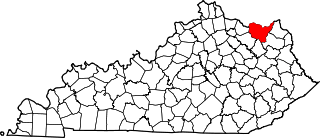
The first people who settled Lewis County came down the river from Pennsylvania. At the time, Kentucky was the “wild west” of the young nation. Later, other settlers came from the east: Maryland, Virginia and North Carolina. Some of them brought slaves. My ancestral families from that region include the Ormes and Pells. Samuel and Mary Smith had eight children who are well-documented, all born in Kentucky except the youngest, Eliza Ann.
In 1820, the Smiths and other allied families, including the Stallcops and Martins, decided to head further down the Ohio River to the newly formed state of Indiana.6,7 If Kentucky was the wild west, Indiana was truly the wilderness. These families were pioneers in every sense.
For a couple years, the Smiths stayed in Lawrenceburg, Indiana, on the Ohio. It was here that Samuel and Mary’s eldest son, John, married Nancy Dean.8 John and Nancy are my 3rd great-grandparents. Nancy’s brother, Phillip Dean, would later marry John’s sister, Alcy Smith. In 1822 and 1823, the Smiths made the arduous journey to Johnson and Marion Counties to purchase government land, settling in an area known as White River.
In the 1830s, the Orme and Pell families also migrated from Kentucky to central Indiana and married with the Smith family. In 1834, Samuel Smith died, and he appointed John and his son-in-law, Phillip Dean, to be executors of his estate. It appears that Phillip did most of the work of settling the estate. Samuel also directed his son, Samuel, to care for the two youngest children, Washington and Eliza Ann.9 Washington was termed “idiotic” by census-takers and had to be cared for his entire life. Perhaps he was born with a genetic condition such as Down’s Syndrome.
Samuel’s children all remained in central Indiana, though his sons Samuel and Robert died young. John and Nancy lived in White River for the remainder of their long lives and had eight children. Their eldest son, Martin R. Smith, is my 2nd great-grandfather. Sadly, three of their adult children died of typhoid fever in 1864.10 These sturdy, adventurous, and hardworking Smiths played their part in the “taming” of the west.
Samuel Smith on Ancestry.com.
Feature image: Google Earth image of central Indiana. A far cry from the wilderness the Smith family encountered in the 1820s.
- Banta, D.D. 1881. A Historical Sketch of Johnson County Indiana. J. H. Beers & Co. Chicago. pp 50-51. ↩
- Ibid, p. 9-10. ↩
- Ibid, Chapter IX. ↩
- Ancestry.com. 1850 United States Federal Census [database on-line]. Provo, UT, USA: Ancestry.com Operations, Inc., 2009. Year: 1850; Census Place: Pleasant, Johnson, Indiana; Roll: M432_155; Page: 19B; Image: 348. ↩
- http://en.wikipedia.org/wiki/History_of_Kentucky ↩
- Ancestry.com. 1820 United States Federal Census [database on-line]. Provo, UT, USA: Ancestry.com Operations, Inc., 2010. 1820 U S Census; Census Place: Lawrenceburg, Dearborn, Indiana; Page: 102; NARA Roll: M33_13; Image: 116. ↩
- Sulgrove, B. R. 1884. History of Indianapolis and Marion County, Indiana. L. H. Everts & Co. Philadelphia. p. 577. ↩
- Banta. 1881. p. 144. ↩
- Will and probate records of Samuel Smith. 1834. From Johnson County records, obtained from L. Stallcop, 2015. ↩
- Banta. 1881. p. 144. ↩
 Myricopia

I’ve never stopped to think about how wild Indiana would have been at that time. It’s such a tame state now. Interesting to muse on how life would have been then, what would have been your daily realities.
LikeLiked by 2 people
It almost sounds like trying to navigate through the Amazonian jungle!
LikeLiked by 2 people
Yes it does 😳
LikeLiked by 1 person
I once read that the trees in that area were so think that squirrels never had to climb down to the ground. They could travel all over through the treetops and find everything they needed to eat. Hard to fathom.
LikeLiked by 2 people
I’ve also read that trees that were toppled by wind never hit the ground, just leaned on their neighbors.
LikeLiked by 1 person
Enjoyed the background on Indiana as well as your family.
LikeLiked by 1 person
Thanks, Allen. I have a ton of family history in Indiana, but the closest I ever lived was Dayton, OH.
LikeLiked by 1 person
Wow! That is definitely not how Indiana looks today! Sometimes I just don’t know how people made their way through such rough land. How did they do it??? What a cool read!
LikeLiked by 2 people
They brought their Stihl chainsaws and gas-powered weed whackers! 😉😁
LikeLiked by 2 people
LOL! 🙂 Right?
LikeLike
Puts into perspective my few days of grumbling clearing out the garden! lol
LikeLiked by 2 people
Yeah, what do we know about clearing the growth?
LikeLiked by 1 person
😀
LikeLiked by 1 person
It’s quite remarkable to think of how thickly forested the state was. I think it’s a testament to how badly people of the time wanted a piece of land to own.
LikeLike