
By Eilene Lyon
During my recent visit to Cleveland, Little Brother and I spent a morning at the Cleveland Museum of Natural History. Unfortunately, they are undergoing a renovation and all the major exhibit halls were closed. In addition to the few exhibits in the open hallways, and a small space upstairs, there was a planetarium presentation and two short 3-D films. They had an outdoor wild animal section, but anything zoo-like I find too depressing. Plus, it was raining and not inviting to be outside.

W examined a large case of glittering mineral samples. One wall had a black & white photographic study of bird nests with eggs. Upstairs we found a collection of Andy Warhol screenprints of threatened and endangered animals from a private collection.

I loved seeing this life-sized model of the famous Australopithecus afarensis, Lucy. The artist’s rendering seemed quite lifelike.

The planetarium program, narrated by a young man with a delicious, deep voice, had the usual constellations. The special program featured solar eclipses. Cleveland will be in the path of totality for a full solar eclipse in April 2024.
I learned more about annular, partial, and full eclipses, both lunar and solar (we had a near-total annular eclipse here in October). I remain somewhat mystified as to why any given place on earth can go centuries without being in the path of totality, given that the moon orbits earth every 28 days.


One of the films featured monarch butterfly migration. The other was about the Titanosaur, a sauropod recently discovered in South America that now reigns as the largest terrestrial animal of all time.
The final two items we saw both had a connection to Alaska. Perhaps because most of the museum’s 40,000 artifacts are currently off limits, a curator brought one out and stood in front of the gift shop, just waiting for someone like me to call out, “Is that from a narwhal?”

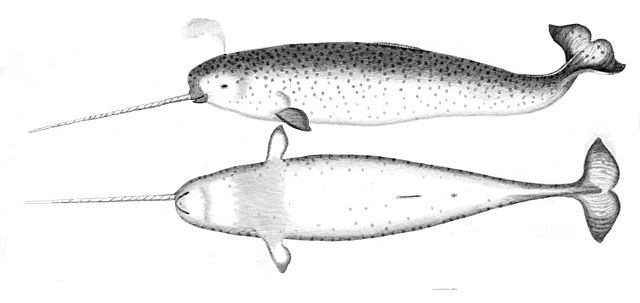
With a pleased grin, she brought the tusk over and answered all my questions, except one. The male narwhal grows a tusk, which is a type of tooth, much like an elephant tusk, but not ivory. They have no other teeth in their mouths. The tusk always grows from the left side, straight out and always twisted the same direction. The narwhal tusk may have been the inspiration for the horn of the mythical unicorn.
The one unanswered question (“We don’t know”) was “Do they ever use the tusk to break through the ice?” According to Google, that is not a behavior that’s ever been observed—nor have any of the many other speculative uses for the tusks. What is known is that the narwhal uses his tusk to detect changes in the environment, such as water temperature, salinity, and the presence of a possible meal.
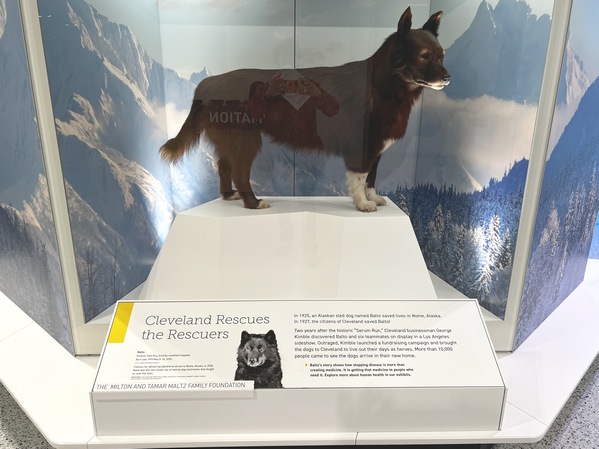
The other Alaska-related exhibit was a taxidermical mount of a sled dog named Balto. A sled-dog team including Balto, and their musher, Gunnar Kaasen, completed the final leg (53 miles) of the 1925 serum run from Nenana to Nome, Alaska. Being the ones to arrive in Nome with the desperately needed diphtheria antitoxin, they were hailed as the heroes. But there’s more to the story.
When children in Nome began experiencing sore throats in December 1924, the local doctor originally misdiagnosed them with tonsilitis. By January, it was clear that a diphtheria epidemic had begun and the local hospital’s supply of antitoxin had expired. An emergency call was put out. The nearest supply was in Anchorage.
The serum traveled to Nenana by train and from there, went 624 miles by dog sled. The relay involved 20 mushers and about 150 sled dogs. The lead musher, and owner of many of the dogs, was Leonhard Seppala. Both Kaasen and all the dogs on his team worked for Seppala. Seppala indicated that Balto was never a lead dog.

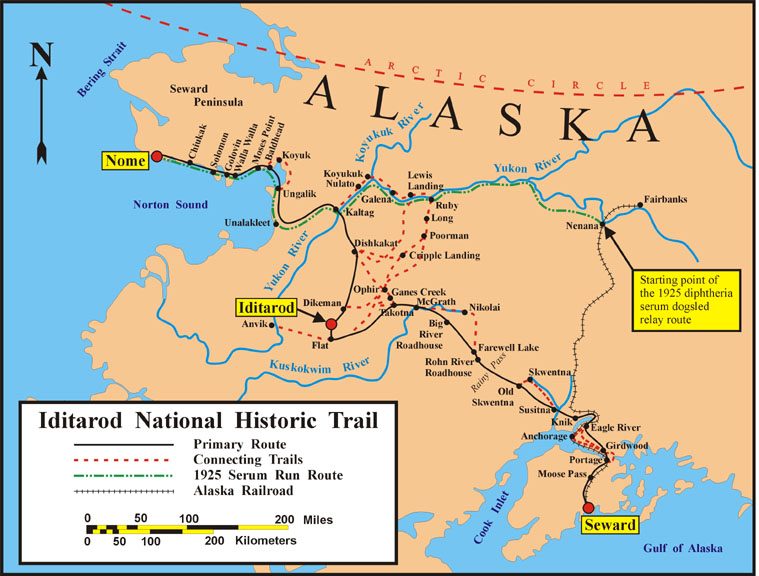
Seppala and his team, led by Togo, traveled 170 miles from Nome to meet the relay, then did a 91-mile leg that included the most treacherous terrain of the entire route. Their 261 total miles dwarfs that of any of the other teams. In reality, Seppala and Togo had rights to be known as the true heroes of the day.

A statue of Balto was erected in New York City’s Central Park in December 1925, and remains there today. What happened to the dogs themselves is another story.
Balto, who was neutered, had no use as a breeder. He and his team wound up on the vaudeville circuit. They were eventually sold and left chained up at a novelty museum in Los Angeles. There, a businessman from Cleveland, George Kimble, found them and was shocked at their condition and treatment.
Kimble arranged for the dogs to be taken to Cleveland where they received a hero’s parade and lived out their lives in a comfortable setting at the Brookside Zoo (now the Cleveland Metroparks Zoo).

Balto died in 1933, was mounted by a taxidermist, and donated to the Cleveland Museum of Natural History. Though Alaska made an effort to bring Balto back permanently, Cleveland declined to honor the state’s wishes. They did loan Balto for two exhibitions in Anchorage in 1998 and 2017.
Feature image: Display photo of Gunnar Kaasen and Balto with the Central Park statue at the Cleveland Museum of Natural History.
Sources:
https://en.wikipedia.org/wiki/1925_serum_run_to_Nome
 Myricopia
That diphtheria and dogsled chapter of history is so fascinating! So is the strange narwhal one.
LikeLiked by 1 person
It certainly wasn’t something I expected to see in a museum in Cleveland! I saw a feature film about the diphtheria story about 5 or 6 years ago at our local film festival.
LikeLiked by 1 person
For a museum that was mostly closed, you sure saw and learned a lot!
LikeLiked by 4 people
We definitely made sure to get our money’s worth.😆
LikeLiked by 3 people
Exactly my thought, Amy!
LikeLiked by 2 people
Really amazing
LikeLiked by 1 person
The exhibits were few but the variety great!
LikeLiked by 1 person
🌹🌹🌹
LikeLiked by 1 person
Happy New Year to you, your family, friends and loved ones
LikeLiked by 1 person
Thank you, and have a wonderful New Year!
LikeLiked by 1 person
Wonderful!
LikeLiked by 1 person
Who would have thought the diphtheria run (basis for Iditarod) dogs would have ended up in Cleveland! It’s always amazing what you can learn in unexpected places. Fascinating post!
LikeLiked by 1 person
I was astonished, too, especially about vaudeville.
LikeLike
Wow – sounds like an interesting museum to visit, even with most of the exhibits closed! What a relief the sled dogs were rescued…a shame they were put in a zoo, though, rather than being adopted out… Still, better than the horrendous treatment they’d received earlier…
LikeLiked by 1 person
I agree. I don’t like animals, especially domestic ones like dogs, to end up in zoos. But given their earlier treatment, they may have had some intractable personality issues.
LikeLiked by 1 person
yes, I had considered that…poor things, as likely, straight from retirement (before being mistreated), they probably could have been adopted… I too am no fan of most zoos.
LikeLiked by 1 person
It was a better life than what they had immediately prior, so that’s something, anyway.
LikeLike
What an interesting museum. Did you ever watch the Disney movie about Balto?
LikeLiked by 1 person
No, I haven’t, though it was mentioned in Wikipedia. I did see a film depicting the entire diphtheria and dog sled event.
LikeLiked by 1 person
My children loved that movie, so I’ve watched it a lot. I was so excited to see Balto on NYC by chance after that!
LikeLiked by 1 person
I’ll have to check it out!
LikeLiked by 1 person
Even thought the museum was partially closed, you were able to see – and learn – a lot! Fascinating!
LikeLiked by 1 person
With so little to see, we could pay more attention to what was there and not rush through and have few take-aways.
LikeLike
Considering the museum didn’t have much on offer, you still came away with some interesting knowledge. I didn’t know the Narwhal used the tusk to detect things. I remember watching a movie about Balto when my son was little, but I don’t remember if there was mention of another dog named Togo or the Novelty Shop tie up…the sadness of which I may have blocked.
LikeLiked by 1 person
It wouldn’t surprise me if that scene was part of the movie – adding to the pathos and drama. I plan on revisiting the museum sometime, once the renovations are done.
LikeLike
Wow. What an amazing post. I learned so much and shed tears over this: “They were eventually sold and left chained up at a novelty museum in Los Angeles.”
LikeLiked by 1 person
Truly a tragic scenario! So glad it ended better for them.
LikeLiked by 1 person
It is a story I’ve never heard about. It’s such a shame that the hero dogs weren’t treated better!
LikeLiked by 1 person
This serum run became the basis of the Iditarod dogsled race. It truly is a shame these dogs were treated so shabbily.
LikeLiked by 1 person
One of my first writer’s conferences I went to, I sat in a children’s writing session with an author who wrote about the Iditarod. I knew nothing about it until then.
LikeLiked by 1 person
There is a dog-sledding outfit near Durango and we went for a sled ride one time. It wasn’t long after my knee-replacement surgery, so not particularly comfortable, but I could tell that being a musher would be a lot of excitement.
LikeLiked by 1 person
It would be!
LikeLiked by 1 person
What a sad story about the dogs! Discarded, or as good as, when no longer useful. I’m glad they had a bit of an improvement at the end of their lives. I wonder why they decided on Balto to immortalise and not the actual leader?
LikeLiked by 1 person
I think it was probably Kaasen’s affection for Balto and the fact that they were the ones that arrived with the serum. People will just glom onto the hero that is presented to them, rather than investigate the facts. I wonder if Seppala ever felt a bit bitter over the attention his employee and second-string sled dog received.
LikeLiked by 1 person
I love the story of the diphtheria run. I hadn’t encountered it before. The lifesize rendition of Lucy was also new to me.
LikeLiked by 1 person
As I mentioned in another comment, this serum run was the inspiration behind the Iditarod dogsled race.
LikeLiked by 1 person
This was new information to me, too!
LikeLiked by 1 person
That was very interesting about Balto and his team Eilene. What an awful fate after such their heroic gesture, so I’m glad Cleveland did not permit them to return to Alaska permanently. With reference to the Andy Warhol display, today marks the official 50th anniversary of the enactment of the Endangered Species Act (ESA). I’ll bet you knocked the curator’s socks off when you asked if that was from a narwhal.
LikeLiked by 1 person
Linda, how is it that I missed the ESA anniversary connection? How awesome of you to come up with that! Yeah – why should Alaska have Balto? Good point.
LikeLiked by 1 person
Eilene – I follow the National Park Service on Twitter and yesterday they posted about the 50th anniversary of the ESA, so it was fresh in my mind. What a coincidence you showed us the Andy Warhol artwork! Alaska treated Balto and the team shabbily.
LikeLiked by 1 person
Well, I probably won’t ever be found on X or even Instagram. I’m only on FB under duress, I swear! So I do miss some things.
LikeLiked by 1 person
I am on social media, but for info, not to post every minute, like some people do. As to X, it is pretty raunchy now since Musk took over and I haven’t gone to Threads (the X alternative) yet. I follow a few meteorologists on Twitter as I am an avid walker and want up-to-the-minute weather info for walking and also for severe weather outbreaks. One meteorologist is retired, but is a climatologist. He is very interesting. I follow a lot of nature sites and park sites on FB. I joined Instagram as a fellow blogger decided to be like me and walk and take photos. She wanted a forum to showcase her photos, but not on her blog and asked me to follow her. I pop on there once a month to see what she does – there can be too much social media and I’m not interested in TikTok – I’m too old for that nonsense. 🙂
LikeLiked by 1 person
I totally get that. There are good things on social media. Just too much nonsense and ads for my time.
LikeLiked by 1 person
The nonsense is a real deal-breaker.
LikeLiked by 1 person
Wow. You saw and learned a lot for a woman who went to a mostly closed museum. Thanks for sharing!!
LikeLiked by 1 person
Making lemonade!
LikeLiked by 1 person
All things considered, you done really good in your visit!
And that tusk . . . my goodness.
LikeLiked by 1 person
It was much longer than I expected!
LikeLiked by 1 person
But you got much out of it.
LikeLiked by 1 person