
By Eilene Lyon
A Place to Start
I shop at antique marts looking for 19th and early-20th century photos. We have only one antique store in Durango, which I’ve thoroughly gleaned, so this usually happens when I travel.
I look for images that have a name inscribed somewhere on them, first/last or at least the surname. A photographer’s mark or logo is helpful. In one case, I was able to work with just a pair of first names (one actually a nickname).
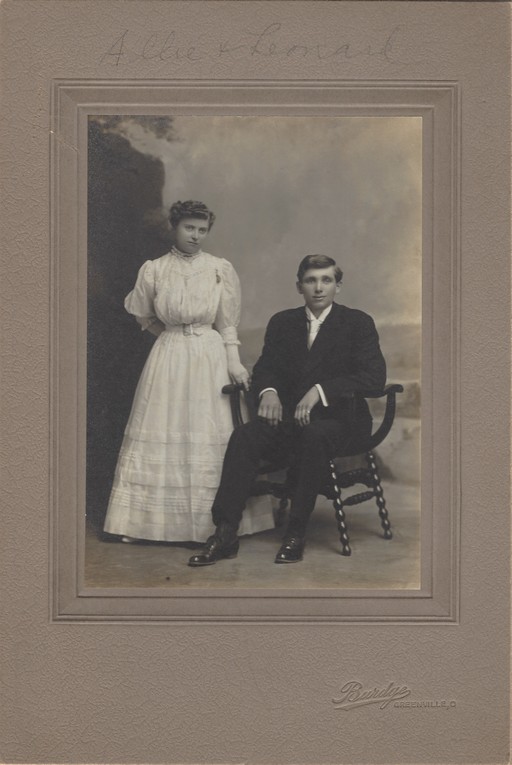
Robert Burdge opened his Darke County, Ohio, studio in 1900 and worked there until his death decades later. I estimated the portrait was taken in the first decade of the 1900s and that the subjects were born about 1885. Sometimes I’m uncannily correct. Both Allie and Leonard were born in 1885. (Collection of the author)
One time, I had no name at all, but the portrait was unusual, not a studio pose. This enabled me to identify the person with just a photographer’s mark and clues from the image.
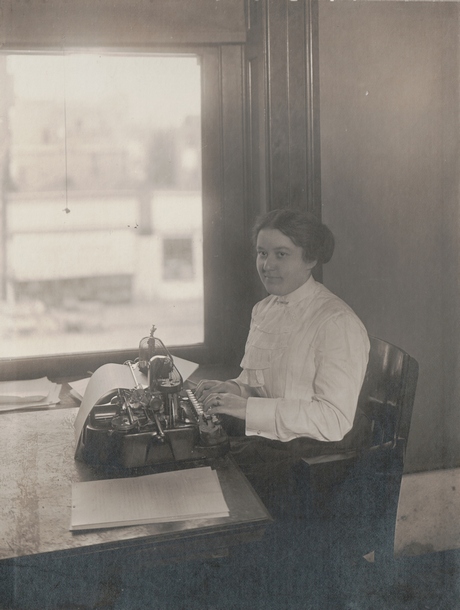
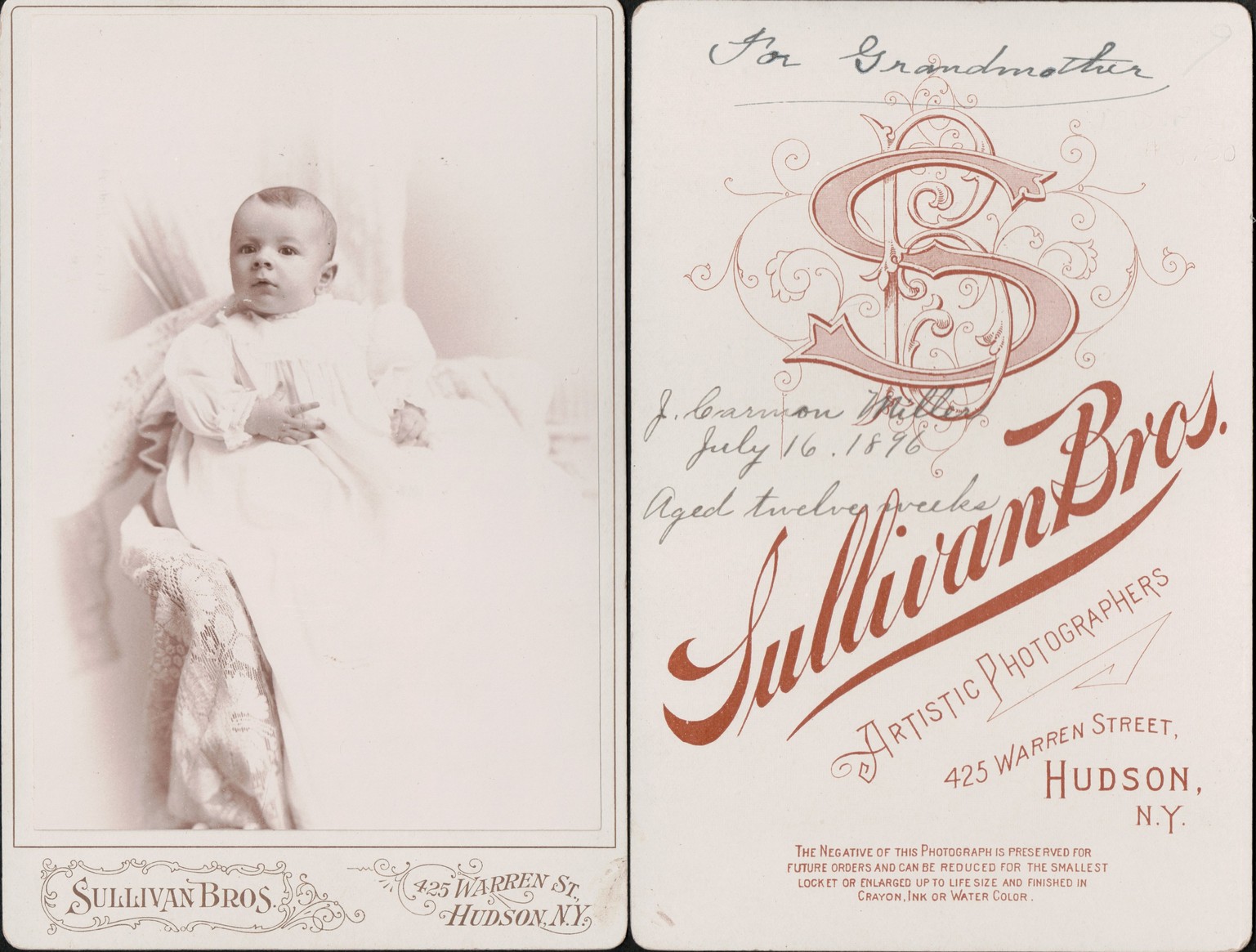
Having a full name, and maybe a date, inscribed somewhere on the image usually ensures success. Often photos of children will include their birth date and/or age. My ultimate goal is to reunite the photo with family. I also share the images in the public domain (one reason I work with older photos).
Ancestry and Find A Grave
I have a public tree on Ancestry called “Found Photos Family Tree.” It’s actually a series of small, disconnected trees, one for each photo I research. I post the image there, making it accessible to Ancestry users. If the photo subject has a Find A Grave memorial, I post it there as well.
If there is no date, I research the studio to find out when it operated, narrowing the time frame. The location of the studio also gives me a place to begin searching for my subject.
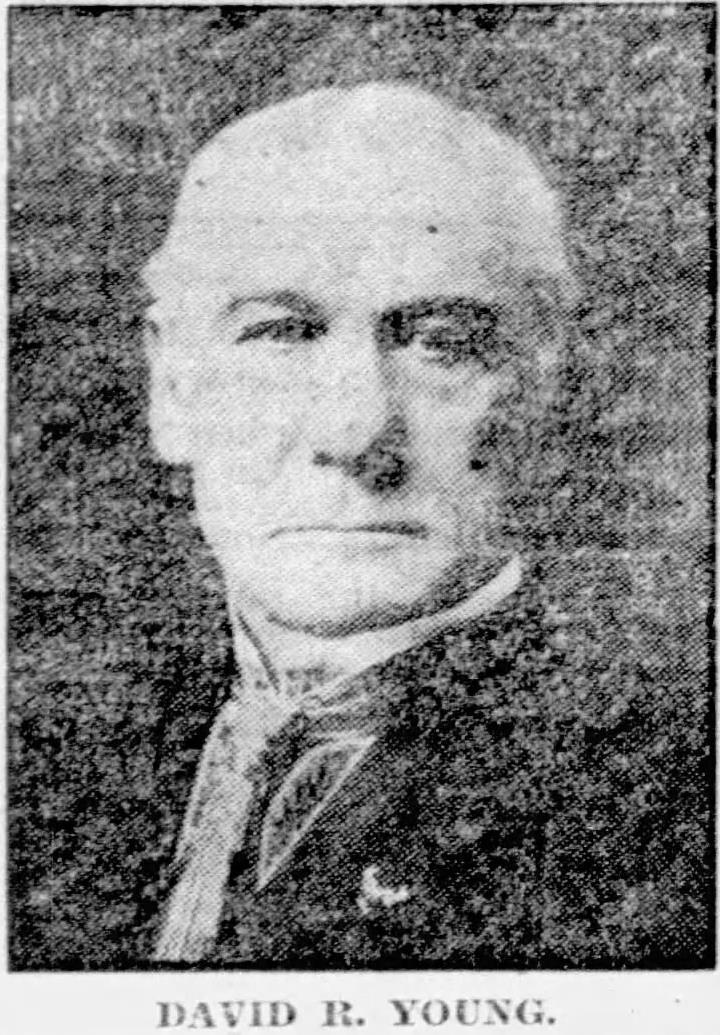
In the case of David R. Young, the photo was dated in February 1896. The photographer, Arthur Glines, was located in Boston, Mass. I gauged that David was about mid-40s when the portrait was done, giving an estimated birth year around 1851.

My search for David in Boston turned up only a Black man, who was too young. David never did live in Boston, it turns out, so I had to widen my search. Looking at family trees turned up a David R. Young born in 1850 in New York, who died in 1918 in Connecticut. This ultimately proved to be the man I was seeking, but I could not yet confirm it.

The loopy handwriting, fancy apparel, and his inscription to his mother, calling himself her “big boy,” led me to suspect he never married. That turned out not to be the case—he had three wives!
But I found a possibility in Find A Grave: David R. Young, born 1856 and died 1930 in Los Angeles. Neither he nor his two sisters married and all three share a vault with their parents. The L.A. location made me wonder if he might have been an actor. But why inscribe a photo just to his mother and not both parents who were still living in 1896?
Newspaper Research
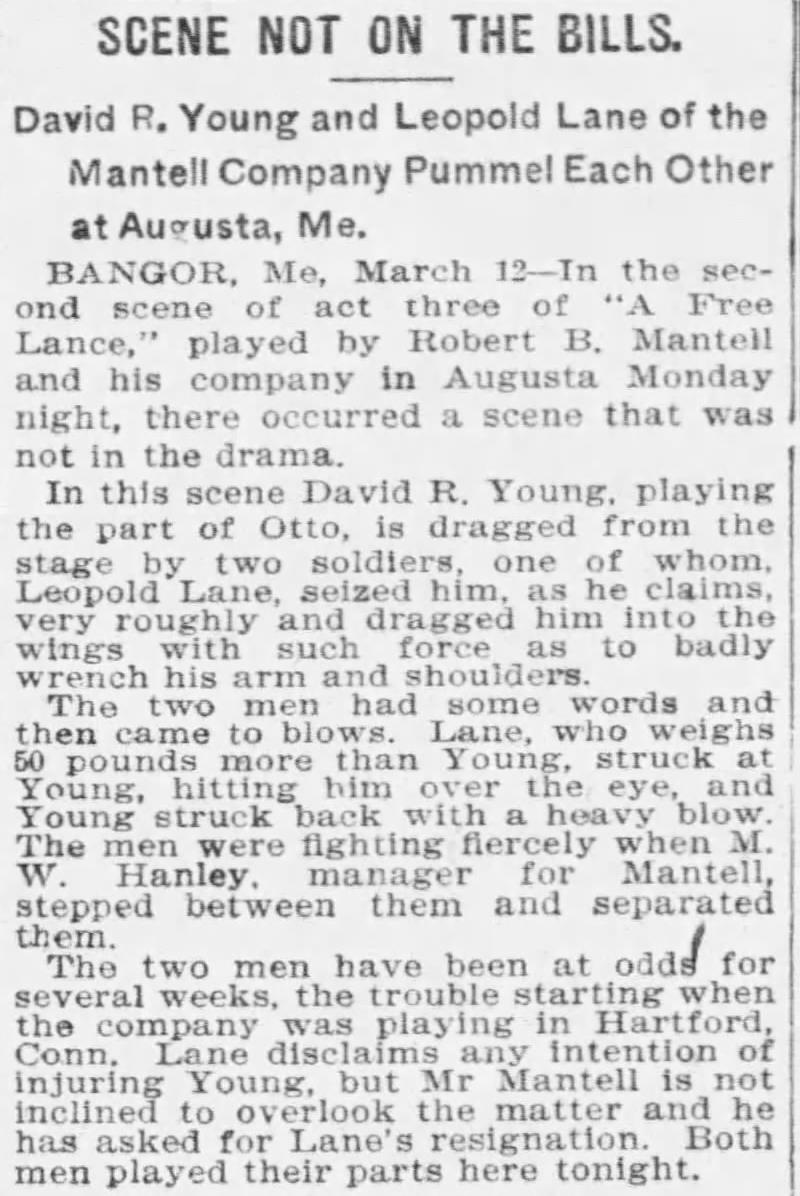
Searching for David R. Young in the 1890s in California and in three east coast states (New York, Connecticut, Massachusetts), did turn up stories about an actor by that name in all four places. But was the one in the California papers the same as the one back east? Given that the east coast man was absent from eastern news during the period he showed up in California, I concluded there was just one actor by that name.
When I plan on writing a blog for a particular photograph, I will do an in-depth newspaper search to develop a life story.
Finalizing the Identity
Going back to David R. Young (1850-1918), I followed all the leads from Ancestry, including his Find A Grave memorial, which had a photo of David taken not long before his death. From that, though weak evidence, I was convinced I had the right man.
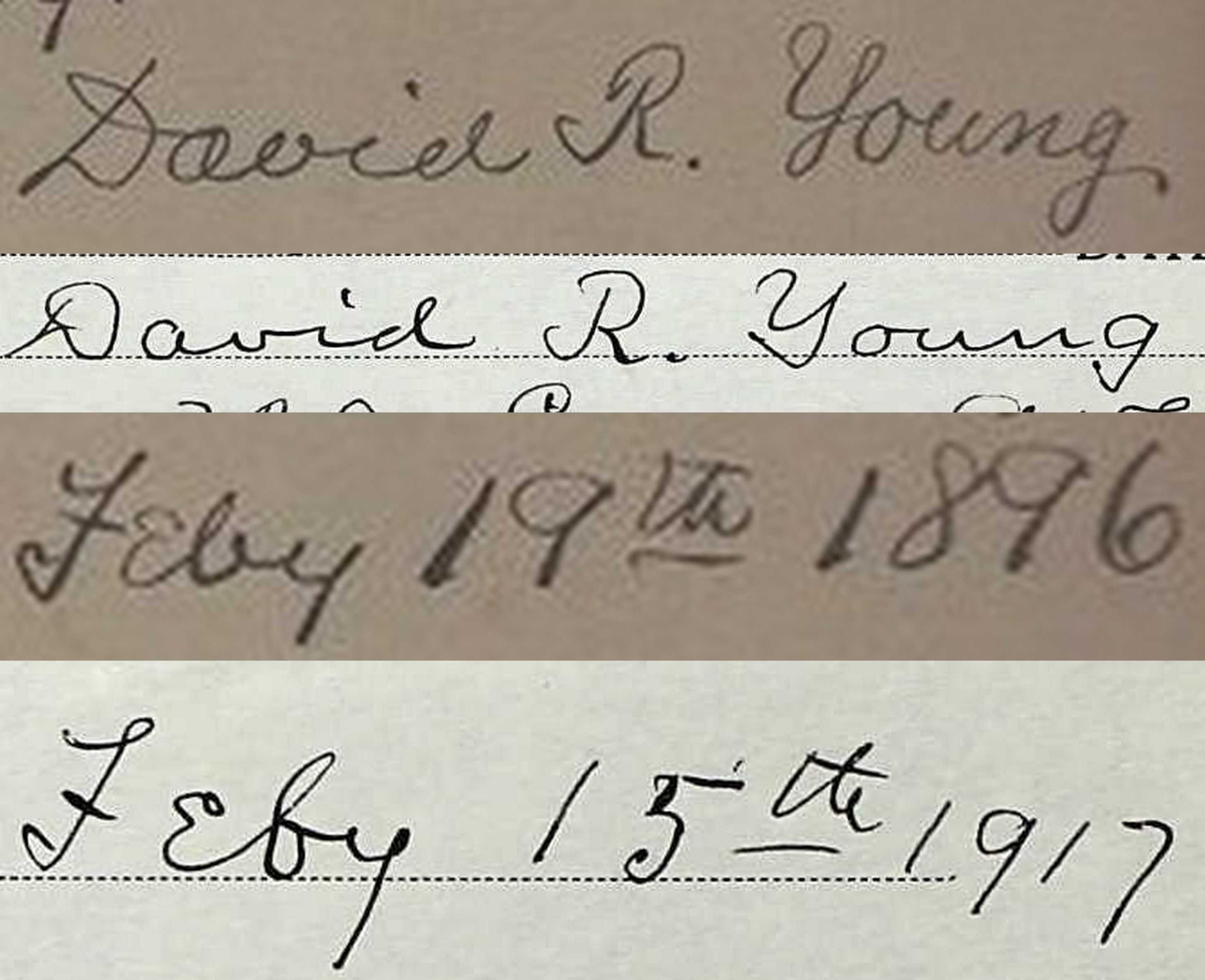
The key document proved to come from World War I. Connecticut conducted a “Military Census” in 1917–1918. According to Ancestry it was done “at the direction of the General Assembly with an eye to assessing manpower available for war and other resources in the state.”
All men over age 15 filled out the form which asked the usual questions found on such a census, but also had many particular questions regarding skills: Can you ride a horse? Drive an automobile? Handle a boat? Experienced with steam engines? Can you swim? Operate a wireless?
David filled out the form himself. Though it was 21 years later than the Boston portrait, his handwriting had changed just slightly. You can see for yourself, particularly with the date, that I had my proof.
Finding Family
My search for family is usually confined to Ancestry users who are related to my subjects. I find them by looking at family trees in my hints. I click to see that person’s page for each tree. Then I follow these steps for each:
- Click on the Tools at top right and select “View in Tree.”
- Make sure the tree is in Horizontal mode.
- Click on the “Home Person” icon (which is often the tree owner, but not always).
- View the home person’s ancestors, looking for the family name in question. If it isn’t there, I also check their spouse’s ancestry.
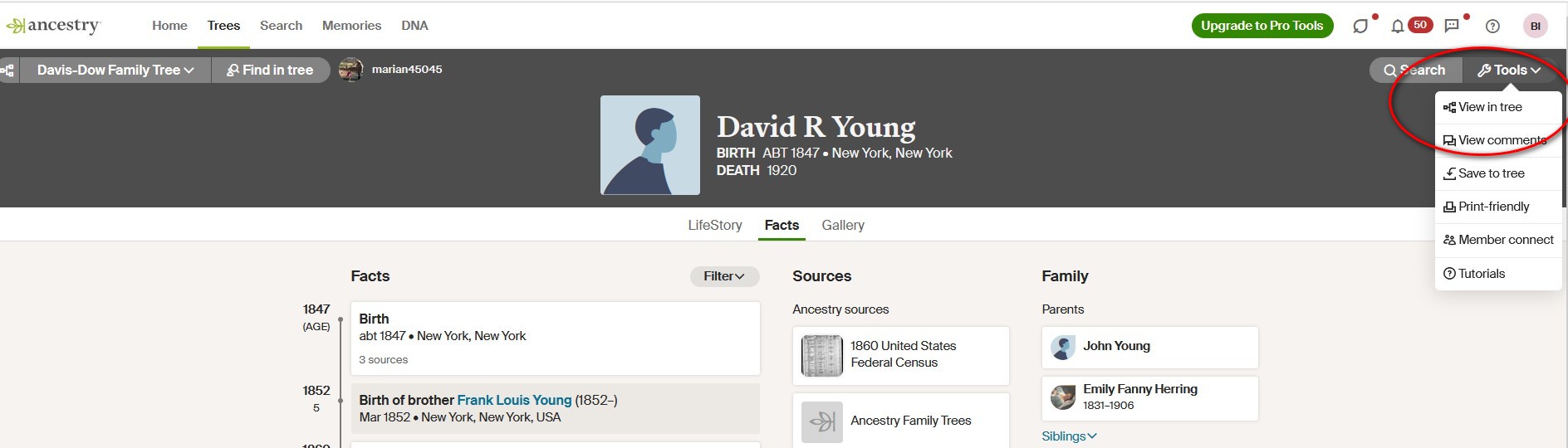
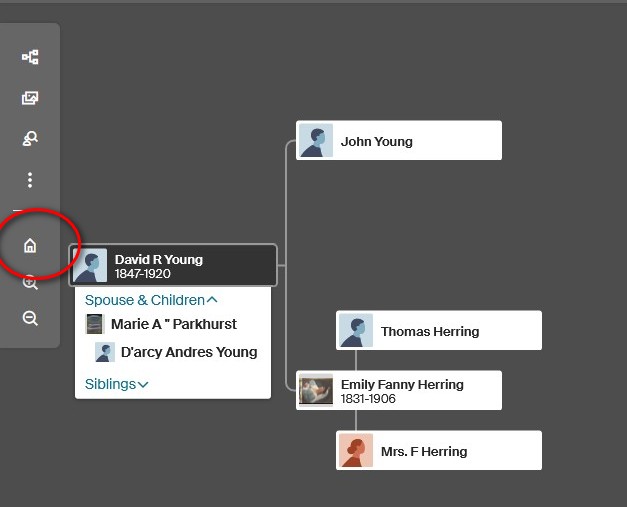
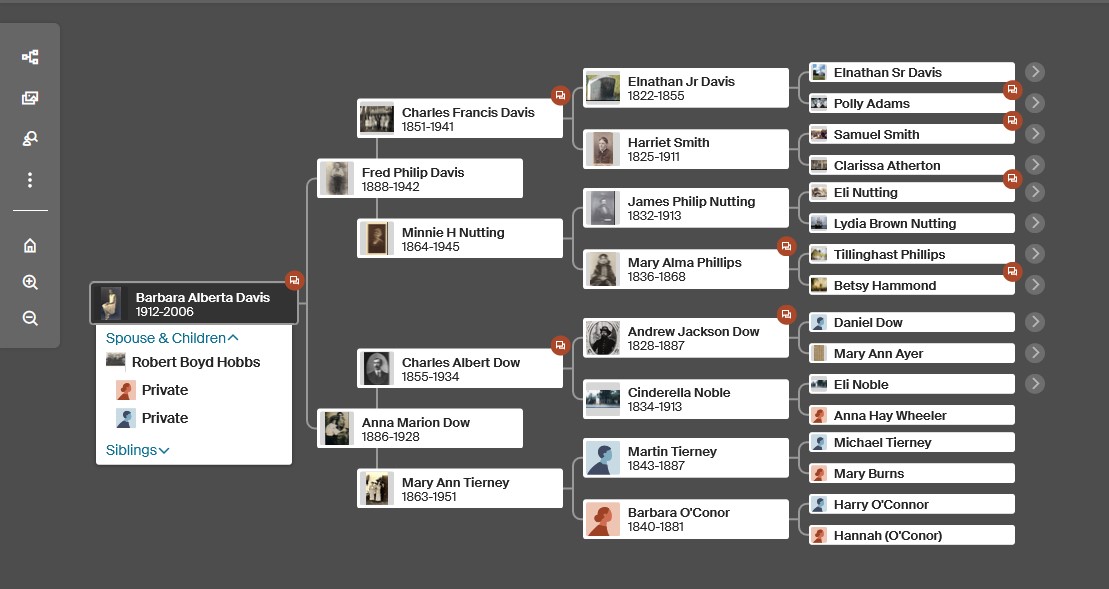
In this way, I often find a descendant on at least one tree. Then I send a message. Unfortunately, many messages go unanswered. After a time has passed, I’ll try another descendant. Sometimes I wind up going to a tangential relative, typically a descendant of a subject’s sibling.
I sometimes reach a dead end: no living descendants for the subject or for their siblings. In that case, my blog, Ancestry, and Find A Grave become the only way to memorialize these people.
On the other hand, I’ve communicated with people who are extremely grateful to have their “lost” family photos. I have shipped them to California, Idaho, Indiana, Virginia, and Ontario. Often, the recipients have never seen them, or any photo of the person pictured. It does warm my heart!
Feature image: Front and back of carte de visite of Anna (Stock) Krug, circa 1890. Though Anna had grandchildren, I’ve not yet found a living descendant. The notation “To Sarah” suggests she gave this to her sister. (Collection of the author)
 Myricopia
Thanks for explaining your process. I know you’ve done some amazing research about the details of people in the found photos. I have one particular photo, found in a box with family photos but is not family, that I’d like to know more about. Good to have places to start.
LikeLiked by 2 people
Any name on it? Idea of where it was taken?
LikeLiked by 1 person
Yes I know the name and it shows where it was taken, but no idea when it was taken– or why someone in my family saved it. 🤔
LikeLiked by 1 person
Hmm. A mystery to be solved. How fun!
LikeLiked by 1 person
There is a lot of work in your process. I can see how it would be very satisfying when you find a relative.
LikeLiked by 2 people
I suppose I shouldn’t be surprised when there are no descendants – probably why the photo wound up in a shop to begin with. But usually there is someone.
LikeLiked by 1 person
I suppose sometimes the line just stops.
LikeLiked by 1 person
More often than you’d think.
LikeLiked by 1 person
Eilene I am so impressed with your thorough detective work. Clearly you have a huge interest and ability to dig for answers. Was it your interest in your own family history that led to the found images or have you always been a sleuth? Police departments would welcome your skills.
LikeLiked by 1 person
Funny you should mention the police. My first degree was in law enforcement. I always like detective work. Research is a passion for me.
LikeLike
I am not surprised at all 🙂 It’s clear just how impressive your skills are.
LikeLiked by 1 person
Thank you, Deb.
LikeLiked by 1 person
Thank you for providing this in-depth explanation of your research process for abandoned family photos. I found it fascinating!
LikeLiked by 2 people
It’s different for every one, but this is a general outline of the process.
LikeLiked by 1 person
What a cool hobby!
LikeLiked by 1 person
I haven’t tired of it anyway!
LikeLiked by 1 person
I’m impressed to learn about your process. I’ve wondered how you could get histories from photos.
LikeLiked by 1 person
Identifying the person isn’t usually too challenging. David Young was trickier because of being a common name.
LikeLiked by 1 person
It seems like very intense work. But I enjoy seeing your results.
LikeLike
Hi Eileen, I find your process and desire quite interesting. There was a time in my life I found myself on Find A Grave because I wanted to learn more about my birth father. I only had a little bit of known information.
Perhaps you will find the descendants of your photo subjects. It’s possible!
LikeLiked by 1 person
Thank you. I’m sure if there are any, I will indeed locate them — or they will locate me!
LikeLike
You deal in forensics, Eilene. It’s remarkable how you can pick up a trail like that and piece it all together.
LikeLiked by 1 person
It is forensics, Marc! It’s no wonder that investigations are so popular on TV. I should start a show on YouTube!😉
LikeLiked by 1 person
Seriously. YouTube episodes on genealogical forensics.
LikeLiked by 1 person
It could happen!
LikeLiked by 1 person
Yes!
LikeLiked by 1 person
😊
LikeLiked by 1 person
That is an amazing and laborious process you use to track down the origin of photos Eileen. How rewarding to connect a photo to a relative, especially when they never knew it existed. I enjoyed the first post on David R. Young and this post where you delved into more intricacies, especially the handwriting analysis was even more interesting!
LikeLiked by 1 person
It’s a rather rewarding hobby, Linda. Even better than asparagus from my garden—maybe! Glad you found this all of interest. David struck me as a particularly lucky find. I don’t usually find “celebrities.”
LikeLike
Rewarding hobbies are the best ways to occupy our time Eilene. I am glad for blogging and interacting with all of you and I do often wonder what would have occupied my time … probably reading more. David was a lucky find and garnered a post all his own plus this one about what you discovered.
LikeLiked by 1 person
I suppose I would read more, too. But blogging and interacting with others via blogs is so rewarding!
LikeLiked by 1 person
Yes blogging is fun and rewarding too. I will never give it up.
LikeLiked by 1 person
Good for you!
LikeLiked by 1 person
Eilene – I think you may enjoy this news story … a little tie to David as well:
LikeLiked by 1 person
I did wonder about any connection to David there for a while! DNA has so many surprises.
LikeLike
I should have clued you in as to what point in the video pertained to David. 🙂 Yes a lot of surprises and this story of a man doggedly pursuing his roots reminded me of your research. He was in for quite a surprise!
LikeLiked by 1 person
I felt bad for his mom—completely in the dark.
LikeLiked by 1 person
Yes, I did too Eilene.
LikeLiked by 1 person
This is fascinating to me. As you know, I am now writing about an album of photos from the 1860s and 1870s, almost all of which had no names attached. How I wish….
LikeLiked by 1 person
Someone left me an album of that era, too, also mostly unlabeled. It’s a frustrating project. People used carte de visite pictures as calling cards and they were put into albums, so they aren’t necessarily related to the album owner. It includes pictures of soldiers, a few who were high ranking and well known. It’s an odd assortment.
LikeLike
exactly! When I first agreed to buy the album, I had no idea it would be filled with pictures of people who might not even be related to my ancestors. It’s been quite a learning experience.
LikeLiked by 1 person
It really becomes a FAN club project. Tough to find the time for it — especially since I’m not related to anyone in the album at all. I tried to get a historical society to take it, and they expressed interest, but never did commit. I suppose I could just ship it to them. It’s a cool artifact, though.
LikeLiked by 1 person
What a kind gift, Eilene. Your tenacity, dedication and ancestry skills are impressive.
LikeLiked by 1 person
Thank you, Jet. It gives me great pleasure to do this sort of thing.
LikeLiked by 1 person