
By Eilene Lyon
My Colorado home experiences exquisite sunrises and sunsets on a regular basis. It takes only a few clouds to add rich hues to our morning and evening skies. Whenever I find startlingly deep cyan set off with billowing cumulous clouds in a vibrant pink-orange glow, I’ve taken to calling them “Maxfield Parrish Skies.” Though it may be some of his many imitators I’m calling to mind.
I found this book about Parrish in the local antique store for $12, so now I have a small representative sample of his work. (It isn’t an antique, of course, having been published in 1999.) The Cutlers have included many lesser known works, in addition to his best known, best-selling art print, “Daybreak” (1922).
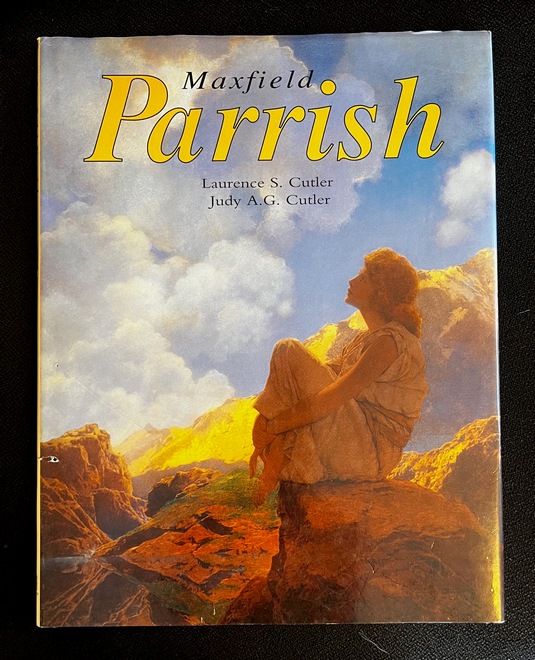
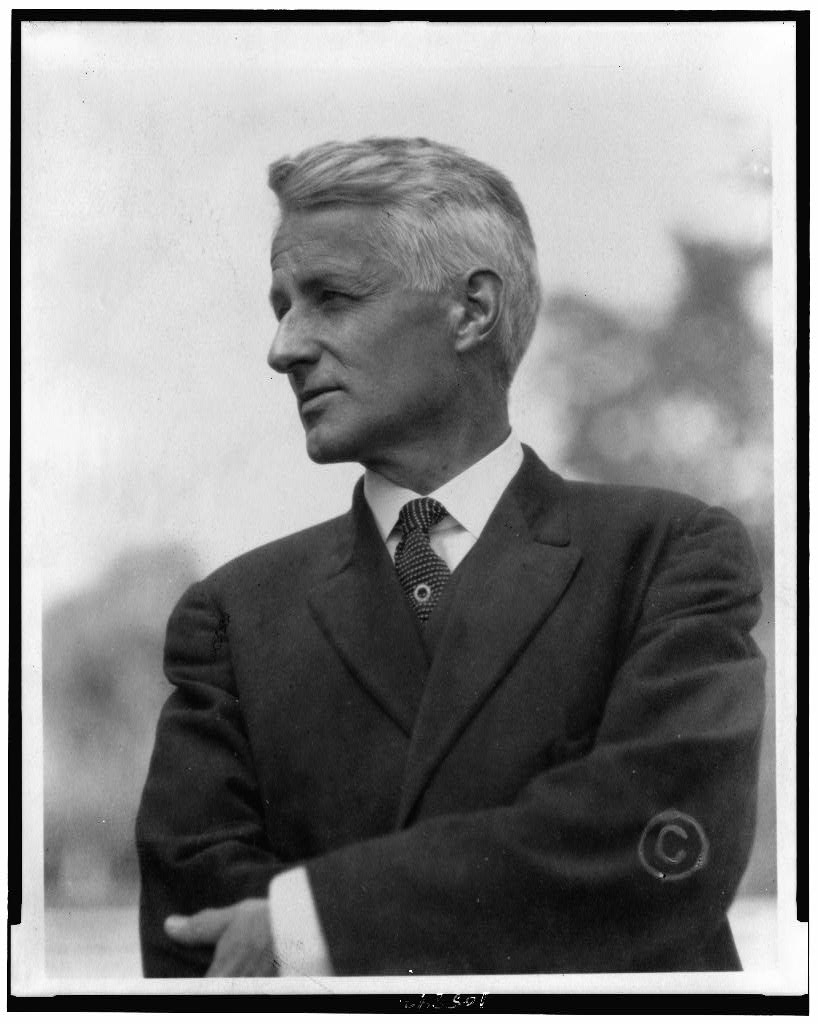
Maxfield Parrish was born Frederick Maxfield Parrish, to an anomalous Quaker artist, Stephen M. Parrish and Elizabeth Bancroft, in 1870. (Quakers generally frowned on art as a career.) Fred began learning his artistic skills from his father at an early age, and took to emulating Stephen in nearly every respect. Stephen appropriated his mother’s maiden name of Maxfield as his middle name, though born without one. Fred eventually dropped his first name entirely at age 24.
Maxfield Parrish spent two years in Europe with his parents, observing the old masters. He studied architecture at Haverford College, but dropped out. He opted to become an illustrator, rather than attempting to make a living in the rarified air of fine arts. But his drafting and painting skills elevated him far above the rank and file of illustrators.
His most prolific years were 1894–1925. He started out with commissions for posters and product advertising, then went on to book illustrations. The first of these was L. Frank Baum’s Mother Goose in Prose. He produced art for the country’s most popular magazine of the time, Century, for nearly two decades.
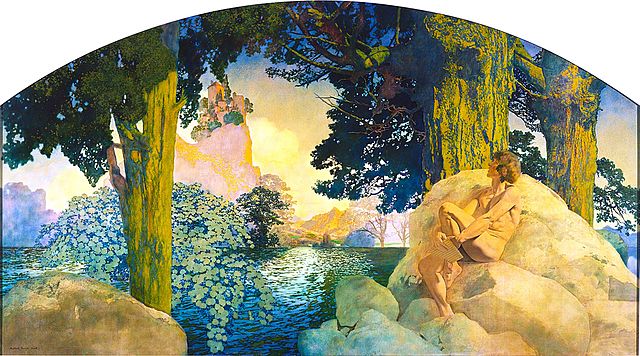
Parrish’s style was painstaking. It involved building up layers of color and varnish–up to 60 layers in total. He often used photographs in place of sketches, and he had his models dressed in dreamy, period costumes. The results were luminous fantasies.
Unlike many fine artists whose output numbered in the thousands of canvases, Parrish completed just 850 works. Many of them were on wood paneling, and therefore more prone to deterioration. Some of his works no longer exist.
Parrish was one of the earliest artists to develop contracts that gave his customers one-time-use permission for his illustrations. It greatly enhanced his earnings. As he put it, “I sell it four times!…for a greeting card, then a calendar, and next an art print, and then finally I sell the painting.”
Though “Daybreak” was his best seller, Parrish’s finest work is considered to be an 18-panel piece called “Florentine Fete” (1913), with each panel over 10 ft. high. The work was commissioned by the Curtis Publishing Co. for the girls’ dining room in Philadelphia. Several of them are reproduced in this book.
Parrish painted until arthritis became debilitating at age 90. He died in 1966 at age 95, survived by four children (by his wife, Lydia Austin), and his partner, Susan Lewin.

Maxfield Parish at Find a Grave
Source:
Cutler, Laurence S. and Judy A.G. Cutler. Maxfield Parrish. New York: Gramercy Books/Random House Value Publishing, Inc., 1999.


My father was a big fan of Maxfield Parrish and introduced me to his work when I was growing up. I love it also.
LikeLiked by 1 person
His illustrations for children’s books are fantastic. I was really impressed with the Florentine works, which I’d never seen before.
LikeLiked by 1 person
Well now I know who to thank for these amazing paintings! I will always prefer the real thing that nature provides however and your photos are amazing Eilene!
LikeLiked by 1 person
Than you, Deb! I do love our sky views here. I did not alter these images in any way (sometimes I fiddle with contrast and saturation).
LikeLike
Wow – thanks so much for sharing this mini-bio… I’m somewhat familiar with Parrish’s work, but knew nothing about him personally. His work is gorgeous and so distinctive.
LikeLiked by 1 person
He really produces very original work. I also knew nothing about him until reading this book.
LikeLike
I hadn’t heard of Maxfield Parrish, but maybe I have seen his work in books. I can see why you have named your skies after him!
LikeLiked by 1 person
I think he had a big influence on popular art for a long time. I expect that Thomas Kincaid modeled his career after Parrish’s.
LikeLiked by 1 person
I didn’t know this artist so thanks for introducing him. You’re skies are wonderful.
LikeLiked by 1 person
In the 1920s, he was the most widely known artist in America, thanks to his art prints.
LikeLiked by 1 person
My sister majored in art. Parrish was a favorite of hers.
LikeLiked by 1 person
He was talented and unique – also astute in business. But then, he grew up in a life of privilege.
LikeLiked by 1 person
I LOVE Parrish’s work, particularly how he depicts light. I have a print of one of his paintings on my bedroom dresser.
LikeLiked by 1 person
I’m going to look for a print of his for my collection, too.
LikeLiked by 1 person
I love Maxfield Parrish’s work and I remember once driving down from Big Bear Lake in the evening when we stopped to watch the Parrish sky. I enjoyed learning more about him from your post.
LikeLiked by 1 person
He was quite the romantic painter!
LikeLiked by 1 person
Thanks for sharing his story. I’ve heard his name but can’t place the context. It’s sad to think that some of his work didn’t survive the years.
LikeLiked by 1 person
Makes the remainder that much more valuable!
LikeLiked by 1 person
True!!
LikeLiked by 1 person
One evening a few years ago, I looked out our window and commented to my husband that the sky looked like a Maxfield Parrish painting. I still have the picture I took on my phone.
LikeLiked by 1 person
He has managed to impact the imaginations of many generations! That’s quite a legacy.
LikeLike
That is an amazing sky Eilene. I had not heard of Maxfield Parrish, but I was impressed all the layers of paint that might go into each creation – how painstaking and he still churned out 850 paintings!
LikeLiked by 1 person
It is still an impressive body of work, indeed. And he painted for a very long time.
LikeLiked by 1 person
I’m not familiar with this artist but find his work compelling. He had a long career and dare I mention, Maxfield Parrish is very handsome.
LikeLiked by 1 person
He did have celebrity good looks—always a plus. That’s why I was astonished that this biography didn’t have a single image of him in it!
LikeLiked by 1 person
I enjoyed this look at the talented Maxfield Parrish, Eilene. And your skies do look like his paintings.
LikeLiked by 1 person
Thanks for stopping by, Jet!
LikeLiked by 1 person
I LOVE HIM!!! A former beau of mine introduced me to his amazing artwork. I’ve been his ardent admirer ever since.
I had no idea the famous painting of Old King Cole in the bar of the same name at the iconic St. Regis Hotel that John Jacob Astor owned till he went down on the Titanic, was by Mr. Parrish. His son took over all his father’s businesses and it’s been hanging over the bar ever since.
They did have a copy hanging for a little while, while it was being cleaned and restored, but Maxfield I’m betting wherever he is, is pleased smiling down from the ether.
Here’s to the best 12 bucks you ever spent Madam.
Thanks for sharing it with me. 🙂
LikeLiked by 1 person
He did a lot of illustrations for fairy tales and the like. I’m not familiar with the painting of Old King Cole or the bar. One of those things I will probably never see! I’m glad you enjoyed the piece, and you’re absolutely right about the twelve bucks.
LikeLiked by 1 person