
This piece was one of my first efforts for the 52 Ancestors in 52 Weeks program by Amy Johnson Crow. I completed three full years and did a smattering for a fourth year. Now I’m just randomly doing my family history posts among other topic. Originally published January 27, 2018. EL
Week 4: #52Ancestors – Invitation to Dinner
By Eilene Lyon
“Which of your ancestors would you like to invite to dinner?” asked Amy Johnson Crow. I’d like to turn that around and be the one invited to dinner by my ancestors. Specifically, the Springers in Heidelsheim, Germany, in 1853.
That would be the year before they emigrated to the United States. Of course, this magical invitation to a dinner in Germany in the 19th century would also impart to me the gift of fluent German, something I do not currently possess. Though I did manage to drum a smattering of the language into my head prior to our trip there in 2014, it’s all faded away now – danke.
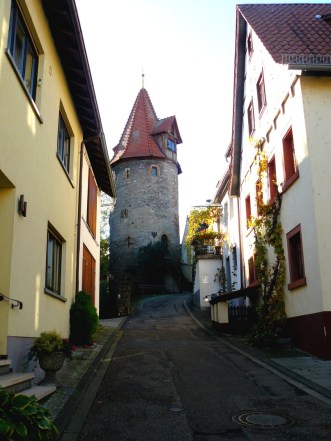
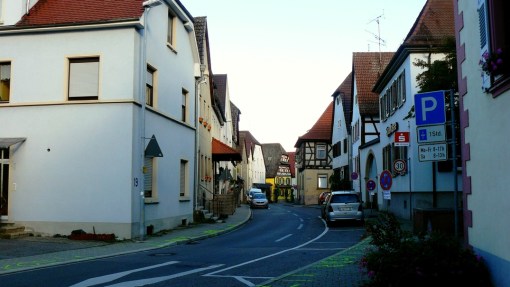
A street in Heidelsheim
I would want to know the reasons behind their decision to come to America. We generally look to larger macro-economic and political events in the countries our ancestors came from, but certainly there was more to the story. Why didn’t they leave in 1848, when political upheaval across Europe was at its height?
I would also like a better understanding of their religious affiliation. The Springer family births, marriages, and deaths are found in Catholic records for Heidelsheim. But in America, the family attended the Lutheran Church and are buried in a Lutheran Cemetery. Were they forced to assimilate in the Catholic Church in Germany? Or did they prefer the Lutheran Church in America, because the local congregation held services in their native tongue?
Mostly, though, I just want to know what their daily life was like: what did they eat, were they farmers or tradesmen, were they involved with civic matters, with whom did they associate, what sort of things did they celebrate and how?
Food. Especially the food. My DNA reveals that I am roughly 79% German, despite my centuries of family history in America. And I LOVE German food. I love Germany, in fact. I’ve been there twice now and hope to return many more times.
I had the pleasure of visiting Heidelsheim, now a suburb of Bruchsal, near Karlsruhe. And no, I can’t properly pronounce any of those names. When I tried it out, no one had a clue what I was saying.
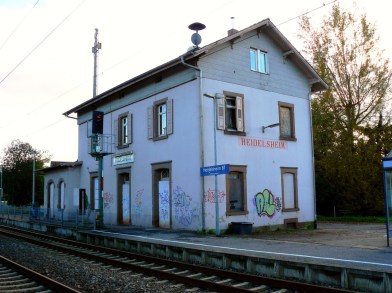
We had to get on a local commuter train in Bruchsal to get to Heidelsheim and despite our general success with understanding the transportation system, we never could figure out how to pay our fare on this local line. So we took our chances. I’m sure a foreigner pleading ignorance in such an out-of-the-way place for a tourist would be granted some slack.
(By the way, Bruchsal has some wonderful things to see if you’re a tourist).
Naturally, we got off at the wrong stop and had to get back on the next train. Having no place to leave our luggage, we rolled our suitcases all over the village. I tried asking some high school girls at the train stop if there was a place to stay in town. They mostly stared at us and giggled, but eventually one of them was able to communicate to me that we would have to go back to Bruchsal. So we did that, found a room, then returned to Heidelsheim to explore a bit more.
In trying to find family graves, I learned that cemeteries in Europe aren’t necessarily like in America. Graves are essentially leased and I think they stack the coffins. Only the current leaseholder can place a stone on the grave. So, looking for your ancestors’ burial is probably a waste of time.
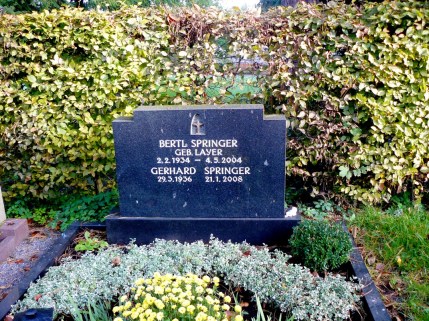
A 20th-century Springer grave in Bruchsal
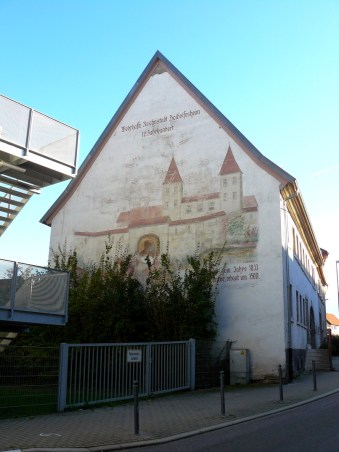
But we did enjoy exploring the old part of the village. A young girl was the only local who took particular notice of us and she showed us a plaque on the outside of her apartment building. There was actually a walking tour designed to showcase the historic locations in town.

Once we returned home, I did a little more digging on the internet and learned that the large stone church in town had an odd history. It is currently a protestant church, but was originally Catholic. During part of its history, it was used by both denominations simultaneously. It was not in use by anyone when we were there, awaiting some restoration work.

I also learned that the town hosts an “Imperial City” festival in odd numbered years. When I return, I want to go there for the festival. It looks like a lot of fun! Maybe not quite the same as dining with my ancestors, but a nice, realistic substitute.
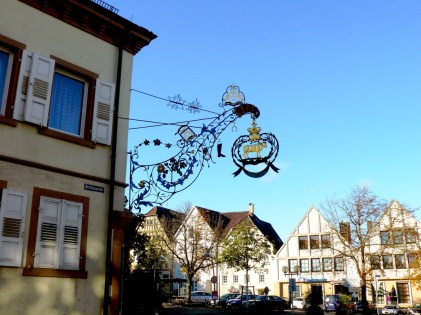
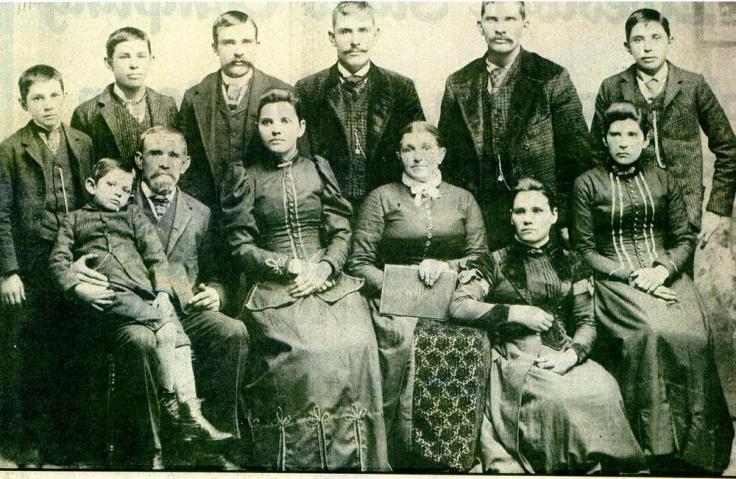
Feature photo: Charles Springer, seated on left, emigrated to America from Heidelsheim, Germany, when he was 22, along with his mother, sister, and two other Springers (relationship unknown). He married Margaret Delle (seated, center), of Kastel Mainz, Germany, in Wisconsin in 1861. They had many children and eventually moved to Codington County, South Dakota. Charles and Margaret are my 3rd great-grandparents.


I feel the same way Eilene. I would so much prefer to go back to visit the places and people as they were. I have a female tribal chief in my history who would be first on my list. Originally known as the Ho-chunk people the more modern name is the Winnebago tribe- originally found in Wisconsin but relocated a few times. My great x ????? grandmother, Glory of the Morning, was/is still one of the only full chiefs of a First Peoples tribe.
LikeLiked by 2 people
That’s a very interesting family background, Deb. I’d love to rad more about her! I think it might be embarrassing to show my 3rd great-grandparents our modern society. Everyone staring at their phones, for example. I’m sure they’d be fascinated by some things, though!
LikeLiked by 2 people
I sort of think the same Eilene, just how amazed our ancestors would be to see what 2024 is like…how many would embrace the changes, and who would scoff at everything 🙂
From my meager online wandering I believe there are 1 or 2 historical books written about the tribe and of course there are bits and pieces around Google about Glory of the Morning. One of these days I will get around to buying and reading what lies within the books 🙂
LikeLiked by 1 person
Reminds me of a fun movie, “Lost in Austen” where a modern young woman (big Jane Austen fan) switches places with Elizabeth Barrett of the book. Elizabeth loves the modern world and has no intention of going back to the (fictional) past.
LikeLiked by 1 person
That movie sounds very familiar. It may have been on one of my to be watched lists. I’ll have to recheck 🙂
LikeLiked by 1 person
I’ve watched it a couple times — I enjoyed it so much.
LikeLiked by 1 person
The shared cemetery plots. hmmm
LikeLiked by 1 person
It’s certainly different!
LikeLiked by 1 person
I enjoyed this interesting take on ancestors and your spirited visit to Germany, Eilene. Very interesting about the European graves, too.
LikeLiked by 1 person
Thank you, Jet. I hope to spend more time enjoying Germany someday and seeing more of my ancestral hometowns.
LikeLiked by 1 person
It would be so interesting to go back and be a fly on the wall. My father was the first to emigrate in his family – so not much intrigue there. My husband’s family came over from Oersta Norway in 1882. We have visited but still the questions remain.
LikeLiked by 1 person
And where did your father come from? My most recent immigrant ancestor was a 2nd great-grandmother, so they’re all a mystery to me.
LikeLiked by 1 person
My father came from England after WWII. He was a commando in the Royal British Navy and stayed on as Merchant Marine after, living in various places around the world before settling in Canada.
LikeLiked by 1 person
Do you have family in England then?
LikeLiked by 1 person
Yes. England, Scotland, and Wales. Plus my former husband was from England. I haven’t been back for 35 years though.
LikeLiked by 1 person
Time for them to visit you, then!
LikeLiked by 1 person
Oh yes. We have had many visitors over the years.
LikeLiked by 1 person
😊
LikeLike
I greatly enjoyed how you wrote this post. All these questions you raised about the Springers are my kind of genealogy.
LikeLiked by 1 person
Thank you, Liz. There are always more questions than answers, of course.
LikeLiked by 1 person
You’re welcome. Of course!
LikeLiked by 1 person
I was fascinated with your journey. There is lots of strong family resemblance between the men in the back row. Are they twins or brothers?
LikeLiked by 1 person
Thanks, E.A. They are all siblings plus the parents. No twins.
LikeLiked by 1 person
Great post, Eilene. Have you really been doing one post a week on ancestors for more than 3 years?!! I’m gobsmacked. 52 weeks will do it for me, but I agree that being able to go back in time and experience what our ancestors experienced would be amazing.
LikeLiked by 1 person
I did do that for three years from 2018 to 2020. I stared out the blog rather gung-ho. I think I did close to 20 posts the first month! Now I strive to do 3 or 4 per month.
LikeLiked by 1 person
I love the idea of traveling across time and place to meet family! To be immersed in their daily life and hear their story would be such a gift.
In Marietta, the Lutheran Church was extremely important to the German migrants who were largely responsible for building the town that we know today because that church was friendly to them and held services in their native tongue. I don’t know that the other churches were unfriendly to these newcomers but I get the impression the Lutheran church was built by and for this particular group. So the switch may have been as simple as wanting to worship among friends.
Also, the shared cemetery plot….. that’s truly odd.
LikeLiked by 1 person
Thanks for sharing the insight into the churches, Brandi. I think in some European countries, good land is at a premium, so they try to use as little as possible for burials. Just a guess.
LikeLiked by 1 person
That makes sense!
LikeLiked by 1 person
I can completely relate to the idea of going back in time to see how and where my ancestors lived. If only time travel was real…
LikeLiked by 1 person
The impossible dream…
LikeLike
I really only learned about my maternal ancestors through my mom and grandmother going through the photo albums with me, but you Eilene have gone the extra mile and been rewarded with a lot of information for your efforts. I like the last photo in its sepia tones. I found it interesting about how the cemeteries in Europe are set up on a lease basis as to graves and what is beneath them.
LikeLiked by 1 person
I don’t really know that much about the cemeteries, but the headstones we saw were all fairly recent, though the graveyards were old. It’s something I need to research further.
LikeLiked by 1 person
I was in Germany twice as my father was from there. I didn’t visit any cemeteries. I was fascinated by the plots of land people buy for gardening (flowers and/or produce). They had a little shed, more than just to hold garden tools, but it had a table and chairs where they went to relax on their “land”. I guess it was especially popular for apartment dwellers. We now have something similar in a nearby city and it’s very popular, especially for people who want to grow their own veggies.
LikeLiked by 1 person
We see those sometimes on our travels. I think in the UK and other places they call them the allotments. They’re wonderful for people who like to garden but live in cities or have tiny yards.
LikeLiked by 1 person
It does make sense to do that. The Goodwill Garden at Heritage Park in Taylor is near such allotments – $50.00 for each allotment and the Goodwill Garden is planted, maintained and harvested by persons doing community service in lieu of jail time and all produce is donated to Fish & Loaves Food Pantry.
LikeLiked by 1 person
That’s a wonderful idea!
LikeLiked by 1 person
I think so too Eilene!
LikeLiked by 1 person
You’ve taken an obvious question and turned it into a fascinating idea.
LikeLiked by 1 person
Thank you, Marc. I hope to visit other ancestral towns in Germany someday.
LikeLiked by 1 person