
By Eilene Lyon
Found Photo Project #11
As happened with young Dorothy Beaty, this found photo project revealed that the person behind the camera had the most fascinating story of all. That’s not to say the subjects in front of the camera are not worthy of their own spot in the limelight.
The Smith Siblings
This pair of portraits came from the nearby Gem Village antique store, where I found the compelling portrait of actor David R. Young. These two images had identical studio folios. Each had only a first name written in the margin: Elva and Gil. The photographer’s imprint “Studio De Luxe” placed the location of the portraits in Pueblo, Colorado.
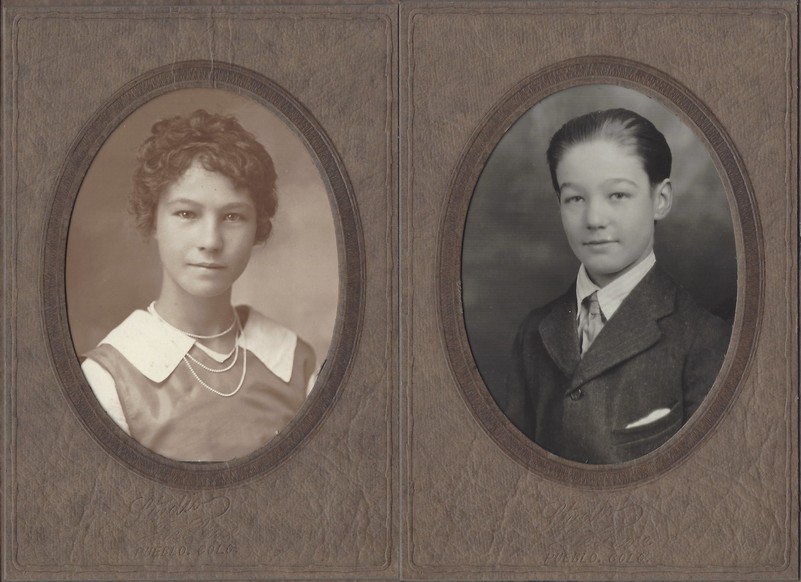
I deduced a couple things:
- The subjects were both in their teens and likely siblings
- The apparel and other clues put the photo date in the 1920s
It took a few tries, but I found a census record that supported these deductions. In 1920, Ada Smith, a divorced farm manager, was living in Sitton, Pueblo County, Colorado, with two children: Elva, age 11; Gilbert, age 8.1 Further research on Ancestry provided evidence that I had the correct people. I also found a portrait of Ada with her two children posted on Find A Grave.

Ada’s ex-husband was a baker from Kansas City, Missouri. Probably not long after these portraits were done, Elva and Gil went to live with their father and his second wife, Arthur and Edith Smith.2 Elva married Thomas Bolen Williams (an electrical engineer) in Kansas City in 1931.3 They had two sons and the family relocated to Ouray, Colorado, by 1950.4 Elva and Thomas both died in the Denver area in the mid-1980s.
I have a good deal more information about Gil, though it comes from an obituary and I have not been able to verify much.5 Gil graduated from the Kansas City Art Institute in the 1930s. In 1940, he sailed by steamship to Skagway, Alaska, and paddled a homemade kayak to the Chilkoot Inlet and settled on a small homestead (about 5 acres) near Haines.
To earn money, Gil worked as a truck driver and painted signs, but his real profession was landscape art. He worked primarily in oils and watercolor and is believed to have completed more than 3,000 images of the stunning scenery that surrounded him in southeastern Alaska. His work was highly esteemed and well-known in his home state. The obituary notes some of his achievements:
- Display at the Smithsonian Institute
- Hung in the Alaska delegation offices in Washington, DC
- Featured on the cover of the Ford Motor Company’s Ford Times magazine

In 1988, Gil suffered a serious stroke and became partially paralyzed. He moved with his partner, Janis Marston, to Glendale, New Mexico. He developed a shading technique to draw wildlife with his left hand. He passed away in Las Cruces in 2000.6 He was 88 years old.
Frank D. Muramoto of Studio De Lux
To my delight, I found an extensive article online about Frank Denichi Muramoto, a Japanese immigrant from the first wave to arrive in America.7 He was born in 1884 and came to America in 1903. One reason for the rising Japanese migration was the passage of the Chinese Exclusion Act of 1882. Mines and railroads still valued Asian labor, despite the law.

Frank spent his early years in the states working for the Union Pacific Railroad, mining, and in the sugar beet fields of Colorado. He moved around the west with the employment opportunities. In 1911 he attended the 9-month program at the Illinois College of Photography in Effingham.
After his graduation, he took a job as a “houseboy” near Spring Green, Wisconsin. His employer? Frank Lloyd Wright, who was at the time constructing his studio, Taliesin. It was a short-term position for Frank, who soon moved to Pueblo to begin his career as a photographer. Aside from a trip to Japan to marry Asako Muruyama in 1915, Frank spent the remainder of his life in Pueblo, where he died of a heart attack in 1958 at age 73.

Pueblo had a growing Japanese population in the early 20th century. Frank partnered with another Japanese man in a studio for a short time before opening his own. He was the principal photographer contracted by the CF&I Steelworks, the largest business in Pueblo. He had a wide format camera that he used to take large group photographs as well as doing studio portraits.
One interesting bit of history I gleaned from the article regarded the internment of Japanese and Japanese-Americans during World War II. There was an internment camp in southeastern Colorado, originally called Granada, but changed to Amache. As an aside, Amache was a Cheyenne woman married to rancher and trader John Prowers (namesake of Prowers County). She would likely have been appalled to have the camp named for her. Her father was one of the Cheyenne headmen murdered by the Colorado 3rd Regiment at Sand Creek in 1864.8
The Japanese population of Colorado, however, were NOT interned, though it’s believed that Frank and his family did visit Granada. Colorado’s governor, Ralph Carr, was the only U.S. Governor to exempt Colorado residents from President Roosevelt’s Executive Order 9066. Frank’s two sons served in the war as interpreters in the Pacific theater.
I encourage you to visit the link to the Pueblo Library District’s article, which gives much more information about the Japanese community in Pueblo, and also has an extensive display of Frank Muramoto’s work (courtesy of the Pueblo County Historical Society). It includes pictures of Frank, portraits, group sittings, tourist attractions around Colorado, and even several short films.
Feature image: De Luxe Studio at 1142 E. Evans Ave., Pueblo, Colorado (Photo by Frank D. Muramoto. Pueblo Colorado Historical Society pchs-p-99-0086a.)
- 1920 U.S. census, Pueblo County, Colorado, population schedule, Sitton Precinct 27, farm 11, dwelling 10, Ada Smith; images, Ancestry (https://www.ancestry.com/imageviewer/collections/6061/images/4294440-00161 : accessed 15 January 2025), images 1 and 2. ↩
- 1930 U.S. census, Jackson County, Missouri, population schedule, Kansas City Ward 2, dwelling 2, family 8, Arthur Smith; image, Ancestry (https://www.ancestry.com/imageviewer/collections/6224/images/4662317_00948 : accessed 15 January 2025), image 1 of 37. ↩
- “Missouri, U.S., Marriage Records, 1805-2002,” Ancestry database, Thomas B. Williams and Elva M. Smith, marriage license, 9 October 1931, image (https://www.ancestry.com/imageviewer/collections/1171/images/vrmmo1833_c12554-2246 : accessed 15 January 2025), image 2236; Missouri State Archives, Jefferson City, Missouri. ↩
- 1950 U.S. census, Ouray County, Colorado, population schedule, Ouray precinct 1, dwelling 37, Thomas B. Williams; image, Ancestry (https://www.ancestry.com/imageviewer/collections/62308/images/43290879-Colorado-075827-0006 : accessed 15 January 2025), image 6 of 24. ↩
- Steve Williams, “Famed landscape artist dies at New Mexico home,” Chilkit Valley News (Haines, Alaska), May 30, 2002 (date unverified); PDF posted on Ancestry by jasamcd (https://www.ancestry.com/mediaui-viewer/collection/1030/tree/158607291/person/212636735654/media/09db30d4-3105-4c02-b94b-45e4a664212a : accessed 15 January 2025). ↩
- “U.S., Social Security Death Index, 1935-2014,” Ancestry database, Gilbert A. Smith, died 4 July 2000. ↩
- “Natural Framing: The Life and Work of Frank D. Muramoto,” The Digital Collection at Pueblo City-County Library District (https://cdm16620.contentdm.oclc.org/digital/custom/natural_framing : accessed 15 January 2025). ↩
- I wrote about Amache and John Prowers in my book, What Lies Beneath Colorado: Pioneer Cemeteries and Graveyards. They are buried in the Las Animas Cemetery, Las Animas, Colorado. ↩


I never knew that any state exempted their Japanese American residents from the internment order. Good for Colorado!
This is all fascinating! Great sleuthing, Eilene. Are there descendants who might want these photos?
LikeLiked by 2 people
That was news to me, too. I like to think it was a moral choice, but I expect there was some pressure from the sugar beet farmers.
I haven’t found any yet, but a descendant of Ada’s sister may be interested. He has done a lot of research on the family and posted the Gilbert Smith painting and obituary.
LikeLiked by 1 person
This is such a good thing that you do!
LikeLiked by 1 person
It’s fun for me. Thanks, Amy.
LikeLiked by 1 person
Another wonderful example of your awesome research. Fascinating how these stories separate lives cross paths. Well done, Eilene!
LikeLiked by 2 people
I do enjoy sharing the stories I find this way. Thank you, Frank.
LikeLiked by 1 person
Great job on the research, you found a ton of useful info to weave that fascinating story together. The art related connection is the most interesting to me.
LikeLiked by 1 person
Thanks, Deb. Glad you enjoyed the stories behind the pictures. You can find more of his work in a Google image search.
LikeLiked by 1 person
You are a remarkable researcher, Eilene. Fascinating stuff!
LikeLiked by 1 person
Thank you, Jane. This one had some ease to it, compared to others.
LikeLiked by 1 person
Such great stories. Elva has a very lively look in her eye in both pictures which i like.
LikeLiked by 1 person
I do wish I could have found more information about her, as I agree. She does look lively! Thanks, Anabel.
LikeLiked by 1 person
Fascinating stories about each person you discovered. Love the photos, too.
LikeLiked by 1 person
Thanks! I have fun doing these random research projects.
LikeLiked by 1 person
You may want to write a book out of your random projects!
LikeLiked by 1 person
Oh, like I need another book idea!😂😂
LikeLike
So compelling!
LikeLiked by 1 person
Thank you, Joy!
LikeLiked by 1 person
Your research is just amazing – the things you are able to uncover!
LikeLiked by 1 person
Thank you, M.B. This one took some unexpected turns.
LikeLiked by 1 person
The people were interesting to read about and more so was looking up Pueblo and the housing. Time to get out of that rabbit warren and head downtown 😉
LikeLiked by 1 person
I looked for the studio on Google Earth, but it’s an empty lot now, apparently. I went to Pueblo while researching my Colorado Cemetery book. It was my first time really looking around the place. I’d only been there once before for a school concert band contest.
LikeLiked by 1 person
I liked the mud? houses, very Spanish like in structure. I’ve never been to that part of the world so it’s interesting when you write up about differing places.
LikeLiked by 1 person
Ah, adobe, yes. Very common in the southwestern U.S.
LikeLike
This impressive and fascinating research that began with an old studio portrait of a brother and sister! (I love watching how you do this.)
LikeLiked by 1 person
Thanks, Liz! Without the photographer’s studio imprint I could not have gone anywhere with this. I didn’t even know the last name of the kids.
LikeLiked by 1 person
You’re welcome, Eilene!
LikeLiked by 1 person
It is always fascinating to me how you are able to connect all the dots about family history just by the photos and any photographer’s imprint. That is amazing. You can tell the resemblance to the older children in the photo with their mother. That was a beautiful painting by Gil, a man of many talents apparently.
LikeLiked by 1 person
Thanks, Linda. I do enjoy the research and learning about interesting people from my photo finds. In this case I didn’t feel I got much on personality and such. But they all seemed to have good lives.
LikeLiked by 1 person
Yes, good lives which translates to going to photography studios to have their likeness(es) captured on film.
LikeLiked by 1 person
Good point!🙂
LikeLiked by 1 person
People say many negative things about the www, but your ability to learn about the people in the photos is an example of how fascinating the www is. I am amazed by the details you find out about people. Thanks for sharing your research here.
LikeLiked by 1 person
I agree that it’s a double-edged sword. The ease of accessing original documents these days assures that I am not likely to give up on the internet. Traveling to archives to see originals is time-consuming and cost-prohibitive.
LikeLiked by 1 person
Gil had quite the resume there. And Frank too. So no internment camp for the Japanese huh? I’m guessing it wasn’t about righting a wrong though.
LikeLiked by 1 person
Gil must have been into art at an early age. Did they put the kid’s drawings on refrigerators in the 1920s?
Yeah, I suspect the governor had agriculture and manufacturing on the mind, not human rights. No matter. The outcome was for the good all around.
LikeLiked by 1 person
How about iceboxes? Do you think they put kid’s drawings on iceboxes?
LikeLiked by 1 person
😂 Did they have magnets back then?!
LikeLiked by 1 person
It was before magnets, but they used other things to hang their prized art work.
LikeLiked by 1 person
A fascinating post all from two portraits you picked up! They’re beautiful photos. Love that Gilbert taught himself a technique to keep up with his art after his stroke. And I had no idea Colorado didn’t intern the Japanese citizens – how enlightened! I know the people here on the Sunshine Coast were mostly horrified when their Japanese neighbours were forcibly removed and relocated to camps in the interior of the province.
LikeLiked by 1 person
It’s great when I learn so many cool things from getting these photos and researching them. They’ll soon be on their way to a family member (on Ada Little Smith’s line).
LikeLike
What a fascinating story behind the story (or, in this case, picture)!
LikeLiked by 1 person
Thank you, Sheryl. These projects are a fun hobby for me, but I also am glad to reunite the pictures with relatives. The Muramoto story was a real bonus!
LikeLike