By Eilene Lyon
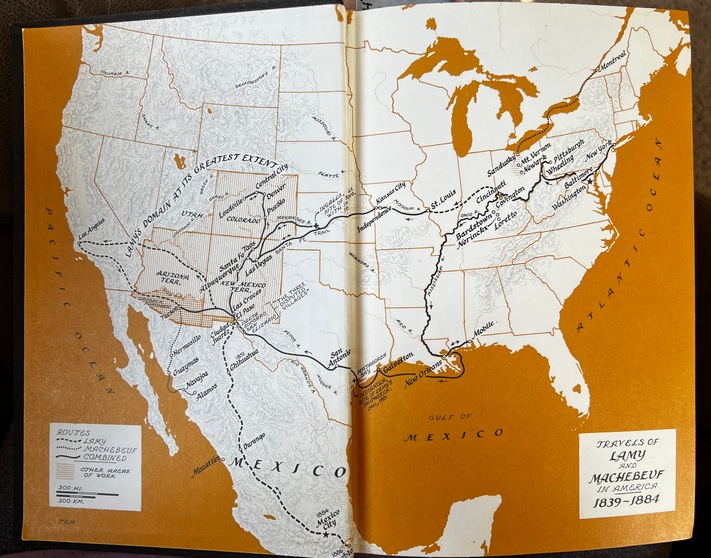
Several years ago, my local book club read Death Comes for the Archbishop by one of my favorite authors, Willa Cather. It’s a fictional story of two real men, missionaries from France, who arrived in Santa Fe in 1851, not long after New Mexico became part of the United States.
Cather calls them Bishop Jean Marie Latour and Father Joseph Vaillant. Their true identities are Jean-Baptiste Lamy and Joseph Machebeuf. They became friends as young men in France and came to America together to serve as missionaries in Ohio.
In the fictional account, Cather vividly brings the New Mexican frontier to life with its Native American and Hispano residents. The weather and harsh terrain are antagonists as much as any persons. The Bishop and Vicar are introduced to some of the more mystical religious beliefs of the people as they work to convert them to the Catholic Church.
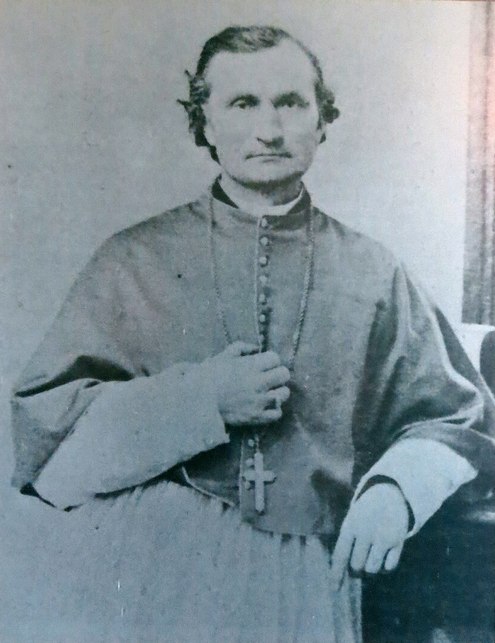
In 1850, Lamy was elevated to become the first bishop in New Mexico Territory, with Machebeuf as his Vicar General. The area had previously been served by priests answering to the bishop in Durango, Mexico. Lamy’s territory encompassed what is now New Mexico, Colorado, Arizona, part of Utah, and the area around El Paso. The southernmost portions were contested by the Mexican bishop for decades.
An arduous journey that included a shipwreck, where he lost most of his belongings, brought Lamy to Santa Fe in the summer of 1851, where he was warmly welcomed by the people—but not by the Mexican clergy, who had no intention of letting this Frenchman take over their parishes!
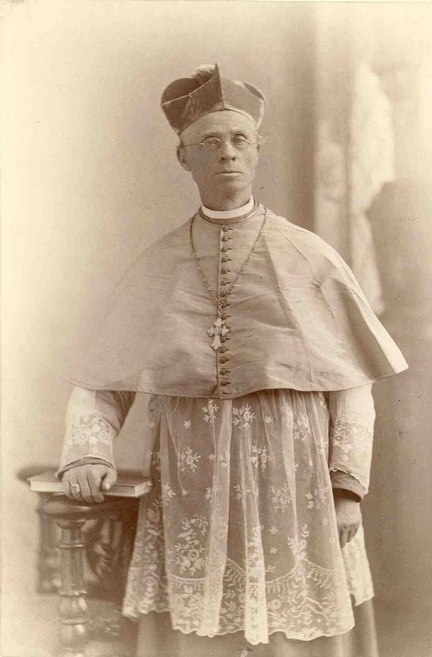
Not long ago I learned, via historian David McCullough, about the biography Lamy of Santa Fe by Paul Horgan, a Pulitzer prize-winning book published in 1975. I found a copy at the local college and slowly absorbed all 400 pages, which includes some wonderful historic photographs.
I’m not religious, and have no connection to Catholicism, but Lamy impressed me with his dedication to his faith and to the people he served. He elevated their quality of life and provided them with inspiration toward a moral existence.
His Vicar General, Joseph Machebeuf, later became the first bishop in Colorado. I wrote about him in my book What Lies Beneath Colorado. He is buried in Mt. Olivet Catholic Cemetery in Wheat Ridge. The two men contrasted in almost every way.
Lamy was tall, but suffered from periods of debilitating health issues. He had a subtle way of dealing with people. Machebeuf was a small, wiry, but tough man. He proselytized with passion and warmth that endeared him to the people he served.
The interior west that was previously “controlled” by Mexico (but more by the Navajo, Puebloans, Apache and Utes), had long been a place where people lived on the margin. There were no educational institutions, and the clergy were corrupt in every possible way: drinking, gambling, stealing, and even adultery.
Lamy changed all that, but not without difficulty. He relied on Rome and his church in France to support his mission in America for many decades. He brought in nuns and priests from Europe and eastern states. They created educational institutions and built churches throughout the southwest.
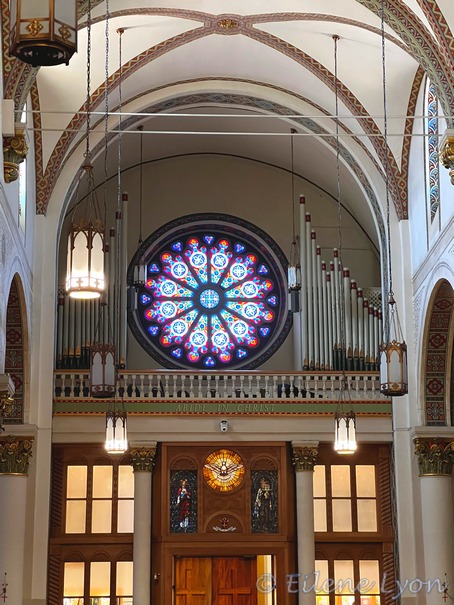
The Cathedral Basilica of St. Francis of Assisi was another major accomplishment, though it was not quite completed in Lamy’s lifetime. An earlier adobe church stood on the site, the last in a line of primitive structures dating back to the founding of Santa Fe in 1610.
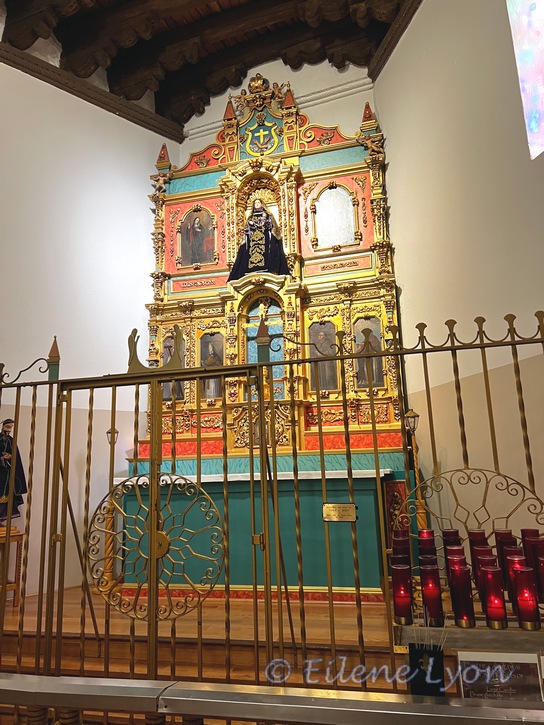
Lamy hired an architect from France and stonemasons from Italy. The builders located stone quarries within 20 miles of Santa Fe. They constructed the new church, built in Romanesque Revival style, around the adobe one, then removed the adobe after the outer portion was completed. Only one small portion of the original remains as a side chapel.


Construction began in 1869 and the cathedral was dedicated in 1887. Pope Benedict XVI elevated it to a Basilica in 2005. Lamy became archbishop in 1875. He retired in 1885, died in 1888, and is buried within the sanctuary.
You can find a virtual tour of the cathedral online. When we visited, a docent shared many stories with us. We learned that the statue of the Blessed Virgin Mary, made in Spain in the 1400s, was brought to America in 1625. She is the oldest such icon in the country.
The cathedral is a beautiful testimony to the life and spiritual improvements that Archbishop Lamy brought to the people of New Mexico.
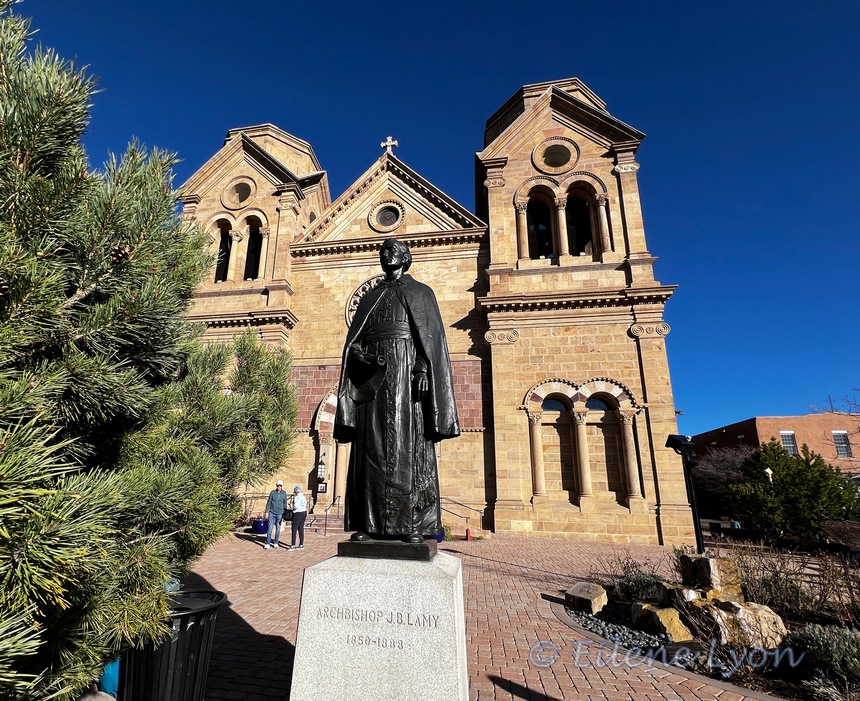
Feature image: Bronze likeness of Archbishop J. B. Lamy in front of St. Francis Cathedral in Santa Fe.
 Myricopia
interesting and beautiful
LikeLiked by 1 person
It’s amazingly small as basilicas go, but quite an achievement for the place and time.
LikeLiked by 1 person
I’m not sure how I feel about missionary work. I don’t have a problem with helping people, but I’m not comfortable with the hard sell on religion. However, the architecture of the Church is beautiful.
LikeLiked by 1 person
Oh, I agree with you. But the church came in when the secular state simply did nothing to help these people get educated and more. And most of the people they served had been converted to Catholicism centuries earlier.
LikeLike
I feel I should expand on that. The Pueblo Indians were nominally Catholic due to the Franciscan missionaries of the 1600s and 1700s. The Hispano population traced their ancestry directly to Spain, even if they were Mestizo. That’s still true of much of the population in this region today.
In Colorado, Machebeuf ministered to the Irish and Italian Catholics who came during the gold rush, not the Native Americans.
LikeLiked by 1 person
I’m with you, not a religious person but I do admire those whose faith is that strong. They don’t preach, they simply do. I dig that just fine. As I do this architecture, and the stories too!
LikeLiked by 2 people
Lamy and Machebeuf were truly servants of their faith and aimed to improve the lives of the people they served.
LikeLiked by 1 person
I love all the details you provided and the photos are gorgeous.
LikeLiked by 1 person
Thank you, EA!
LikeLiked by 1 person
👍🏼
LikeLiked by 1 person
I have never read Death Comes for the Archbishop, but now that I know it is partly in Santa Fe, I must add it to my last. I wonder whether my great-great-grandfather met Lamy. I bet he did as their time in Santa Fe must have overlapped.
Thanks, Eilene!
LikeLiked by 1 person
It’s a certainty they would have known one another. Lamy had a very good relationship with the Jewish community and they did some things jointly.
LikeLiked by 1 person
I wonder if any of the books you mentioned about Lamy mention the Jewish merchants in Santa Fe, perhaps even my gggf Bernard Seligman.
LikeLiked by 1 person
It did mention them, and I think maybe it said Seligman Bros. Not positive. It wasn’t a major point. I didn’t think of your Santa Fe story when I read it.
LikeLiked by 1 person
Cather’s book? Or Horgan’s? Thanks!
LikeLiked by 1 person
Horgan’s, the biography.
LikeLike
This is a beautiful Cathedral and thanks to all the information you provided and the virtual tour that I just took, I feel like I have visited here in person.
LikeLiked by 2 people
Glad you enjoyed the tour, Linda. It’s a small cathedral, but quite lovely.
LikeLiked by 1 person
Yes, I did and it was lovely Eileen. I was looking forward to that continuation of your last post.
LikeLiked by 2 people
Glad I didn’t put it off, then!
LikeLiked by 1 person
Yes!
LikeLiked by 1 person
Interesting indeed…sounds like he was maybe more accepting of the indigenous people than many others of the Catholic faith. I still don’t hold with converting people, but at least it seems he approached it different than others.
LikeLiked by 2 people
I’m not sure how much conversion was going on, especially at that point. Hispanos were from the Catholic tradition though many had lapsed over the years. Given how the priests behaved, not too surprising!
LikeLike
Ah, I see it was in the fictional account you mentioned conversion…Either way, good to know he was a better priest than many and worked with people, rather than raising himself above them. Clearly Lamy was an important man if a Pulitzer Prize winning book was written about him. I do love learning all this history from an area of the US I’m not overly familiar with 😊
LikeLiked by 2 people
Yeah, I didn’t get the feeling from the biography that he was trying to convert people so much. The Pueblo tribes had previous exposure from earlier days. As I mentioned to Amy, he had a good working relationship with the Jewish community, too.
LikeLiked by 1 person
Very interesting history! The Cathedral Basilica is beautiful. I haven’t yet read Death Comes for the Archbishop. Would you recommend it?
LikeLiked by 2 people
I loved Cather’s book for its depiction of New Mexico in the mid-1800s. She really knew how to bring a place alive on paper.
LikeLiked by 1 person
I know nothing about New Mexico except for its location. This alone makes the book a worthwhile read.
LikeLiked by 1 person
New Mexico Magazine used to always have a back page feature called “One of Our 50 is Missing.” They ran clips from other publications that put the state in Mexico (or some other foreign country!). It does seem to be off the radar sometimes.
LikeLiked by 2 people
Sounds fun!
LikeLiked by 1 person
😁
LikeLiked by 1 person
I understand and share your position of not being religious but admiring some of the dedicated exponents of it. We came across many stories of inspirational and caring priests in the Hebrides.
LikeLiked by 3 people
When we understand the conditions people suffered and what the church did to alleviate some of that, it makes sense to admire that.
LikeLiked by 1 person
There is much beauty to admire in these ornate churches. It always amazes me how much money is poured into these churches and cathedrals, and the congregation keeps giving, no matter how little they personally have and been brought up a Catholic is one reason why I detest institutionalised religion. Though of course there are exceptions to every generalisation. There are those who do good.
LikeLiked by 2 people
My grandfather took a lot of pride in helping build a Presbyterian church where he lived. Not my thing, but it means a lot to others to create that space and gather to worship in it.
LikeLiked by 2 people
Of course, Eilene and I can see the pride and joy of him helping build the church. Les’s grandad at 14 assisted in building a very small church in Devon. There was much pride when we found a brick with his name on it honouring his work.
LikeLiked by 1 person
It’s always been interesting to me that studies show people who have the least are usually more generous than people who have the most.
LikeLiked by 1 person
Oh yes, we found that while housesitting. It was interesting and sometimes not so amusing when they left us no basic provisions though most did and we returned the favour.
LikeLiked by 1 person
That would be a bummer—especially if there was no toilet paper! But It’s nice to have some coffee and spices, etc.
LikeLiked by 1 person
The poor give to the churches because it is THEIR communal house of worship. The priests come and go but the building remains where the folks gather. Of course it should be beautiful…and they put it together with the good art and ideas from their clergy. Thank you, Lamy!
LikeLiked by 1 person
That makes sense. Charles riches have always been community spaces. Often different denominations and even non-Christians share a building. Lamy allowed the Jewish community in Santa Fe to use church property, too.
LikeLike