By Eilene Lyon
In my previous post about the Snapp family, I closed with a page from Elizabeth Snapp’s will. It is an unusual document, because young, unmarried women did not typically have estates, especially not in the 18th century. In addition, it was written in German, not English, even though Elizabeth was born in the U.S.
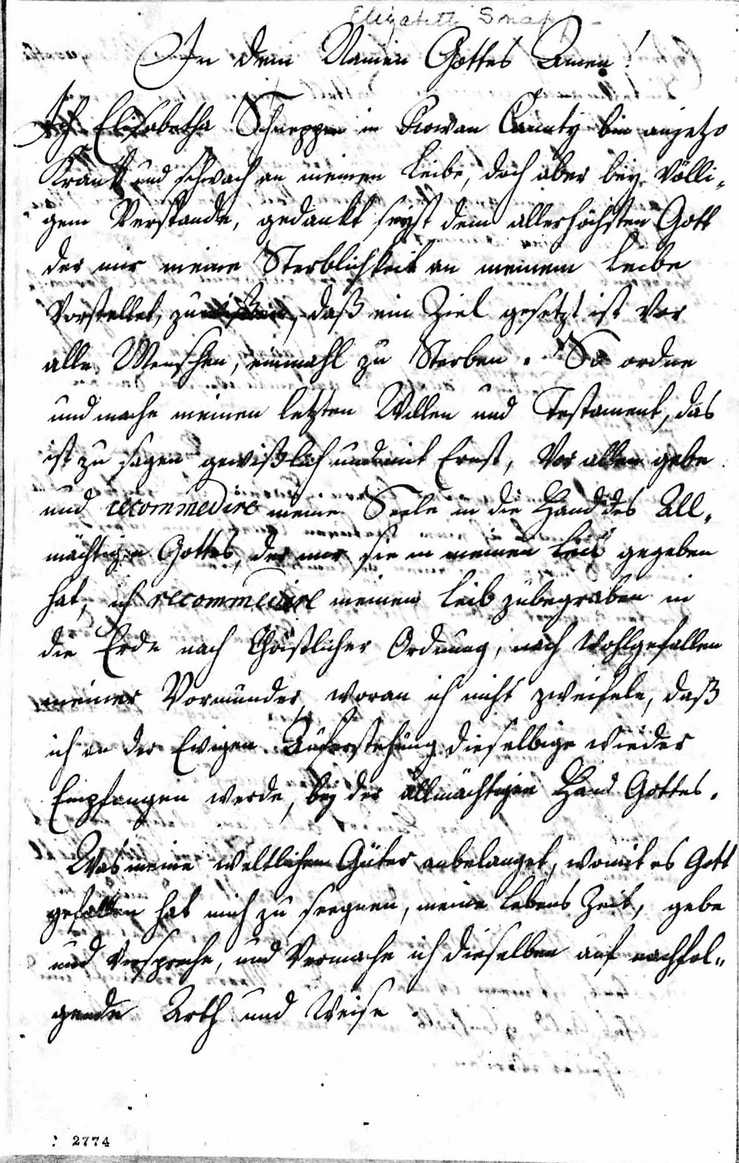
I really wanted to find out more about her estate, but the handwriting was difficult to transcribe and translate. My first step was to send the images to my niece, who is a German-language major at an Ohio university. She could pick out a few names and phrases and she told me the dialect was likely Pennsylvanian. The Germans who settled western North Carolina generally hailed from Pennsylvania communities, so that made sense.
My previous experiences with transcribing handwritten documents using A.I. (ChatGPT most recently), were quite unsatisfactory, even when the document was in English with a legible hand. Things would be out of order, left out, or invented from scratch. I was hesitant to try with something like Elizabeth’s will, with its foreign language, poor handwriting, and ink bleed-through.
I found the document on Ancestry and the site offered a transcription, but not a translation. This is where things got a bit interesting. I went to Google and copied the Ancestry OCR transcription, asking for a translation. Using A.I. mode, the initial response was:
“It is written in a heavily distorted, archaic historical dialect (likely 18th-century Swiss-German or Austro-Bavarian) with significant phonetic spelling, archaic legal/religious phrasing, and structural handwriting transcription errors.”
A translation was provided, but then the bot asked me if this was OCR and where the original text was found. I stated that it was OCR and provided the sample page shown above. That changed things quite a bit.
“Seeing the original document reveals that this is a Last Will and Testament written in early Pennsylvania Dutch / American-German dialect by a woman named Elisabeth. The text heavily uses standard, deeply religious German boilerplate formulas for 18th-century wills.”
Bear in mind here that the bot misread the county name from the first line of the will. I did not divulge where this document originated (Rowan County, North Carolina). It apparently decided that since the language was Pennsylvania Deutsch, that the will and the people and property it named must have been in that state. That led to some incorrect transcription and translation. I had the bot do the entire four pages.
A full-text search in FamilySearch (FS) revealed that a descendant, Milton Snapp, had done some research on this branch of the family. FS has his collection. The papers included a translation of Elizabeth’s will. The following are some excerpts comparing the A.I. transcription/translation and Milton Snapp’s version.
A.I.:
I, Elisabeth Schnyder [Schneider] in Berdan County [likely a phonetic spelling of a colonial U.S. county, such as Berks or Northampton], am currently sick and weak in my body, but of completely sound mind—thanks be to the Almighty God, who reminds me of the mortality of my body, to consider that a limit is set for all humans to die once. Thus, I ordain and make my last will and testament, that is to say, legally and with full force.
M.S.:
I, Elisabetha Schnepp of Rowan Co., being sick and weak of body but sound of mind, for which I thank Almighty God, realizing that life must end, wish to get my affairs in order and make this my last will and testament.
[At this point, I’m thinking his version might be abridged, or A.I. is embellishing.]
A.I.:
As touching my worldly goods, wherewith it has pleased God to bless me during my lifetime, I give, promise, and ordain them in the following counsel and manner:
M.S.:
As concerns my earthly goods which God has seen fit to bless me with through life, I give as follows:
[The bot also provided the full German transcription before giving me the translation, so here is the German version: “Was meine weltlichen Güter anbelangt, womit es Gott gefallen hat mich zu segnen, meine Lebens Zeit, gebe und Verspreche, und Verordne ich dieselben nach nachfolgender Rath und Weise.”]
A.I.:
- First: I give to my dear sister, Anna Margretha Diendelmann, a saddle, an old red quilted skirt/petticoat, and a medium-sized iron pot. To her daughter Elisabeth, I bequeath a small measuring pitcher (Meßlin Kanne), a quilted blue skirt, as well as the cloak and a damast.
- Second: To my dear sister Catharina Riehl, I bequeath a hymnal. To her daughter Elisabeth, I bequeath a gold ring, a silk pitcher/jug, a striped and a scarlet pitcher/jug, as well as a white silk neck-cloth.
M.S.:
First- I give my dear sister Anna Margaretha Rintleman my saddle, an old red quilted frock and an iron ____ of medium quality. Her daughter Elisabetha _____ I give a quilted blue frock and an overcoat and bonnet.
Second- To my sister Catharina Riehl I give a prayer book and to her daughter Elisabetha I give a golden ring and a silk _____, a striped ______ and also a white silk scarf.
[In these first two bequests, the bot seems a bit more thorough and literal, but the silk and striped goods being labeled “pitcher/jug” must be incorrect. Milton couldn’t read it either, though!]
In addition to household items and cash (“£5 in gold and £2 in silver”) distributed to her four sisters, she requested that her brother-in-law sell her 200 acres of land (or, in the A.I. version, the land is located next to him) and divide the proceeds among the same heirs. Then comes a surprising statement.
A.I.:
- Eleventh: It is my special will that my brother Lorenz Schnyder shall never have any part or inheritance of my estate left behind; yes, any claim to the same shall be completely denied to him.
M.S.:
Eleventh- It is my particular desire that my brother Lorentz Schnepp be denied any part of my remaining estate and that any of his claims against the same be positively denied.
[Earlier in the will, she does call her brother “my dear brother Lorenz” and adds that he owes her ₤8 plus interest.]
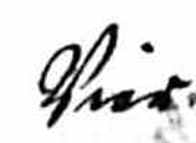
Both translations give the same month and day, but A.I. says 1773 and Milton says 1774. The year is written in text, not numerically. Does this say “Drei” (three) or “Vier” (four)?
There are differences between the two translations in naming particular items (rings vs. skirts; a mare vs. goods/merchandise), but the overall information is remarkably similar. Frankly, I was surprised the Google A.I. bot did such an incredible and thorough job with some errors, mostly geographical, and without adding hallucinations.
After doing the translations, the bot also provided me with historical context, and located Lawrence’s will which confirmed that Elizabeth and her siblings named there match those in her will. I’d call this a worthwhile collaboration, but I was glad (and fortunate) to have Milton’s translation to test the A.I. version.
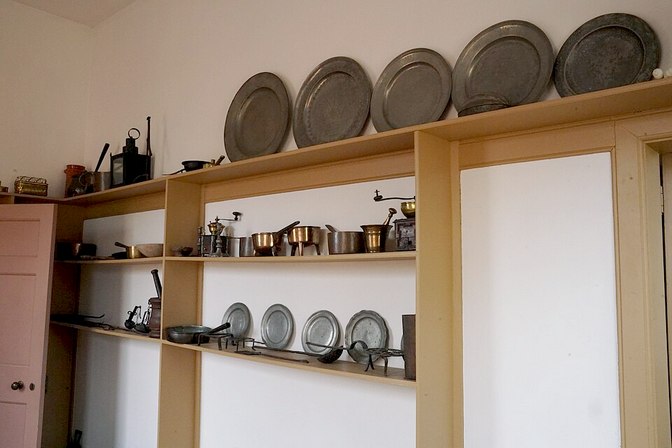
Feature image: Pewter plates in Tryon Palace, home of the territorial governor of North Carolina in the 1760s. Elizabeth bequeathed a half dozen pewter plates to be divided among her sisters. (Wikimedia Commons)


This post straddles so many worlds, Eilene, this is a marvel in itself.
LikeLiked by 2 people
It really does stretch, doesn’t it?
LikeLiked by 1 person
This is so fascinating that you used A.I. and had Milton’s version to decipher the will.
LikeLiked by 1 person
Probably neither is a complete translation, but between the two, I certainly have the gist of it.
LikeLiked by 1 person
👍🏼
LikeLiked by 1 person
While I’m not claiming to be a total advocate of AI it seems in this case it did help in many ways. I had to pause as I read the list that Elizabeth bequeathed to family. I wonder what the reaction would be today to be told you were getting a beloved dress from your sister?
LikeLiked by 1 person
We have much too much stuff these days. Back then a quality dress would indeed be a valued gift. Now heir want money, houses, cars, etc.
LikeLiked by 1 person
Interesting how this will read and it tells me she did not have a lot of possessions, or maybe she did, but these were Elizabeth’s most-prized possessions. I Googled “damast” thinking it was “damask” and it was. I wonder what her brother Lorentz did to be cut out of the will entirely? I remember you and I commented on AI awhile back and you mentioned having AI translate/decipher a will for you. I am always amazed at AI’s capabilities if I inquire about something and instantaneously at that.
LikeLiked by 1 person
There are definitely uses for genealogy, but I try to use it as little as possible. Still, it’s amazing what it can do!
LikeLiked by 1 person
Yes it is!
LikeLiked by 1 person
👍
LikeLiked by 1 person
That was interesting! Family politics even then!
LikeLiked by 1 person
Maybe quilted skirts were prized possessions then as they were warm like a quilt? If you didn’t have much stuff back then, maybe you named the stuff that was of more value – like the saddle? I’m just guessing, but I remember reading about Shakespeare’s will and how he left his wife, his second best bed. which scholars have debated over for years. I wonder what the land was worth?
LikeLiked by 1 person
The quilted description might not be correct, but at this point, I don’t really know.
LikeLiked by 1 person
It really was surprising in so many ways. I wonder what her estate was actually worth in total? I haven’t delved into those real estate records.
LikeLiked by 1 person
A fascinating exercise!
LikeLiked by 1 person
It took several turns I hadn’t planned on or expected.
LikeLiked by 1 person
Your experience mirrors mine with Gemini. And Milton, the human, was providing a literate not a literal translation – the human touch. Finding his translation certainly was a bonus!!
So many great details in the will, especially the barring of her one brother from receiving anything from her estate.
LikeLiked by 1 person
I agree that Milton was going for the essence of her phrases. I wonder if he was fluent in the dialect himself. I know in some parts of Pennsylvania they still speak it, and I do have relatives in those areas, but we’re so distantly related I haven’t explored there. I do get invited to an annual reunion, so maybe I’ll jump on that someday.
LikeLike
I’m shocked and impressed (both) at AI’s ability to navigate these searches, seeing as how it ain’t easy pickins by any stretch.
LikeLiked by 1 person
Given my previous (not-that-long-ago) experience, I was truly amazed at what happened in this case. And how much better will it be a month from now? Scary, in a way.
LikeLiked by 1 person
Yeah it is
LikeLiked by 1 person
😱
LikeLiked by 1 person
As you know, I have gotten some very bizarre results using AI to translate and transcribe documents written in the old German script. Which ones did you use? I have found that Claude is best for that task.
LikeLiked by 1 person
In this case, I just used Google AI (Gemini). I was astonished at how good it did. I think they are all getting better at this over time, and quickly, too.
LikeLiked by 1 person
Fascinating project! To be a fly on the wall when the brother found out he was getting nothing and he still owed her money!
LikeLiked by 1 person
Haha! I’ll bet he saw that coming, actually. He probably inherited almost everything from their father, after all.
LikeLiked by 1 person
True! The way she spelled it out is fantastic!
LikeLiked by 1 person
I love the whole document. It such a historical treasure.
LikeLike