By Eilene Lyon
My North Carolina German family lines did not make that colony/state their first stop on this continent. For the most part, they arrived in Philadelphia and settled in established German communities in Pennsylvania.
They, or their descendants, later moved to North Carolina where good land could be had for less money. There was a 435-mile-long road leading from Philadelphia to western North Carolina. The maps below show the route from Philadelphia through Lancaster and York, then bending south through Maryland and the Shenandoah Valley of Virginia.1
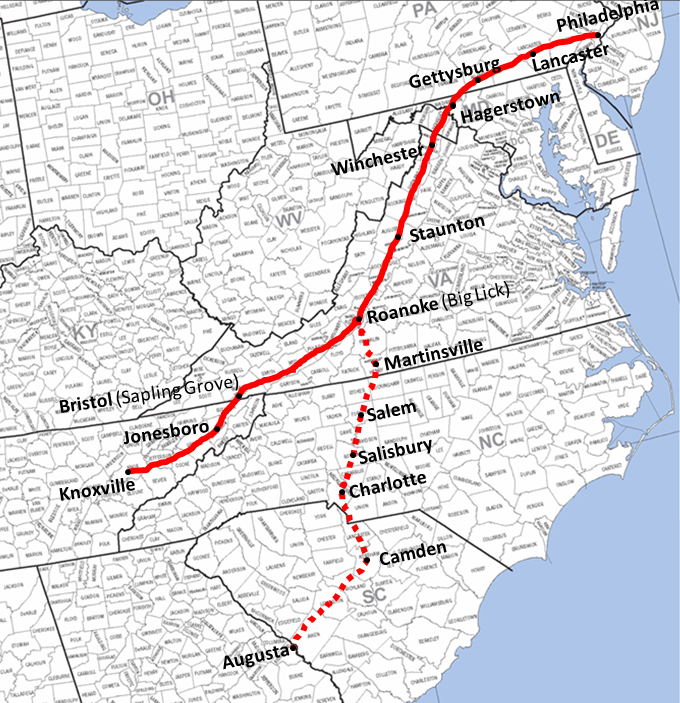
This interactive map show the major points along the route to western North Carolina. You can zoom in to see details.
These German lines all stem from my great-grandfather, Sterling Price Davis. Looking at the third and fourth columns in the pedigree chart below, the German lines are: Mock, Hoover, Beard, Snapp, Leibengut, Hornberger, and Eddinger. I suspect Jesse Taggart’s (second column) line is also German, but he’s currently a brick wall.
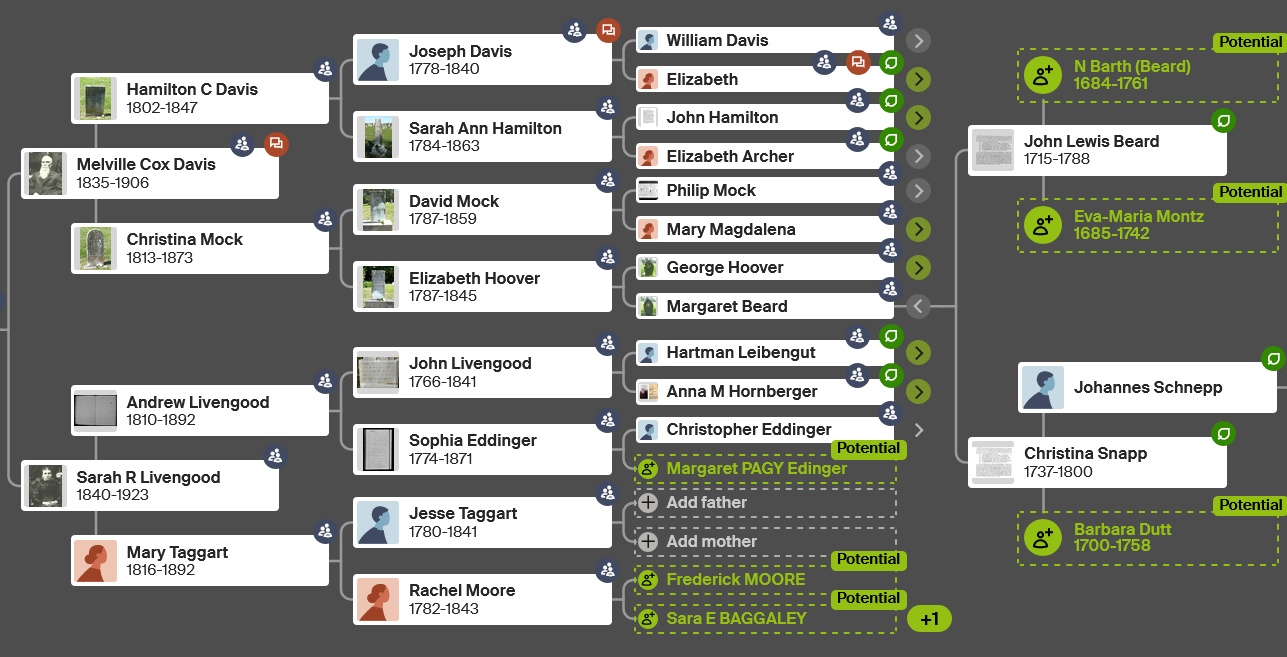
Most of these names were directly translated or changed phonetically to be Americanized: Mack/Mock, Huber/Hoover, Barth/Beard, Schnepp/Snapp, Leibengut/Livengood. I have not done much research into the Hornbergers or Eddingers, though I’ve found several different spellings for Eddinger. John Lewis Beard will be the primary focus of this post.
John Lewis Beard relocated to North Carolina in the 1750s. The others came after the Revolution or just prior. Some of them served during the war, all on the side of the Americans. Born Johann Ludwig Barth in Germany about 1715, Beard arrived in Philadelphia in 1749 at the age of 34.2
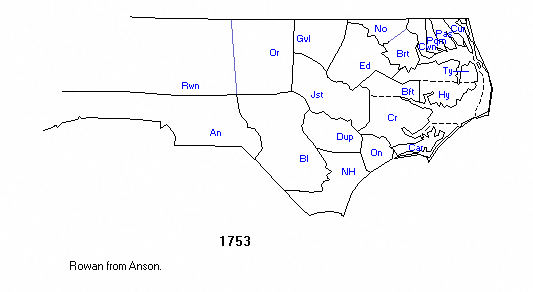
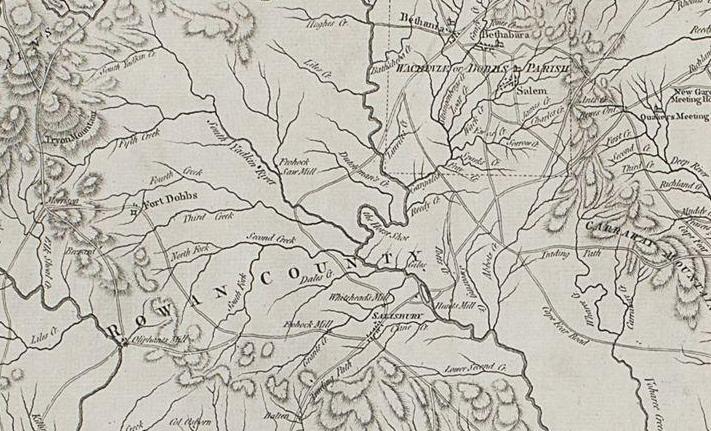
Embracing his new homeland, he Anglicized his name, settled in North Carolina, in the Salisbury District, and soon became an important citizen of the region. The Salisbury District encompassed (at the time of the Revolution) Anson, Tryon, Surry, Guilford, Mecklenburg, and Rowan Counties.
Sometime prior to his arrival in Salisbury (perhaps along the way!), Beard married Christiana Snapp of the Opequon Settlement in Frederick County, Virginia. Christiana married at 14 and had her first child at 15. That seems awfully young, considering Beard was 22 years her senior.
Beard established a farm on Crane Creek in Rowan County, and a butcher shop in the new town of Salisbury nearby.3 He obtained a license to run an ordinary or inn there in 1756.4 He later also ran a tannery.5
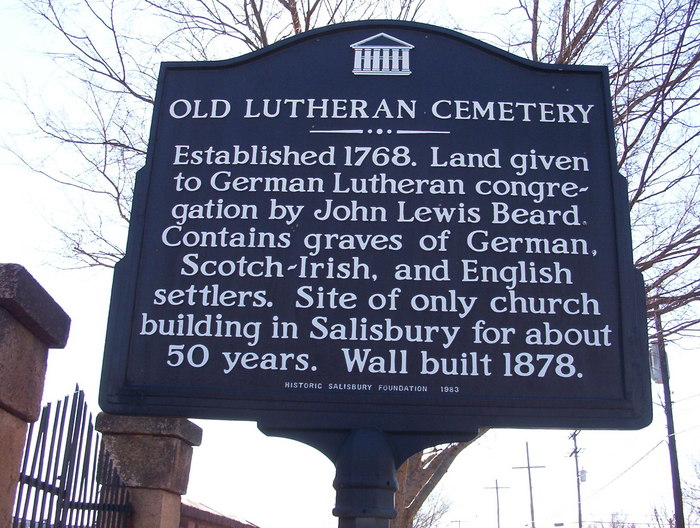
In 1768, Beard deeded an acre of land to the German Evangelical Lutheran congregation for a graveyard and church. This gift resulted from the death and burial of a daughter, but I can find no record for this child. It was the first Lutheran church in western North Carolina and used by other denominations, as well.6
Eleven Salisbury town commissioners, including Beard, were appointed by statute in 1770.7 An interesting document from 1772 issued by the Salisbury District Chief Justice, Martin Howard, to the county coroner ordered the latter to round up Daniel Boone, John Lewis Beard, and Rob Johnson to bring them into court to pay a debt.8
In 1774, after the Boston Tea Party led to the British blockade of Massachusetts, the other colonies rallied to support their embattled peer in New England. The North Carolina citizens soon set up Committees of Safety. Beard was appointed to serve on the committee of 25 men for Rowan County.9 This committee issued a list of resolutions. Though it started with one avowing loyalty to the Crown, the remainder were clearly revolutionary in character.
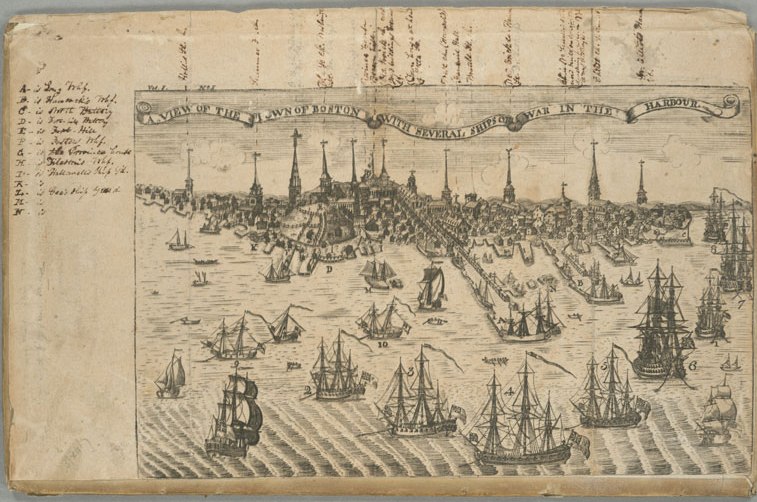
They state an unequivocal support for the Massachusetts Bay Colony and Boston; that only the General Assembly of the colony has the authority to levy taxes on the citizens; any taxes imposed by Parliament deprive them of their property without consent; and a great deal more. One that stands out states:
“Resolved, That the African trade is injurious to this colony, obstructs the population of it by freemen, prevents manufacturers and other useful emigrants from Europe from settling among us, and occasions an annual increase of the balance of trade against the colonies.”10
Of course, some of the men writing this document were slaveholders, including John Lewis Beard. They also included a resolution to do without imported luxuries, though I doubt much of this document had any impact on the daily realities for the Rowan County people.
Though I can’t state exactly how Beard became so wealthy, it’s clear that he further enriched himself as a result of the war. The Patriots confiscated land belonging to Loyalists. In Rowan County, much of this land had belonged to Henry McCulloch. It was auctioned off after the war and Beard bought a substantial amount.11 He also bought a 640-acre land grant warranted to a Continental army private for his service.12
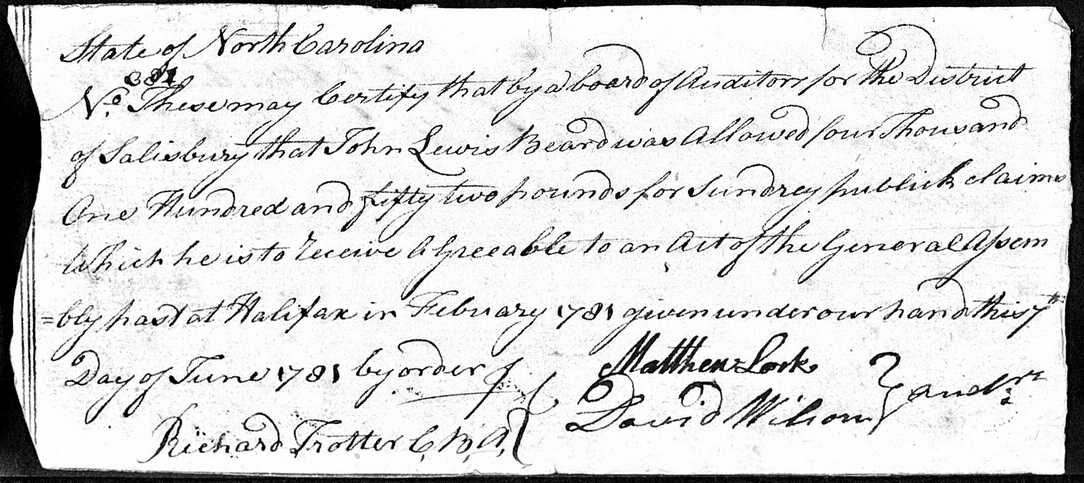
In addition, perhaps because he had rendered supplies to the Patriots, and maybe also because the British Army had occupied his home as their headquarters during their Southern campaign, he received ₤4,152 by an act of the General Assembly for “sundrey publick claims.”13
Beard’s oldest son, Valentine, was in the Continental Army during the war.14 His son, John, after the war belonged to the Rowan Light Horse company and in 1791 he met Gen. George Washington as the general approached the North Carolina border, and escorted him to Salisbury.15 His daughter, Margaret, married George Hoover and they were my 5th great-grandparents.
John Lewis Beard wrote his final will and testament and addendum on December 13–14, 1788 and died shortly after. He endeavored to split the estate equally amongst his heirs: his widow, Christiana and their nine children. Along with real property and some household items, he included bequests of four enslaved persons: Boatswain, Tom, Bob, and Cloe.16
Feature image: City Seal of Salisbury, N.C. (Wikimedia Commons)
- Samuel J. Ervin Jr. A Colonial History of Rowan County, North Carolina., The James Sprunt Historical Publications, Pub. under the Direction of the North Carolina Historical Society … V.16, No.1 (Chapel Hill: The University of North Carolina, 1917), p. 11, https://catalog.hathitrust.org/Record/002047084. ↩
- Ralph Beaver Strassburger, Pennsylvania German Pioneers: A Publication of the Original Lists of Arrivals in the Port of Philadelphia from 1727 to 1808, vol. 1, ed. William John Hinke (Pennsylvania German Society, 1934; repr., Genealogical Publishing Co., Inc., 1980), pp. 407–9 https://www.ancestry.com/search/collections/48379/. ↩
- Henderson, p. 350; note: misspelled here as “Cane Creek.” He mentions this property in his will, see Note 5. Rowan County, North Carolina, Deed Book 5, p. 184; image FamilySearch (https://www.familysearch.org/ark:/61903/3:1:3QS7-99DH-29PT-3 : accessed 29 Jun 2026; this indenture states John Lewis Beard is a butcher. ↩
- Jethro Rumple, A History of Rowan County, North Carolina : (Salisbury, N.C. : Republished by the Elizabeth Maxwell Steele Chapter, Daughters of the American Revolution, 1916), p. 71, http://archive.org/details/historyofrowanco00rump. ↩
- John Lewis Beard, “North Carolina, U.S., Wills and Probate Records, 1665-1998,” Rowan County, Will Book Vol. C–D, 1780–1807, pp. 129–136 , Ancestry database (https://www.ancestry.com/search/collections/9061/ : accessed 29 Jun 2026), images 82–89. ↩
- Ervin, p. 44. ↩
- Ervin, pp. 22–3. ↩
- Archibald Henderson, North Carolina, the Old North State and the New, V. 5 (The Lewis publishing company, 1941), p. 350, https://catalog.hathitrust.org/Record/001874226. ↩
- Ervin, p. 51. ↩
- John H. Wheeler, Historical Sketches of North Carolina, from 1584 to 1851 (Philadelphia : Lippincott, Grambo, 1851), pp. 360–1, http://archive.org/details/historicalsketch00whee. ↩
- James S. Brawley, The Rowan Story, 1753-1953 : A Narrative History of Rowan County, North Carolina (Salisbury, NC : Historic Salisbury Foundation, 1988), p. 71 and 84, http://archive.org/details/rowanstory17531900braw. ↩
- John Lewis Beard, “North Carolina and Tennessee, U.S., Early Land Records, 1753–1931,” North Carolina (Revolutionary War) Land Grants, Roll 02: Book A-1, p. 116 No. 228; Ancestry database (https://www.ancestry.com/search/collections/2882/ : accessed 29 Jun 2026), image 59. ↩
- John Lewis Beard, “North Carolina Revolutionary Pay Vouchers, 1779–1782,” Bateman, John to Bell, Robert; Ancestry database (https://www.ancestry.com/search/collections/61947/ : accessed 29 Jun 2026), image 397. ↩
- Henderson, p. 350. A pay voucher dated 1792 indicates he served at the rank of Lieutenant (original source not cited), posted by Melissa Stewart on Ancestry, 29 Jan 2021. ↩
- Jethro Rumple, A History of Rowan County, North Carolina : (Salisbury, N.C. : Republished by the Elizabeth Maxwell Steele Chapter, Daughters of the American Revolution, 1916), p. 248, http://archive.org/details/historyofrowanco00rump. ↩
- See Note 5 for will. ↩
 Myricopia
When I think of the distances some of our ancestors traveled to try for better lives, I’m amazed!
LikeLiked by 1 person
Crossing the ocean in sailing ships really was a leap of faith and daring! Even the 435 from Philly to NC was no piece of cake. Many rivers had to be forded or crossed by ferry (and many people couldn’t swim if they ended up in the water). But they had motivation!
LikeLiked by 1 person
Whenever you mention NC ancestors I always think back to my paternal grandma. I assumed she was born there and I know Alison went back a ways when she was doing some of our family ancestry. Then I get busy and forget to look. Makes me wonder if I still have the link to all of our info. Grandma had a very German-ish air about her though, if that makes sense 😉
LikeLiked by 1 person
Lots of German ancestry in this country! I have quite a bit myself, on both sides of my tree.
LikeLiked by 1 person
We both have German ancestry, our latest immigrants, who arrived in Iowa during the 1870s. My husband’s came through Pennsylvania. Mine came from the island of Pellworm, which was part of Denmark a generation earlier. So am I part German or Dane?
LikeLiked by 1 person
I’ve never heard of Pellworm! Sounds interesting. I have a German line that has a surname which seems to come from a place in Poland. Does it make me Polish?
LikeLiked by 1 person
You have fascinating family history. I’m impressed with all the information you have gathered. My dad’s parents came to the US from Finland through Ellis Island in the 1920s. Unfortunately, I don’t have much info on them.
LikeLiked by 1 person
Wow! If they came that recently, there should be gobs of information. I have to really struggle with these people from the 18th century or earlier. 19th century is pretty good.
LikeLiked by 1 person
I did find record of them coming to Ellis Island. But that’s about it. I’m so impressed with your research.
LikeLiked by 1 person
Check census records, city directories, newspapers, etc. That’s just a starting point.
LikeLiked by 1 person
Thanks!!!
LikeLiked by 1 person
💕
LikeLike
I found The Astoria Finnish Brotherhood Lodge online. My grandparents settled in Astoria, Oregon. It had a large Finnish population with fisherman, which was what many of the Finns did for living in Finland.
LikeLiked by 1 person
Very cool. Never heard of it.
LikeLiked by 1 person
Google is leading me to some resources. Plus those you mentioned.
LikeLiked by 1 person
I hope you’re finding it helpful. Be careful—you can soon find hours of time vanishing with this kind of research!
LikeLike
The land journey would have tested them.
LikeLiked by 1 person
Absolutely! This was no interstate highway, for sure. The southern portion of the road was also marked “Indian Road” on the 1776 map. There were still plenty of Cherokee (and not always friendly) in western NC.
LikeLiked by 1 person
The Native Indian history isn’t one that’s overly published or perhaps not in main stream overseas news. All we had were Western Movies with the cliché cowboys and Indians stories.
LikeLiked by 1 person
It’s all way too ugly to promote!
LikeLike
Very true. I wouldn’t even try to give a Maori perspective on colonisation.
LikeLiked by 1 person
Exactly.
LikeLiked by 1 person
Very impressive research! I’m wondering how the “resolution committee” reconciled avowing loyalty to the king in a revolutionary document, as well as disavowing the slave trade while at least of the committee had slaves.
LikeLiked by 1 person
It wasn’t a document of lasting value, it seems! Not long after they certainly were NOT loyal to the crown. In fact they drove the Loyalists out.
LikeLiked by 1 person
Apparently not! (Not worth the paper it was printed on, eh?)
LikeLiked by 1 person
The situation was rapidly deteriorating. I expect these guys did try to roll with the changes. Still, not sure how effectual they would have been in reality.
LikeLiked by 1 person
Wow – that’s quite the history! I had no idea so many people from Germany left Europe for North America during the 18th century…was there a particular reason?
LikeLiked by 1 person
Many of my German ancestors came then and even earlier. Religious persecution was a big factor. America had land to offer, too. Pennsylvania was a big draw because William Penn established the colony with religious tolerance in mind (quite unlike the Puritans of New England).
LikeLike
I did wonder if it was religious persecution. I remember learning about William Penn in history class. It’s hard to fathom how difficult that journey must have been in the late 17th and early 18th centuries!
LikeLiked by 1 person
Undeniably unpleasant at best! Frequently deadly.
LikeLike
John Beard sure was a successful businessman after relocating to the U.S. That is quite a disparity in the ages of him and Christiana; I guess even back then it might have been shocking to marry a 14-year-old girl. People likely were mum about their feelings on that since Beard made so many meaningful contributions to the area, from the land for the church/graveyard to many businesses. So, John and Christiana Beard remained married until his death and they had nine children (possibly ten as you state). He had a meaningful life in many aspects.
LikeLiked by 1 person
He obviously was a real go-getter! I have to wonder if his family had wealth back in Europe. But he clearly worked hard. When he gave his son, John, the tannery in his will, he instructed him to finish processing all the hides. Said he had to furnish his own tools, but he’d get the net proceeds for the finished product.
The age disparity is a bit shocking to me, too. But it might have been a more common thing than we expect. Especially in certain classes (he may have given Christiana’s father a sum!).
LikeLiked by 1 person
Yes, he was so young to have amassed such wealth, so it makes you wonder. He had a good work ethic and that’s good he passed that mindset on to his son as he inherited the tannery. He was lucky to have a healthy wife to have borne him so many children, because in so many of your bios, there are multiple wives, due to some dying in childbirth or shortly thereafter. He knew he wanted to leave a legacy and have children, especially sons, to do so and leave the entire family wealthy and stable.
LikeLiked by 1 person
I can just imagine him meeting the Scnepp family and seeing Christiana saying, “Gut sturdy girl! Strong arms for verking, gut teeth, big hips to make lots of kinder! She can milk de cows and nurse de babies at the same time! Ha! I’ll take her.”
LikeLiked by 1 person
Ha ha – yes, she was a prize, worth her weight in gold for all those attributes!
LikeLiked by 1 person
Certainly in my imagination, anyway.😉
LikeLiked by 1 person
Mine too Eilene – high stakes there and he got the prize!
LikeLiked by 1 person
It did last, which was not guaranteed.
LikeLiked by 1 person
Yes, you gamble and sometimes you do come out a winner!
LikeLiked by 1 person
Married at 14 with at least 9 pregnancies! What a life – though she would have only have been in middle age when her husband died so hopefully he left her well off enough to have an easier time.
LikeLiked by 1 person
No telling the final value of his estate, but I expect she was comfortable indeed.
LikeLiked by 1 person
I have to admit I raised an eyebrow when I read that he married a 14 year old girl. Today he might be seen as a pedophile, especially given how old he was at the time. But then when I saw they remained married for the rest of his life and had nine children, I wondered whether I should re-evaluate and not be so judgmental. Or maybe not…
LikeLiked by 1 person
I find it creepy, but that my modern mores kicking in. I hope they did have a good marriage. I find it funny (not ha ha) that it was in the addendum to his will that he bequeathed his wife the slave girl, Cloe. And all she got was hers only if she didn’t remarry. I wonder if she had to gripe to her dying spouse that he planned to sell her servant with the rest of the estate!
LikeLiked by 1 person
Hello Eilene! Thank you for writing this! I’m from California but moved to Yadkinville, NC a couple of years ago. I’ve always had an interest in genealogy, and as I moved here I found there’s a very good likelihood I’m a descendant of John Lewis Beard as well! I’m descended through his daughter Catherine. I’ve been down to Salisbury to the cemetery, it’s incredible! Thanks again, I really enjoyed reading!
LikeLiked by 1 person
Hi Jay! Thanks for reading and commenting. I love hearing from my cousins through the blog. I have never been to NC, but hope to go maybe next spring. Now that I’ve finally been digging into this corner of my past, I’m excited to see the places my ancestors roamed, and also visit the archives there. Maybe find some other cousins. Who knows? I haven’t even delved into all the records pertaining to Beard, not even the land files.
LikeLike