By Eilene Lyon
Though I spent years of my childhood in Virginia, Pennsylvania, and Ohio, I had never been to Harpers Ferry before our September biking trip. Knowing a small bit of its history (particularly John Brown’s Raid), I planned for a day off and an extra night spent there before our last day of riding to Washington, D.C.
This was an expensive proposition for a few reasons:
- The bike rental places expect you to finish the ride in seven or eight days. We had to pay an extra day of rental for the two ebikes to make it a nine-day trip.
- Lodging is limited and expensive in Harpers Ferry.
- The National Park Service chose this summer to build a new stairway to the bridge that goes from the C&O Canal Towpath to Harpers Ferry. Though scheduled for completion in July (when they tore down the old, spiral staircase), the work was not even close to done in mid-September. Thus, we had to pay a shuttle service to take us to town and then later, back to the bike trail. Not cheap at $75 each way.
Despite the cost, it turned out to be a wonderful side trip, and the history ran much deeper than I knew. Harpers Ferry is located at the confluence of the Shenandoah and Potomac Rivers running through a gap in the Blue Ridge Mountains.


Peter Stephens established a ferry at the site (across the Potomac) in 1733, later selling it to Robert Harper. A bridge replaced ferry service in 1824. A decade later, the Baltimore & Ohio Railroad and the C&O Canal provided additional transportation options. Today, Harpers Ferry sits at the meeting point of Virginia, West Virginia, and Maryland. The Harpers Ferry National Historic Park has a footprint in all three states.
The town’s industrial age began with the establishment of the United States Armory in 1801 to produce small arms. Later, water power built successful mill operations, including a major flour mill and a wood-pulp mill. Periodic floods eventually wiped out these going concerns. There are some visible ruins of the various factories on Virginianus Island on the Shenandoah side.


The armory essentially built the town, employing up to 400 people, driving the local economy. It was destroyed in the early days of the Civil War in 1861. The location was a valuable prize and changed hands between the Union and Confederacy numerous times. John Brown’s 1859 raid on the arsenal at Harpers Ferry with 21 other men, many of them former slaves, helped spark the War.
We began our tour day at Storer College, a historically Black college that closed in 1955. It was the site of the second meeting of the Niagara Movement in 1906, a precursor to the NAACP.


But long before John Brown came to town, another illustrious visitor arrived for a very different reason. Meriwether Lewis, about to embark on a cross-continental journey, purchased firearms here, which were essential to the success of the expedition, primarily for hunting purposes.
Lewis also purchased a collapsible metal boat frame, which unfortunately never managed to serve its intended purpose. Additionally, he bought numerous items to use as gifts for Native American people along the route to the Pacific.


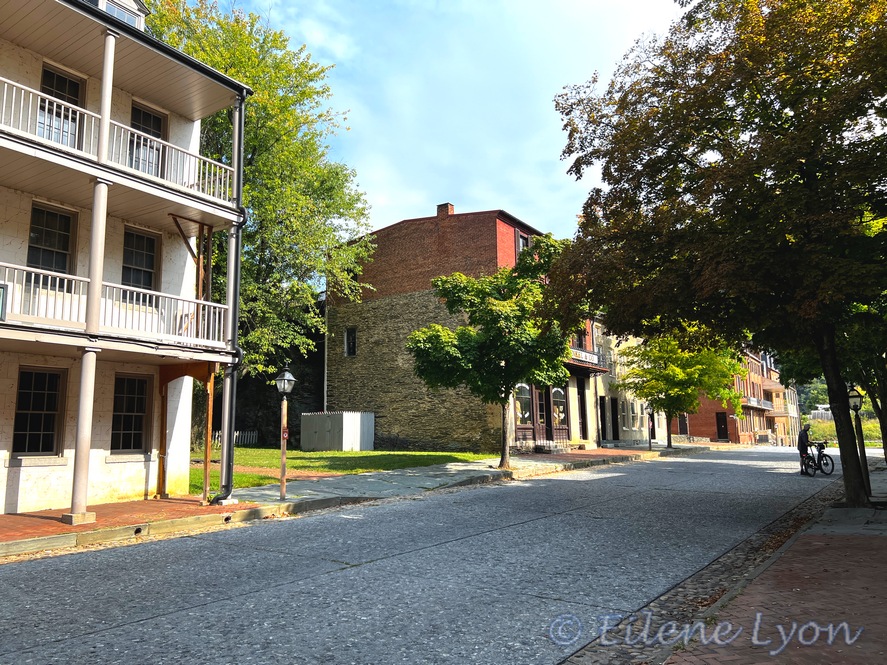
Many early 19th-century buildings have been preserved or rebuilt in the lower portion of town. Some contain museum exhibits; others are living history displays. We listened to a ranger talk about one of the Civil War battles, an era that is the primary focus for the park service.


Harpers Ferry is a charming historic village, and has excellent restaurants and even commuter and Amtrak train service, in addition to the B & O freight trains that come through. A great place for a day trip if you’re ever in the area.


To Be Continued…
Feature image: Historic Shenandoah Street in Harpers Ferry, part of the National Park.


It looks beautiful! And as someone who’s always been interested in the Civil War, I definitely should add this to my bucket list. But I won’t be biking there!
LikeLiked by 1 person
I thought it was even more interesting than I had anticipated. I’m sure you can find alternative transportation to get there.😉 Maybe the Amtrak!
LikeLiked by 1 person
Beauty and history all in one package!
LikeLiked by 1 person
It really is! I enjoyed walking around the town taking photos of homes and gardens (and a cat who looked at me with disdain while resting on a small trampoline).
LikeLiked by 1 person
It sounds like a relaxing day!
LikeLiked by 1 person
Certainly more than riding 50 miles!
LikeLike
I’m so enjoying this series – seeing all these historic places, and at such a beautiful time of year is wonderful. Thanks for also sharing some of the history – like you, pretty much all I knew about Harper’s Ferry was John Brown’s raid.
LikeLiked by 1 person
Thank you, Teresa. There’s so much out there to see and learn about.
LikeLike
This had to be so worth the extra cost Eilene. I could have roamed this area for days both for the nature and the history.
LikeLiked by 1 person
It would be nice to return and take some of the hiking trails in the area, for sure.
LikeLiked by 1 person
Apparently we visited in 2014 – the wonders of having a blog, you can easily check these things! It was the start of a tour of Virginia and West Virginia which we really enjoyed.
LikeLiked by 1 person
Aha! Then you have photos as well as stories about it. Do you think you’ll do anymore traveling in the U.S.?
LikeLike
Here’s the post (not as comprehensive as yours!) And certainly under present circumstances we won’t be travelling to the US. Pity, because we’ve had some wonderful trips.
LikeLiked by 1 person
Hey, you the basics! And you clearly had better luck with lodging than me.
LikeLike
Thank you for sharing your photos of your Harper’s Ferry visit! I knew about John Brown’s raid, but I didn’t know how badly the town had fared during the Civil War.
LikeLiked by 1 person
According to the signage, the population went from about 3000 down to around 100. Yikes!😬
LikeLike
Wonderful photos and information about Harpers Ferry.
LikeLike