By Eilene Lyon
Continuing with my ancestors from Germany who settled first in Pennsylvania, but then moved further south, we’ll look at the family of Christiana Snapp, wife of John Lewis Beard. Her father, John Snapp (Johannes Schnepp) came to America earlier than most, arriving at the Port of Philadelphia in 1733, immigrating from the Alsace region with his family and younger brother, Lawrence (Lorentz).1
Philadelphia passenger manifests go back at least to the 18th century. With these records, it may be possible to show that there were connections between some of my ancestral families back in the Old Country (particularly since they seem to have originated in the same area). However, some of the surnames (Mack, Huber) were quite common, making it nigh on impossible to be sure.
Daniel W. Bly, in the first volume of his book From the Rhine to the Shenandoah (1993), digs deeply into Schnepp family roots in Alsace. John Snapp and his siblings descended from a long line of herders and husbandmen. They roamed the region, thus birth record locations tend to vary for each child. As the commons became restricted and fenced in, the herding life was less feasible for John and Lawrence’s generation. Migration to other parts of Germany and America became common.2
John Snapp did not remain long in Philadelphia before relocating his young family (wife Barbara, two sons, and a daughter) to Orange County, Virginia. This large county encompassed nearly the entire western portion of the colony. The area the Snapps lived in became Frederick County in 1738. Barbara Snapp had four more daughters, including Christiana in 1737.
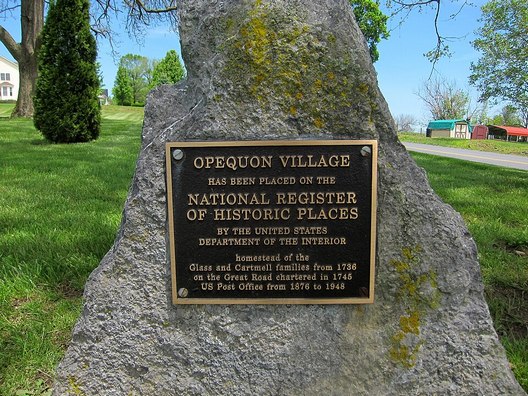
The John Snapp family belonged to the Opequon Lutheran congregation, established a few miles south of Winchester in 1736.3 Two of their daughter’s baptisms (Catherine and Christiana) are found in the records of circuit rider Rev. John Casper Stoever, but not the two sisters who followed (Margaret and Salome).4
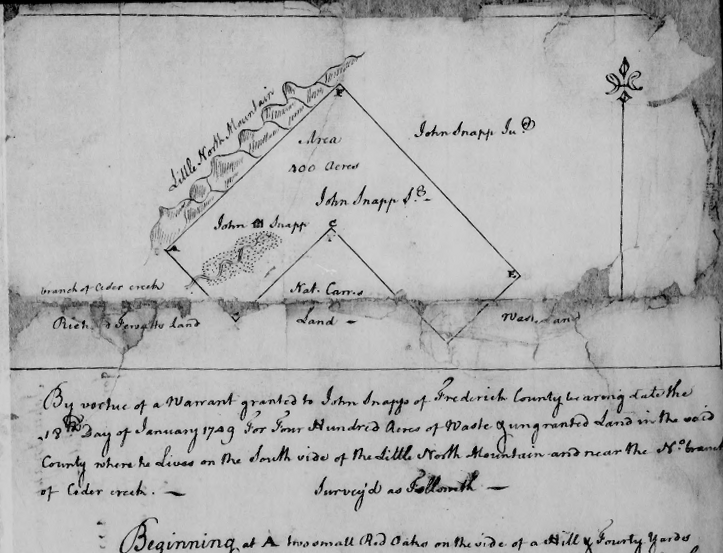
John settled on 400 acres in the Shenandoah Valley, southwest of Winchester and Opequon Creek, and west of the Blue Ridge. The first permanent settler in the Valley is believed to have been Jost Hite, also from Alsace, who arrived in 1732.5 Many German settlers there migrated from southeastern Pennsylvania.
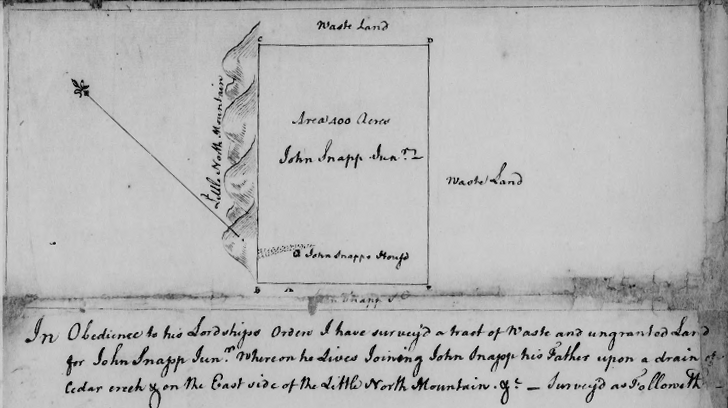
Snapp’s land was not officially surveyed until 1750. Shortly after, he received his grant from Lord Fairfax. He sold this land to his son John Jr. (who already held adjacent property) after Barbara [Dutt] Snapp died in 1758. John Sr. died four years later.6
The Snapp family of Winchester was later known for their foundry. Francis R. Snapp, a descendant of John Sr. and Barbara through their son Lawrence, established the foundry after the Civil War. Francis’s wife, Theodora, ran the business after he died in 1872.7 It existed well into the 20th century, known throughout the region, eventually passing out of family hands.
John Sr.’s brother Lawrence (the immigrant) relocated to Rowan County, North Carolina, possibly at the time Christiana and her new husband, John Lewis Beard, moved there in the 1750s. It was probably comforting for Christiana to have her uncle, aunt, and cousins nearby—no other members of her family moved to North Carolina.
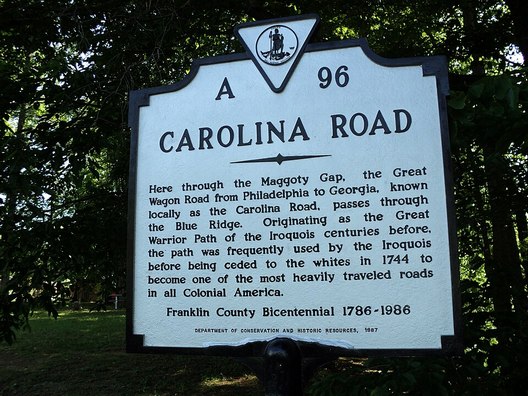
Land was much cheaper there than in Virginia. Migration from Virginia to North Carolina surged during and after the French-Indian War (1757–1763) because of the violence and the post-war tax increases to pay for it.8 It was possibly due to the war that violence came to Rowan County anyway.
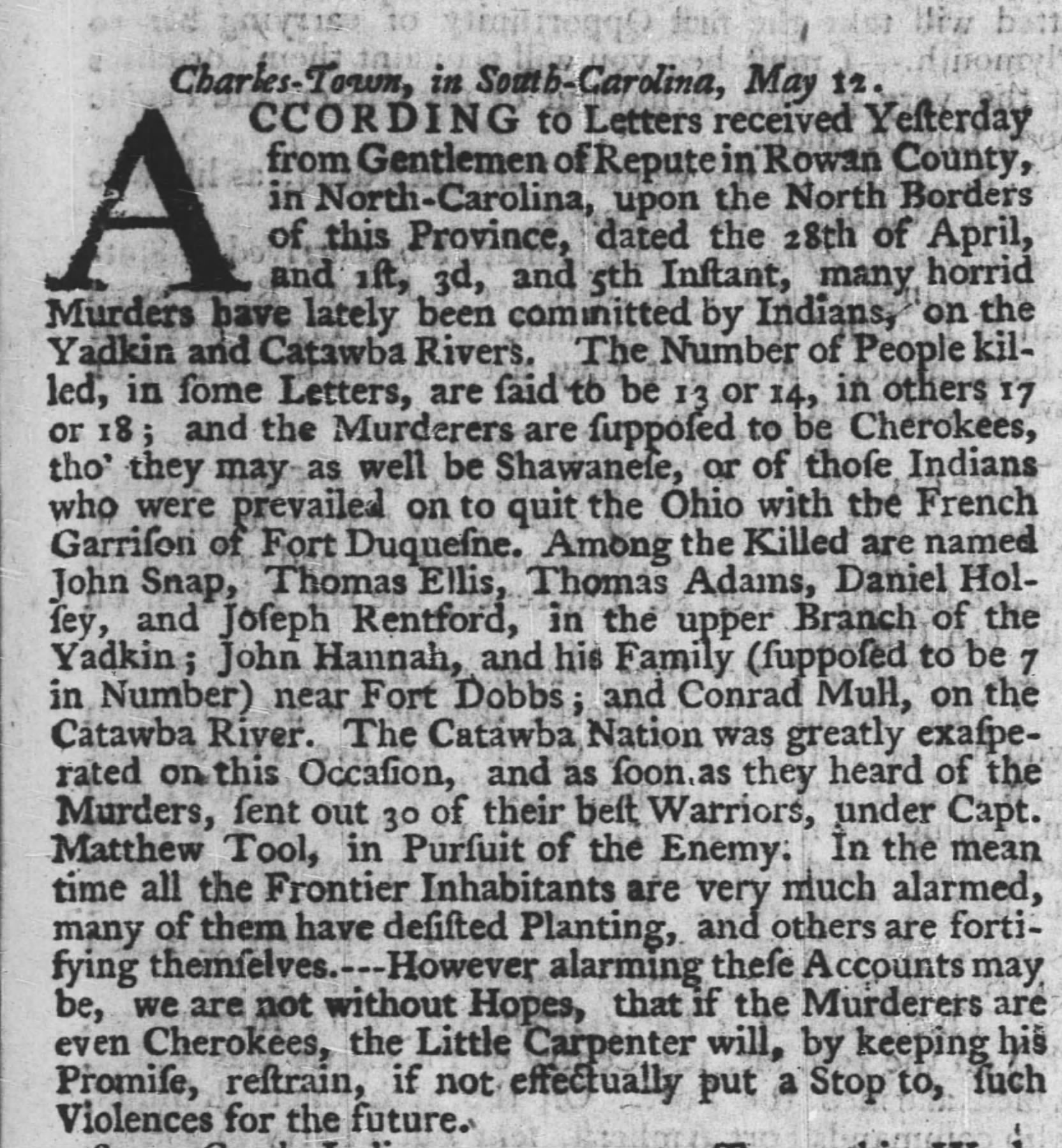
Letters sent north in April and May 1759 indicated that somewhere from 13 to 17 settlers along the Yadkin River and environs in Rowan County had been murdered by Indians. Some thought the culprits were Cherokee, but others speculated they had been driven from Fort Duquesne (Pittsburgh) along with the French, and had migrated south. Lawrence’s 20-year-old son, John, was one of the victims.9
If you’re having trouble keeping names straight, welcome to the club! Immigrant brothers John and Lawrence gave their children the same names. John’s: John, Lawrence, Barbara, Catherine, Christiana, Margaret, Salome. Lawrence’s: John, Lawrence, Elizabeth, Catherine, Margaret, Christina, Barbara. The same thing happened with the next generation. It’s crazy difficult to deal with.
A couple more items of interest I came across while researching the Snapps: Like John Lewis Beard, Christiana’s family members were also involved in the slave trade. Her father’s will does not give particulars as to his property, only that it be divided equally among his children. But I found a runaway-slave ad that indicates her brother, Lawrence, was an enslaver.
Will ran away from the Marlborough Iron Works of Frederick County, Virginia, on December 10, 1780. He possibly belonged originally to Henry Bradford. Lawrence Snapp purchased Will from Bradford in 1773. In turn, Snapp sold Will to David Pancoast, who then put him to work in the foundry. Will was 24 years old at the time the ad appeared in February 1781.
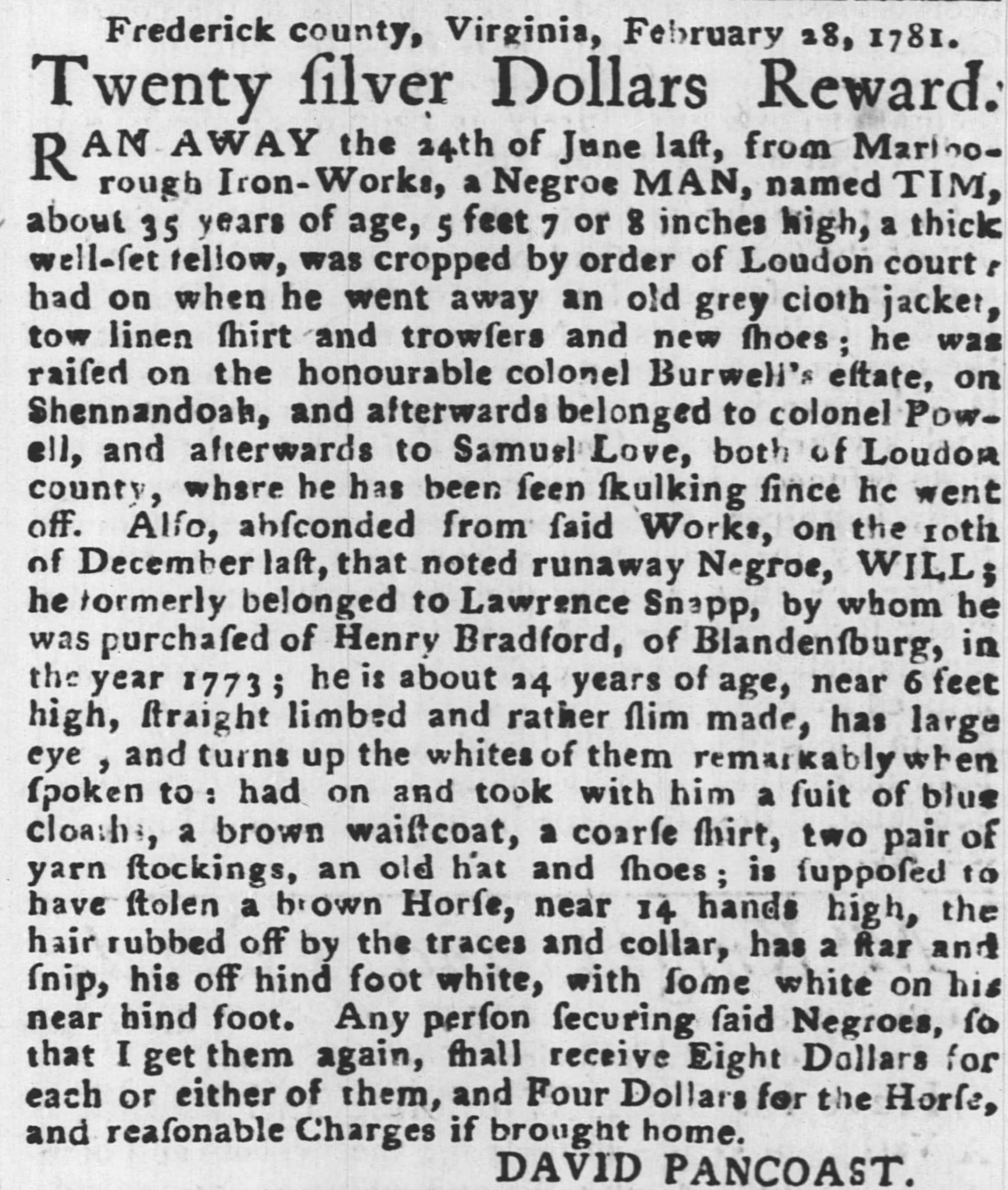
The ad describes him as “near 6 feet high, straight limbed and rather slim made, has large eye[s], and turns up the whites of them remarkably when spoken to : had on and took with him a suit of blue cloaths, a brown waistcoat, a coarse shirt, two pair of yarn stockings, an old hat and shoes ; is supposed to have stolen a brown Horse, near 14 hands high…”10
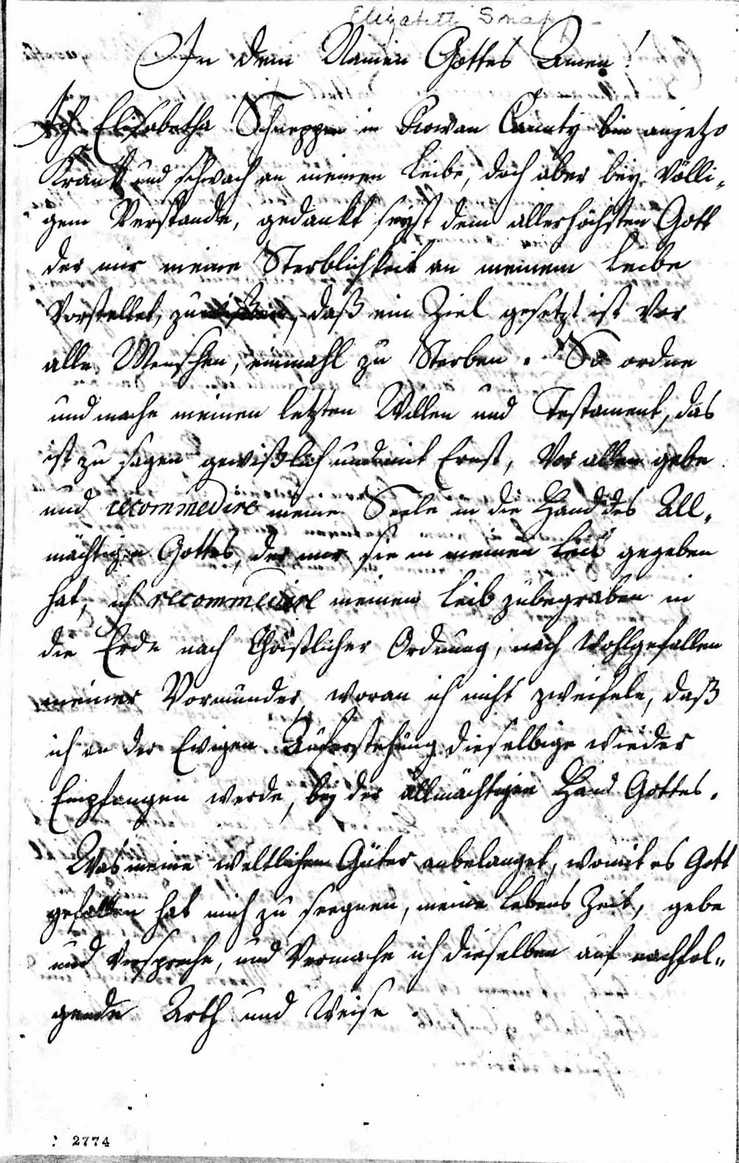
The last item involves Christiana Snapp Beard’s first cousin, Elizabeth Snapp. Like Christiana, Elizabeth was the daughter of German immigrants, but born in America. Her family undoubtedly spoke German at home in Rowan County, North Carolina.
Elizabeth never married. She inherited some property from her father, Lawrence, who died a widower in 1771. She wrote her will in October 1773, not long before she died in 1774 at age 32.11 Her father’s will was written in English (not by him) as that was the language of commerce and law. Elizabeth’s, however, is written in old German script. I used Google AI mode for transcription and translation of this unusual document. Look for a future post on that.
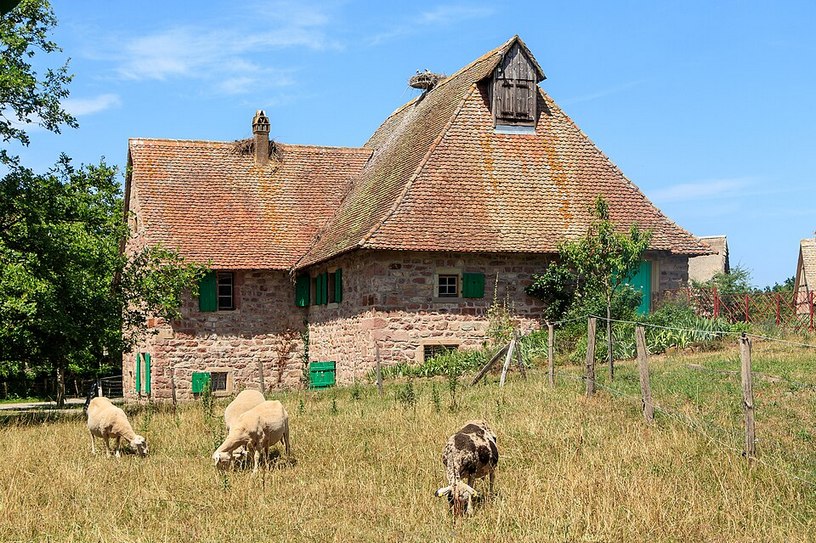
Feature image: Sheep by a watermill at the Écomusée d’Alsace, Ungersheim, Haut-Rhin, France (Wikimedia Commons). My Snapp/Schnepp ancestors were herders from Alsace.
- Ralph Beaver Strassburger and William John Hinke, Pennsylvania German Pioneers; a Publication of the Original Lists of Arrivals in the Port of Philadelphia from 1727 to 1808, vol. 1 (Norristown, Penn. : Pennsylvania German Society, 1934), pp. 110–11 http://archive.org/details/pennsylvaniagerm42stra. ↩
- Daniel W. Bly, From the Rhine to the Shenandoah: Eighteenth Century Swiss & German Pioneer Families in the Central Shenandoah Valley of Virginia and Their European Origins, vol. 1 (Baltimore: Gateway Press, 1993), p. 151. ↩
- John Walter Wayland, The German Element of the Shenandoah Valley of Virginia (Charlottesville, Va.: Author, 1907), p. 104, http://archive.org/details/germanelementofs00wayl. ↩
- Christina Schnepf, “Pennsylvania, U.S., Lutheran Baptisms and Marriages, 1730-1799,” database, Ancestry, (https://www.ancestry.com/search/collections/4640 : accessed 28 Aug 2026), citing Early Lutheran Baptisms and Marriages in Southeastern Pennsylvania. (Philadelphia, PA, USA: n.p., 1896). Though the source title and database suggest the Opequon Church was in Pennsylvania, it was actually in northern Virginia. ↩
- Wayland. p. 34. ↩
- Cecil O’Dell, Pioneers of Old Frederick County, Virginia (Marceline, Mo.: Walsworth Pub. Co., 1995), pp. 365–6, https://archive.org/details/bwb_W8-BNY-823/mode/2up. ↩
- “Out of the Past…from the archives of The Winchester Star,” blog post, (https://www.winchesterstar.com/winchester_star/out-of-the-past-from-the-archives-of-the-winchester-star/article_b4fe9ff6-5937-5fa4-8026-6a79e5463a03.html : accessed 28 Aug 2026. ↩
- O’Dell, pp. 13–14. ↩
- “According to Letters received…” The Pennsylvania Gazette (Philadelphia), 29 June 1759, p. 1; image, Newspapers (https://www.newspapers.com/image/39398312/ : accessed 19 August 2026. ↩
- “Twenty silver Dollars Reward,” Poulson’s American Daily Advertiser (Philadelphia), 10 March 1781, p. 3; image, Newspapers (https://www.newspapers.com/image/39423212/ : accessed 19 August 2026. ↩
- Elizabeth Snapp, “North Carolina, U.S., Wills and Probate Records, 1665-1998,” database, Ancestry (https://www.ancestry.com/search/collections/9061 : accessed 28 August 2026), images 1389–1393; citing Wills and Estate Papers (Rowan County), 1663-1978, Author: North Carolina. Division of Archives and History. ↩
 Myricopia
Keeping track of whose who would be challenging. In my family we added ‘little’ ‘big’ to identify who we were talking about. The generation after mine did not duplicate names.
LikeLiked by 1 person
Yeah, I think this is the worst case scenario! I’ve seen a lot of repeated names, but my North Carolina families take the cake!
LikeLiked by 1 person
I had the same problem with names on my paternal grandfather’s side. Generation after generation of Sarahs and Johns.
LikeLiked by 1 person
I wish it were just one or two names to deal with. This family is insane!
LikeLiked by 1 person
😁
LikeLiked by 1 person
What a great piece of research, Eilene! So interesting, all the different paths our ancestors took.
LikeLiked by 1 person
I’m fortunate that Bly has done so much research on this family and documented it well enough that I feel confident in his work. When it comes to colonial times and the eastern states, there’s been a lot of history written.
LikeLiked by 1 person
Such a fascinating family history. I’m sure it’s a struggle to keep the generations straight with all the same names.
LikeLiked by 1 person
It seems to be a particular problem with some of these North Carolina families. The Davis family is similar.
LikeLiked by 2 people
I’m pretty sure my paternal grandma, who I’ve mentioned before was from N. Carolina, was a Davis before marriage… 🙂
LikeLiked by 1 person
Who knows? Could be related.🙂
LikeLiked by 1 person
My family is full of Robert’s and John’s. My dad, grandfather and nephew are (or were) Johns. But we had small families.
LikeLiked by 1 person
Even then, it had to be hard to be clear which you were referring to sometimes.
LikeLiked by 1 person
Yes, it is confusing.
LikeLiked by 1 person
Just about the time I was getting confused with the names, you had the paragraph that began “If you’re having trouble keeping names straight, welcome to the club!” That’s interesting that Google AI was able to translate the Old German script writing with all its flourishes. You do so much research on your own, so I hope Google AI can make your research easier going forward.
LikeLiked by 1 person
I knew people would be thinking that about then! Even a chart wouldn’t help much.
I’m leery of AI and find it makes errors and invents things, which was true on Elizabeth’s will project. But it did waaay better than the last time I used ChatGPT to transcribe a neatly handwritten document in English. That surprised me.
LikeLiked by 1 person
You anticipated that well! I always see AI’s disclaimer that they may make mistakes … that’s kind of like saying “let the buyer beware!”
LikeLiked by 1 person
And in this case, I didn’t invest a dime!
LikeLiked by 1 person
AI does come in handy sometimes.
LikeLiked by 1 person
I hate to admit it, but it does. I used it to help me write a grant proposal (we got it!) and to find other potential grant sources.
LikeLiked by 1 person
I am amazed at “conversations” I have had with AI when looking for information on something and getting instantaneous results after one query. That is great news about getting your grant thanks to AI’s assistance!
LikeLiked by 1 person
Believe me, I did heavy editing, but it was a big time-saver.
LikeLiked by 1 person
I really enjoyed reading this (as I do with all your posts)…I learn so much about the people who helped build your country.
Intrigued to read about your experience with Gemini and Elizabeth’s will, as my own experience with Gemini and transcription/translation has been mixed.
LikeLiked by 1 person
The AI was not actually showing as Gemini, but as “AI Mode” in the Google search engine. I’ve never had a good transcription experience with any AI, even in clearly written English. So this came as a huge surprise.
Western North Carolina was largely settled by Germans from Pennsylvania and Scot-Irish. Some were the early “mountain men” like Daniel Boone. Dressing in leather was common.
LikeLike
I was gonna ask you, how DO you keep the names straight???
LikeLiked by 1 person
I wish I had a good answer. It involves accumulating evidence and building a case that it belongs to THIS John, not THAT John. Pretty soon you can see the hallmarks that make it easier to sort the bits.
LikeLiked by 2 people
Well, you’re a pro at this stuff.
LikeLiked by 1 person
Lots of recycled names in my family too – I’m at least the 3rd generation. Sometimes people are known by different forms of the name – in four successive generations, Janet, Jen, Netta and Jan were all actually Janets.
LikeLiked by 1 person
Are there variants on Anabel?
LikeLike
Oh yes, I definitely have the bargain basement version. My great aunt and aunt were / are Annabella. My great aunt was known as Anna or Annie and my aunt is known as Annabel. My mother thought Anabel would be easier for me to learn to spell, but no-one else ever spelled it right which became a particular problem once the internet became important. I guess Eilene might be similar!
LikeLiked by 1 person
Indeed, my name is constantly getting “corrected” by spellcheck. I know that and don’t get worked up about it. Why do we like so much to have people spell our names right? A couple hundred years ago, people were very inconsistent in spelling their own names!
LikeLike
I stopped correcting people a long time ago, then started again when It made a difference to things like email addresses.
LikeLiked by 1 person
That’s a good point.
LikeLiked by 1 person
It must have been such a culture shock to leave a built-up area in Germany for one with wide-open spaces and long travel times.
LikeLiked by 1 person
I think many European migrants were craving the open space, cheap land, fewer neighbors and restrictions.
LikeLiked by 1 person
Yes, I never thought it like that and I would imagine most would enjoy the freedom of space.
LikeLiked by 1 person
Just too bad it came at the expense of those who were there first, and the seduction to get involved in slavery.
LikeLike
I wish we could say that slavery was a part of our historical world. Though I would imagine more people are being trafficked nowadays.
LikeLiked by 1 person
Yeah, it’s true. The ugly things people do just never seem to go away.
LikeLiked by 1 person
I am always fascinated by these “ancient” American ancestors and the old records that trace their land ownership and migrations. My earliest American ancestor came in the 1840s, and by then your family were “old-timers!”
LikeLiked by 1 person
In some lines, I can even go back in America to the early 1600s! No Mayflower, though. No Puritans, in fact. Seventh Day Baptist, Quaker, etc.
LikeLiked by 1 person